
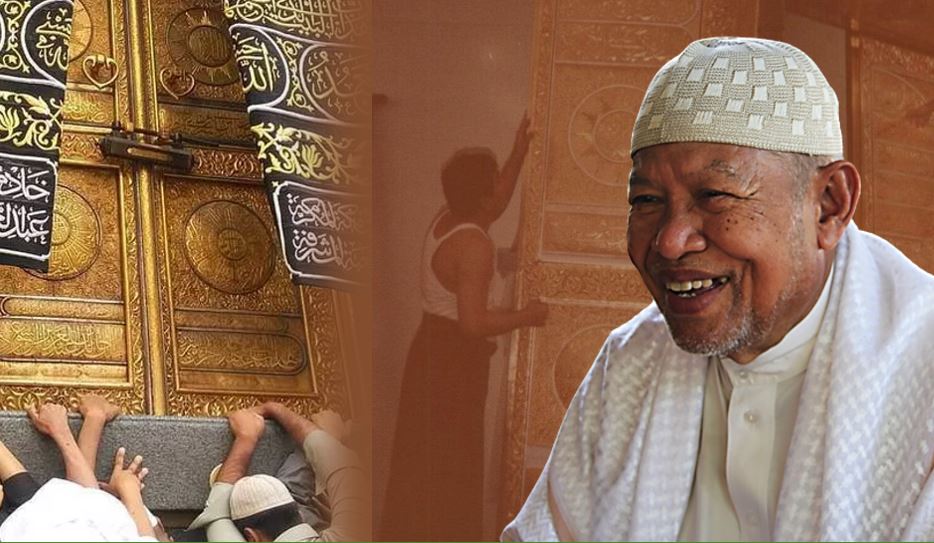

At 75 years old, Professor Abdullah still looks healthy, possibly due to maintaining his health and living in the unpolluted hilly area of Pak Chong, Nakhor Ratchasima.
“Age is catching up… but I can still drive,” he told Apa Khabar TV during a recent visit to his settlement.
With a walking stick, Professor Abdullah walked alongside the writer towards a building – The Door of Kaaba and Masjid Al-Haram @ Mecca Learning Center – which he established upon returning from Saudi Arabia.
It is at this center that he has immortalized all the memories of being a supervisor in the creation of the Second Kaaba Door during the Saudi Kingdom under the Al-Saud dynasty.
Looking back, after more than two years of carving and plating 280 kilograms of gold on the Kaaba Door made from Makhamong wood (Black Rosewood) (see photo below), the door was finally completed.


Professor Abdullah joked that the calligraphy work of Quranic verses, known as ‘khat,’ on the Kaaba Door took a lot of time. This was due to the health problems of Sheikh Abdulraheem Ameen, the calligrapher.
“The old Kaaba Door was made of metal, very heavy… built during the reign of King Abdulaziz Ibn Saud, the first King of Saudi Arabia.
“Sheikh Abdulraheem, who wrote the khat on the old door, was still alive. He also wrote the calligraphy on the door we built.
“At that time, he was quite old. His health was not very good… he could write one verse and then be admitted to the hospital. That’s how it went… that’s why we were delayed for years because of this (Sheikh Abdulraheem),” he said with a laugh.
The installation process of the door was not easy. A team of technicians took about 10 full days to install the new door on the frame in the Kaaba. They spent a whole week in the middle of Masjid al-Haram.

Professor Abdullah still had to interact with the head of the Al-Syaibah family – descendants who inherited the position of Keeper of the Kaaba Keys since the time of the Prophet Muhammad (PBUH).
“The eldest son of the Al-Syaibah family will always hold this key. If he doesn’t open the door for you, no one can enter. Not even national leaders if he doesn’t allow it,” Professor Abdullah explained the family’s privilege over the Kaaba.
“At that time, Sheikh Taha al-Syaibah held the key. He scolded me every day, claiming the Thai craftsmen were slow in doing the work.”
Moreover, during the door installation, they still hadn’t obtained approval to bring a fan into the Kaaba. Therefore, the seven Thai craftsmen and the supervisor had to place the fan outside.
However, the door installation period was something that brought great satisfaction to Professor Abdullah and his colleagues.
This is because he and his colleagues were among the few Muslims who had ever set foot inside the Kaaba, which is usually only open to kings or national dignitaries for prayers.
“I was in Baitullah for 10 full days during the door installation work. I entered and prayed inside the Kaaba. I prayed inside it, facing any direction.
“Usually, we cannot do such things when praying outside… we need to face the Qibla, which is the Kaaba. But inside the Kaaba, you can face any direction,” Professor Abdullah recounted, wiping away tears of gratitude for being allowed to enter the Kaaba.
When the door was fully installed, King Khalid bin Abdulaziz Al Saud, the King of Saudi Arabia at that time, came to officially open the new Kaaba Door.
King Khalid sat in a wheelchair, which was then lifted in front of the Kaaba Door, for the opening ceremony, Professor Abdullah further explained.
The Kaaba Door, made by craftsmen from Thailand, has been showcased to Muslims around the world.
Then a shocking incident happened to the Kaaba when a group of armed Arab extremists stormed into Masjid al-Haram, threatening to overthrow the Saudi royal family. Consequently, a battle ensued for more than two weeks, causing many casualties.
Photos showing Thai carpenters and goldsmiths working on the Second Kaabah Door in Makkah in 1978 and 1979.


Feeling bored and with workers’ welfare poorly managed, Professor Abdullah, who had been away from his homeland for a long time, decided to return to Thailand, even though Sheikh Ahmad Ibrahim offered him another job.
Upon returning to Thailand, Professor Abdullah temporarily stayed in the Watthana district, Bangkok, and became the first imam at Soi Nana Mosque – Soi Sukhumvit 3/1, Khlong Toei Nuea Subdistrict.
Using some money from his previous works, including in Mecca, Professor Abdullah bought land in Pak Chong, Khao Yai, Nakhon Ratchasima in 1988. At that time, the area was still quiet.
“Using a bit of money, I bought land in Khao Yai for 20,000 baht (about RM2,000 at that time) per rai (0.395 acres). I bought 20 rai or about 7.90 acres.
“Do you know how much the land costs per rai here (Khao Yai) now?” Professor Abdullah asked. The writer guessed perhaps a million baht.
“Now if I want to sell one rai of land here, you have to pay eight million baht (about RM1.06 million),” he said, explaining that he started raising chickens and sheep.
Gradually, he began turning the area into a tourist spot, establishing a ‘Halal’ resort. All operations are run according to Islamic principles and it is named ‘Nagnawa Farm and Resort.’ The resort is now well-known among Thai Muslims to this day.
“I bought this land because of its high altitude. Looking down, it resembles Bonn when I lived in Germany before.”
Now, the once-empty land has everything, including a restaurant, resort, lecture hall, and space for conducting annual summer camp activities for youth.
In 2012, Professor Abdullah opened a model village to introduce Arab culture that he knew and displayed the history of the Kaaba Door at the highest point of Nagnawa Farm and Resort.
But in 2021, the ‘Learning Center’ was moved to a slightly lower point because at the highest point of the resort, it would be difficult for tourists to climb. This also facilitated visitors.
Professor Abdullah also spent a lot of money buying various pictures related to the Kaaba and its door to display to visitors.
He also bought a Makhamong wood stump – the same type of wood used to build the current Kaaba Door – that is 200 years old and placed it in the courtyard of the ‘Learning Center.’
“Not many Arabs know that the Kaaba Door was made by craftsmen from Thailand. Since communicating and establishing relationships with the people of Saudi Arabia, they have come to see this place and are very surprised.
“No one believes that Thais built it. They did not tell each other about it,” said Professor Abdullah, adding that he got the idea to open the center to expose it to the outside world.
Only a few Muslims today, including in Malaysia, can enter and pray inside the Kaaba.

Concluding the conversation with Apa Khabar TV, Professor Abdullah smiled, clearly showing how proud he is to have completed a significant mission at Baitullah – befitting the name ‘Abdullah’ he bears.
“Thank you… don’t forget to come again,” said Professor Abdullah, who saw the writer off to Muak Lek town in Saraburi province, bordering Korat (Nakhon Ratchasima).
“Insha-Allah… assalamu alaikum,” I replied. Professor Abdullah then drove away slowly, leaving the writer who was about to embark on the return journey, carrying a thousand memories.
As usual, thanks to several individuals who provided assistance, including financially, to make the series “Meeting the Maker of the Second Kaaba Door” successful.
Some might wonder about the cost of visiting The Door of Kaaba and Masjid Al-Haram @ Mecca Learning Center owned by Professor Abdullah in Khao Yai, Nakhon Ratchasima.
RM3,000 in the pocket. This amount is considered comfortable for the trip – by train and bus – from Narathiwat, Thailand. This cost includes one night’s accommodation (shared by two people) at Nagnawa Farm and Resort, one night’s hotel stay (shared by two people) in Bangkok, transportation in Bangkok, and meals.
P.S.: Apa Khabar TV has received information about another goldsmith who completed the Second Kaaba Door. Insha-Allah, the meeting with him will follow.


A journey to Thailand to meet the professor behind the Kaaba Doors – Part 1
MALAY VERSION:
Siri bertemu pembuat Pintu Kaabah Kedua – Bahagian I
[Gambar-gambar] Bahagian akhir siri bertemu pembuat Pintu Kaabah – 10 hari solat dalam Kaabah
Leave a Reply