
By Vincent D’Silva
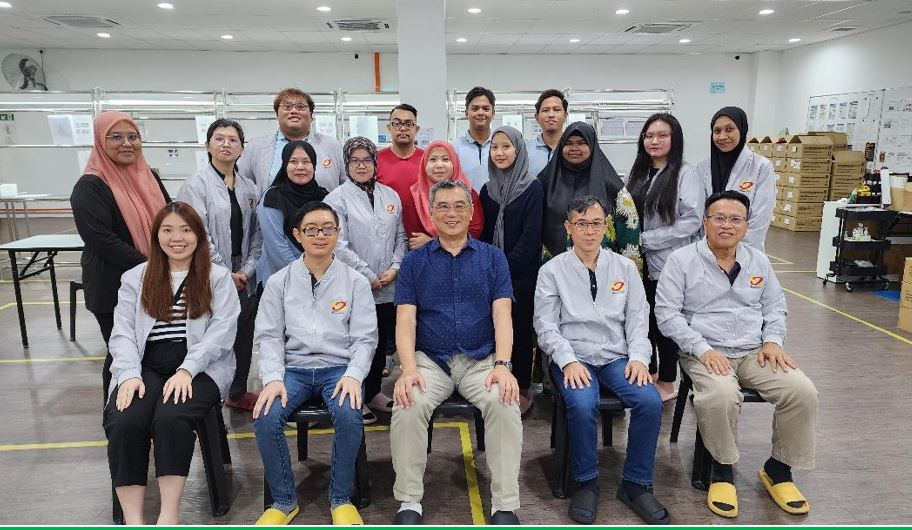
JOHOR BAHRU: In a modest Malaysian research and development company, where ideas are shaped not only by machines and drawings but by concern for human safety, health and everyday comfort, Lau Teik Hock speaks of innovation with the conviction of a man who believes that technology must first serve people.
For Lau, Executive Director of Far East Pyramid Sdn Bhd, invention is not merely about producing a new gadget for the market. It is about recognising the small frustrations, hidden dangers and silent anxieties of modern life — and turning them into practical solutions.
Established in 2008 as an electronic research and development company, Far East Pyramid has built its name around product design and technology-driven solutions. Its focus has been on creating safe, practical and health-conscious products for homes, workplaces and the increasingly connected world.

“We create products to ease human problems,” said Lau. “Before making a product, we need to make the humans. This is our main task.”
That simple philosophy has guided the company through years of experimentation, certification and perseverance. Far East Pyramid was among the first batch of 54 companies recognised by the Malaysian government as an innovation company, a milestone that Lau still regards with pride.
Although the original purpose of the certification was to help innovation and start-up companies secure easier access to bank loans or grants, the journey was not as smooth as expected. Lau said commercial banks remained conservative, and the funding support did not come as hoped.
Still, the recognition became an important mark of credibility.
“We were certified and recognised as an innovation company, but we could not get the easy loan from the commercial banks,” Lau recalled. “Even so, it was a good certificate. It recognised Far East Pyramid as an innovation company.”
One of the company’s earliest products was born from Lau’s own experience as a frequent traveller. Carrying conventional socket extensions during overseas trips was inconvenient, bulky and impractical. From that frustration came the idea for the Powerlink Modulink Socket — a flexible, customisable socket system inspired by the familiar Lego concept.

Unlike fixed extension sockets in the market, the Modulink Socket allows users to arrange and adapt the system according to their needs. But convenience alone was not enough. Lau said the company also wanted to address the danger of electrical fires caused by malfunctioning appliances.
“We combined the current socket with the Lego concept so it becomes flexible and user-friendly,” he said. “Then we added fireproof and lightning-proof functions. The idea is convenience, lifestyle and safety.”
The Covid-19 pandemic also sharpened the company’s attention on health protection. Far East Pyramid developed the Powerlink UVC Lamp to help disinfect spaces by eliminating up to 99.9 per cent of bacteria and viruses.
What makes the concept different, Lau said, is its focus on continuous disinfection even when people are present. Conventional UVC systems are usually used only in empty rooms because exposure can harm the eyes and DNA. Far East Pyramid’s design aims to allow disinfection to continue safely around people, helping to reduce airborne risks in shared environments.
“If we leave the room first and only then start cleaning, it may already be too late because infection could already have happened,” Lau said. “Our concept is to continue killing the virus 24 hours. When we come into the room, it is virus-free.”

He said tests by International Medical University showed that the system could reduce virus levels within minutes and continue the process over a longer period.
Another area close to Lau’s heart is electromagnetic radiation. As mobile phones, computers and electronic devices become inseparable from daily life, the company developed the EMF Radiation Harmonizer to address concerns over exposure from modern gadgets and electric vehicles.
Lau said studies and test reports, including those associated with Universiti Sains Malaysia and research in Utar, showed positive performance indicators related to sleep quality, depression and cell inflammation.
“We are going to publish to the market and promote Malaysian technology to the world,” he said. “Our products are designed, developed and produced here. All are 100 per cent Malaysian.”
Far East Pyramid is also working with a Japanese marketing house, which promotes its products across 24 countries. For Lau, the partnership is encouraging because it shows that international players recognise Malaysian technology.

Yet his larger dream remains deeply patriotic.
“My dream is for Malaysian products to go directly to the world,” he said.
“Designed in Malaysia, made in Malaysia, patented to the world. From Malaysia, we sell directly to the world.”
The company is also studying radiation concerns in electric vehicles and developing a scan-based glucose meter that can measure blood sugar without finger-prick sampling — a response to the growing number of younger diabetes patients and the need for easier monitoring.
For Lau, the road ahead will require funding, talent development and patience. Government representatives are expected to visit the company on June 11 to better understand its needs and future direction.
But beneath the language of patents, products and markets lies a quieter story — of a Malaysian company trying to prove that innovation can begin from ordinary human concern.
“We will continue to explore human needs and deliver innovative solutions to society,” Lau said.
In Far East Pyramid’s small but determined world, technology is not cold metal or silent circuitry. It is a promise — that Malaysia, with its own hands, minds and courage, can design answers for the world.


Leave a Reply