
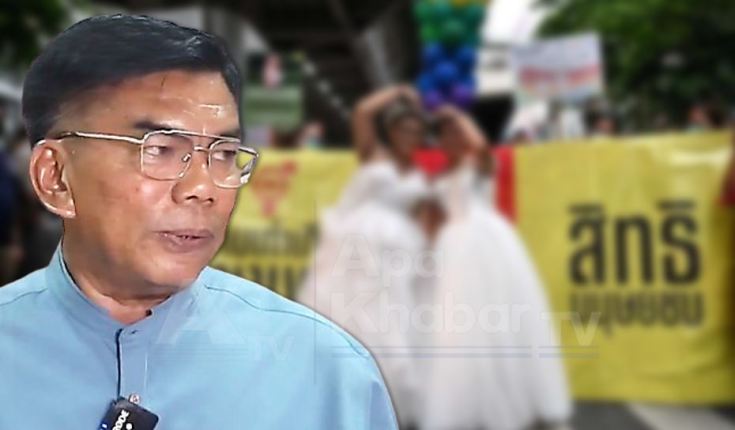

THAILAND has become the first Southeast Asian country to recognize same-sex marriage after the country’s parliament voted to pass a new law on March 3, 2024, thereby acknowledging the lesbian, gay, bisexual, transgender, queer (LGBTQ) community.
The legislation will change references to “male,” “female,” “husband,” and “wife” in marriage laws to gender-neutral terms. It will also grant inheritance rights and adoption rights to LGBTQ couples equivalent to those of heterosexual marriages (individuals who are sexually or romantically attracted exclusively to people of the opposite gender).
The law will apply to all Thai citizens once it is enforced. What is the situation for Muslims in Southern Thailand regarding this issue?

Muslim members of the Thai parliament, especially those from parties currently in coalition with the government led by Srettha Thavisin, need to clarify this.
Follow the explanation of Narathiwat MP (5) Kamonsak Leewamoh, also known as Wan Johan, who is the spokesperson for the Prachachart Party.
“The same-sex marriage law does not apply to Muslims in the four provinces of Satun, Yala, Pattani, and Narathiwat,” said Wan Johan in an interview on Facebook last night.
He reminded Muslims in these provinces not to be confused by the previously passed same-sex marriage law.
“Muslim MPs, particularly from the Prachachart Party, opposed the law. However, because our voices only number nine compared to other parties, it was certain that we would not be heard.
“Nonetheless, as a party within the current government, we have advantages and power. We sent representatives to the special committee drafting the law and requested the inclusion of two sentences.
“Those two sentences state that the law does not apply to Muslims in the four provinces with local Islamic laws,” he said.

For the record, these four provinces have Islamic laws, but not Sharia law. They are governed by their respective provincial Islamic religious councils.
Previously, in an interview with Apa Khabar TV on April 28, Wan Johan, who is also a lawyer, said his party was studying laws to prevent LGBTQ elements from infiltrating the Muslim community in Thailand.
“We (the Prachachart Party) are now in the government… and we are also studying laws that are not in line with Islamic law, as well as those related to the Malay community,” he said.
Elaborating further, Wan Johan expressed concern that in the second committee reviewing the draft law, the two sentences might be removed.
“Among the members of the second committee is a Muslim who strongly supports LGBTQ. He is a Muslim but supports this matter.
“However, we also sent representatives to this committee to explain in detail the Islamic prohibition against same-sex marriage. There are also members of other parties on this committee.
“We had to lobby other MPs to ensure the two sentences remain in the bill. Alhamdulillah, the result is that the law does not apply to Muslims in the four provinces.
“Actually, the LGBTQ community wanted the law to apply to all Thai citizens. But we prevented it and succeeded,” he further explained.
Answering the question of whether same-sex marriages by followers of other religions in the four provinces are a problem, Wan Johan said it is not an issue as it does not involve Muslims.
“We have set up a ‘fence’ to prevent LGBTQ activities from spreading among Muslims in Satun, Yala, Narathiwat, and Pattani,” he said.
However, Wan Johan clarified that the responsibility of him and members of the Prachachat Party is not limited to Muslims in Southern Thailand only, but includes all Muslims in Thailand.
Therefore, his party is working to provide inheritance and family laws applicable to all Muslims in Thailand.
“In this way, God willing, we will be able to prevent the influence of LGBTQ from spreading among Muslims in Thailand,” he said.



Leave a Reply