
By Vincent D’Silva
JOHOR BAHRU: The quiet roll of wheelchair wheels across a school corridor may seem like a small sound to many, but on Friday morning at Malaysian Red Crescent Society Johor Bahru’s latest outreach, it carried with it something far greater — dignity, compassion and the reassuring reminder that no student should ever feel left behind in moments of physical hardship.
Lee Ket Seng, a generous and compassionate donor, contributed 18 wheelchairs to the Malaysian Red Crescent Society (MRCS) for distribution to selected primary and secondary schools identified by the organisation.
In a heartfelt gesture rooted in humanity and care, the Malaysian Red Crescent Society (MRCS) Johor Bahru branch donated six wheelchairs to three Chinese secondary schools in Johor, offering not merely mobility assistance, but comfort and hope to students who may one day find themselves physically vulnerable.

The schools that received the contributions were Foon Yew High School, Stulang Laut, Foon Yew High School Seri Alam and Foon Yew High School Kulai with each institution receiving two wheelchairs.
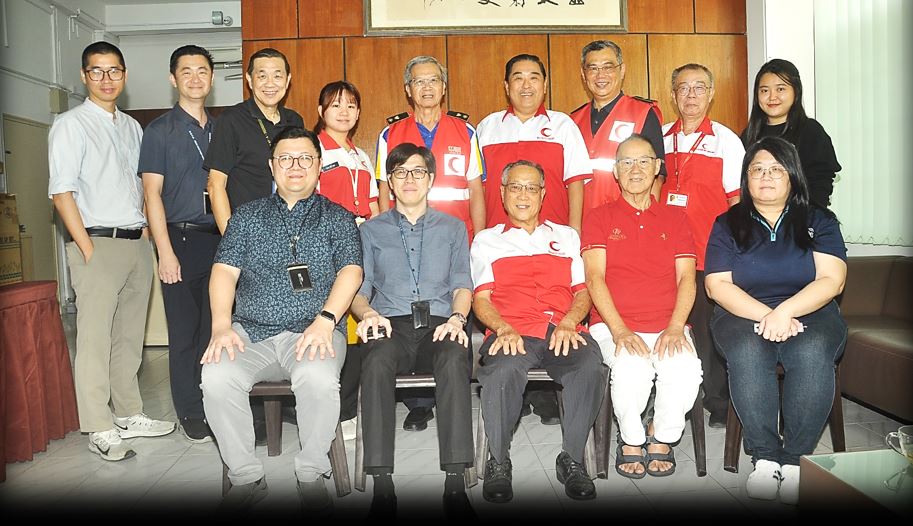
The handover ceremony took place quietly yet meaningfully inside the principal’s office of Foon Yew High School in Stulang Laut, where school administrators and MRCS officials gathered in a warm atmosphere filled less with formality and more with shared concern for student welfare.
The wheelchairs were presented by MRCS Johor Bahru branch chairman Chua Liak Ching to the school’s principal Chua Zhen Xiong.
Also present were Goh Khoon Tak, Principal of Foon Yew High School, Kulai, Loh Pey Chin, senior administrative teachers from Foon Yew High School Seri Alam, MRCS Johor Bahru advisor Chong Ah Ng and several MRCS officials.
Though the donation ceremony was modest in scale, the emotions surrounding it were deeply human.
Speaking later, Chua said the wheelchairs were contributed with the hope that schools would be better prepared to care for students facing injuries, health emergencies or temporary mobility difficulties.
“Sometimes people only realise the importance of a wheelchair when an accident happens or when a student suddenly falls ill,” he said.

“These are things schools may not use every single day, but when the need arises, it becomes extremely important. In those moments, having a wheelchair nearby can make a very big difference.”
He said MRCS believed compassion should not wait for tragedy before action was taken.
“We want schools to feel prepared. We want students to feel safe and cared for. Even a simple wheelchair can help preserve dignity when a child is in pain or unable to walk properly,” he added.
Chua noted that schools are not merely places of academic learning, but spaces where young people should feel protected physically and emotionally.
“A school is like a second home for students. When a child becomes weak, injured or unwell, the school community must be able to respond quickly and compassionately,” he said.
He described the contribution as part of MRCS Johor Bahru’s broader humanitarian commitment towards the community, particularly young people.
“Our duty is not only during disasters or emergencies. Humanitarian work also means helping people in their everyday lives. Sometimes the smallest assistance can bring the greatest comfort,” he said.
Earlier, MRCS Johor Bahru had also donated seven wheelchairs to government secondary schools and primary schools in the district as part of its continuing community outreach efforts.

Chua said the organisation hoped more institutions and members of the public would embrace the spirit of caring for others, especially those facing physical challenges.
“When we help people move, we also help restore confidence and hope. A wheelchair is not just equipment. For some people, it becomes a bridge between helplessness and independence,” he said.
He added that MRCS Johor Bahru would continue identifying meaningful ways to support schools and vulnerable communities across the district.
“We may not always be able to solve every problem, but if we can reduce someone’s burden even slightly, then our effort is worthwhile,” he said softly.
Outside the principal’s office, the school day continued as usual — students walking briskly through corridors, teachers hurrying between classes and the familiar rhythm of youthful life unfolding under the morning sun.
Yet tucked quietly within one corner of the office stood the newly donated wheelchairs — silent symbols of kindness waiting patiently for the day they may be needed most.



Leave a Reply