

By Makadir Ajam
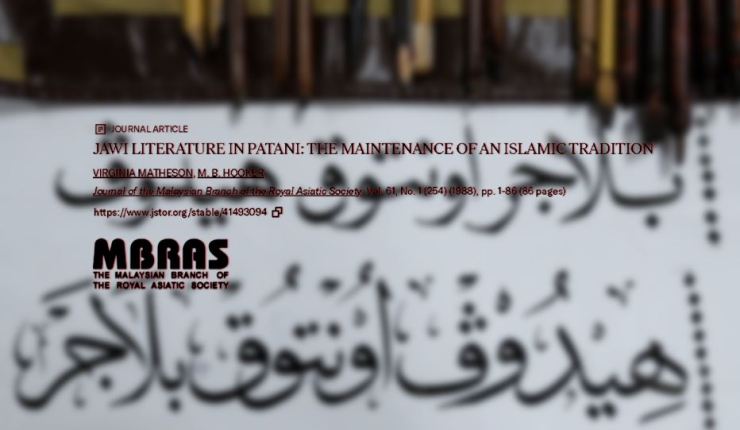
IN their compelling study, Matheson and Hooker (1988) delve into the rich tapestry of Jawi literature in Pattani, unveiling how this literary form has played a pivotal role in maintaining Islamic traditions in a region marked by its historical and cultural complexities.
Their research not only highlights the resilience of Islamic literary traditions but also the broader sociopolitical implications of cultural preservation under shifting powers.
The narrative begins in the historical context of Pattani, a region known for its distinct identity within the Malay Peninsula, where Jawi—the Arabic script adapted for Malay—was not merely a means of communication but a profound expression of cultural and religious identity.
Through the lens of Matheson and Hooker, we journey into the heart of Pattani’s society, where Islamic scholars and local intellectuals have long used Jawi literature as a vessel to sustain and propagate Islamic teachings and values despite the tides of colonialism and modernization.
The study meticulously examines various genres of Jawi literature, from theological texts and legal manuscripts to poetry and royal correspondences, which collectively have served as a repository of Islamic knowledge and ethical guidance for the Pattani community.
These texts are more than just written words; they are the carriers of a legacy, intertwining religious precepts with the local dialect, customs, and wisdom, thereby reinforcing a unique Islamic identity that has withstood the test of time.
However, the story of Jawi literature in Pattani is not without its challenges. Matheson and Hooker critically assess the impacts of external influences, such as Thai nationalism and the push towards centralization, which have threatened the traditional Islamic and Malay cultural practices.
The authors argue that the resilience of Jawi literature is a form of resistance—a declaration of cultural and religious autonomy that resists assimilation into a homogenized national identity.
Through their critical analysis, Matheson and Hooker present Jawi literature not only as a means of cultural preservation but also as a dynamic field of study that offers insights into the ongoing struggle for cultural and religious relevance in Southeast Asia.
They depict how this body of work has been instrumental in fostering a sense of community and continuity among the Muslims of Pattani, serving as both a bridge to their historical past and a beacon for their cultural future.

Their storytelling, rich in historical and cultural references, serves as a poignant reminder of the power of literature in maintaining identity and continuity in the face of external pressures and transformations.
This critical narrative invites readers to reflect on the broader implications of maintaining cultural and religious traditions in minority communities, suggesting that the preservation of such traditions is crucial not only for historical continuity but also for the empowerment and identity affirmation of the community in contemporary settings.
READ MORE:
- Script and Identity: The Enduring Legacy of Jawi in Southeast Asia
- The Impact of Jawi Script on Malaysian Currency: Cultural Significance and Broader Implications
- Revitalizing Jawi Script: Preserving Malay Intellectual Heritage in the Modern Era
- Scripted Identity: The Cultural Erosion of Jawi and Its Impact on Malay Heritage




Leave a Reply