
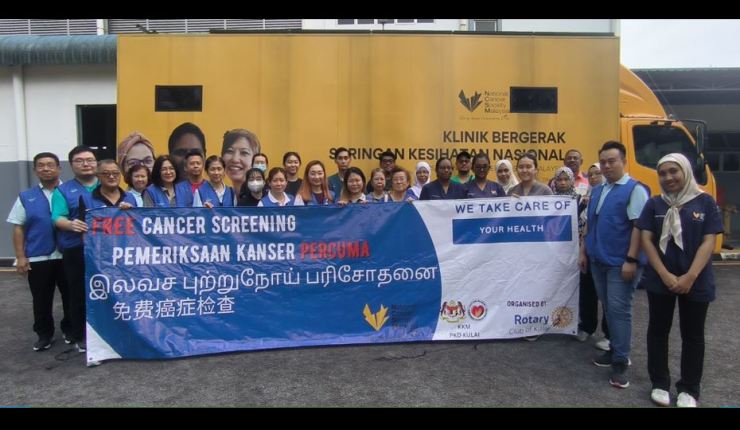

JOHOR BAHRU: The Rotary Club of Kulai (RCK) recently held a free cancer screening programme to create awareness of the importance of undergoing regular health checks.
The event, held in collaboration with the National Cancer Society of Malaysia (NCSM) and Kulai District Health Department, was held at SJK(C) Kulai Besar.
RCK President Amber Goh said such programmes were important as “many people chose to ignore their yearly screenings due to ignorance and fear.”

“What are a few moments of pain compared to years of suffering? These screening events are necessary to remind them to be proactive about their health,” she said.
Amber stressed that such programmes were important as cancer has the second highest mortality rate in Malaysia after heart-related diseases in terms of non-accidental deaths.
Not mincing her words she said sixty percent of cancer cases here are presented at late stages of the disease, resulting in more expensive treatment and high mortality rate.
According to Amber it is predicted that cancer incidence will rise from 37,000 cases in 2012 to 57,000 cases by 2025.
She explained that the reasons for the rise in the number of cases were low awareness and participation in cancer screening, or lack of affordability to do so.
She said this is the third time RCK is organizing this cancer screening programme in collaboration with NCSM.
Those who attended were given professional medical consulting, clinical breast examination, cervical cancer screening, colorectal cancer prevention screening and lung cancer prevention screening.

The community event attracted more than 142 people from all walks of life and they had the opportunity to receive free cancer screening.
Also, some 13 women aged between 13-20 years received the human papillomavirus (HPV) vaccine. It was given free to them.
She said cervical cancer is the third most common cancer among women in Malaysia. The HPV vaccine can protect women from cervical cancer and help prevent cervical cancer.
Meanwhile, RCK is supporting this program without leaving anyone behind and hopes to eradicate cervical cancer in Malaysia.
She further pointed out that Malaysia is seeing a surge in cancer cases as statistics indicate that in 2020, there were 48,639 new cancer cases reported in Malaysia.
“By 2040, the incidence of cancer in Malaysia is predicted to double,” she remarked.

Making it clear, she said approximately one in every ten individuals in Malaysia will receive a cancer diagnosis in their lifetime.
“Lifetime risk of developing cancer in Malaysia is one in every ten males and one in every nine females,” she said.
She further clarified that lifetime risk refers to the likelihood of an individual developing cancer before they reach the age of 75 years in the absence of other causes of death.
She said the response to the cancer screening programme was encouraging and many took the opportunity to pose pertinent questions to the health officers and NCSM officials.
RCK, she said thanked NCSM and the Kulai District Health Department for their joint efforts to help raise awareness among the people.
“We will not stop here and RCK plans to make this an annual affair and raise awareness among the people of Malaysia,” she said.
Looking at the turnout at today’s screening, she said, “Cancer is one of the many health issues that has among the highest potential of forcibly retiring people from the workforce, especially if it’s detected in its late stages.”
She said she hoped to see more similar proactive health campaigns from other health-related bodies in the future.

When it comes to battling cancer, it is a race against time, a run to save lives.
She said RCK’s main goal is to eradicate cervical cancer through early detection and improve screening accessibility.
According to the World Health organization (WHO), cervical cancer is the fourth most prevalent cancer in women, resulting in 604,000 new cases and 342,000 deaths in 2020 globally.
In Malaysia, it is the third most common cancer impacting women.
The percentage of cases detected late is increasing annually.
“The most effective approach lies in a combination of HPV vaccination and cervical screening, which offers the strongest defence against cervical cancer,” she noted.
On a serious note, she said cervical cancer is often referred to as the ‘silent killer’ since it develops slowly without presenting any warning signs or symptoms.
“We the Rotarians strive to positively educate and impact society by making cervical screening more accessible and acceptable to women, particularly those who may not be fully aware of the impact of the disease,” she added.
RCK thanked the school for providing the venue without cost.

Leave a Reply