
By Vincent D’Silva
JOHOR BAHRU — Oil and grease were making their way into the drains near the canteen at SMK Taman Sutera when teacher Thipanraj Katigasu put a question to his students.
“Instead of just complaining about this problem, why don’t we find a solution?”
The answer took shape through late nights, failed experiments and the patient work of students who, at first, waited for him to tell them what to do. By the time they stood on the national stage on Nov 18, they could explain what they had built, defend their decisions and take questions from professionals.

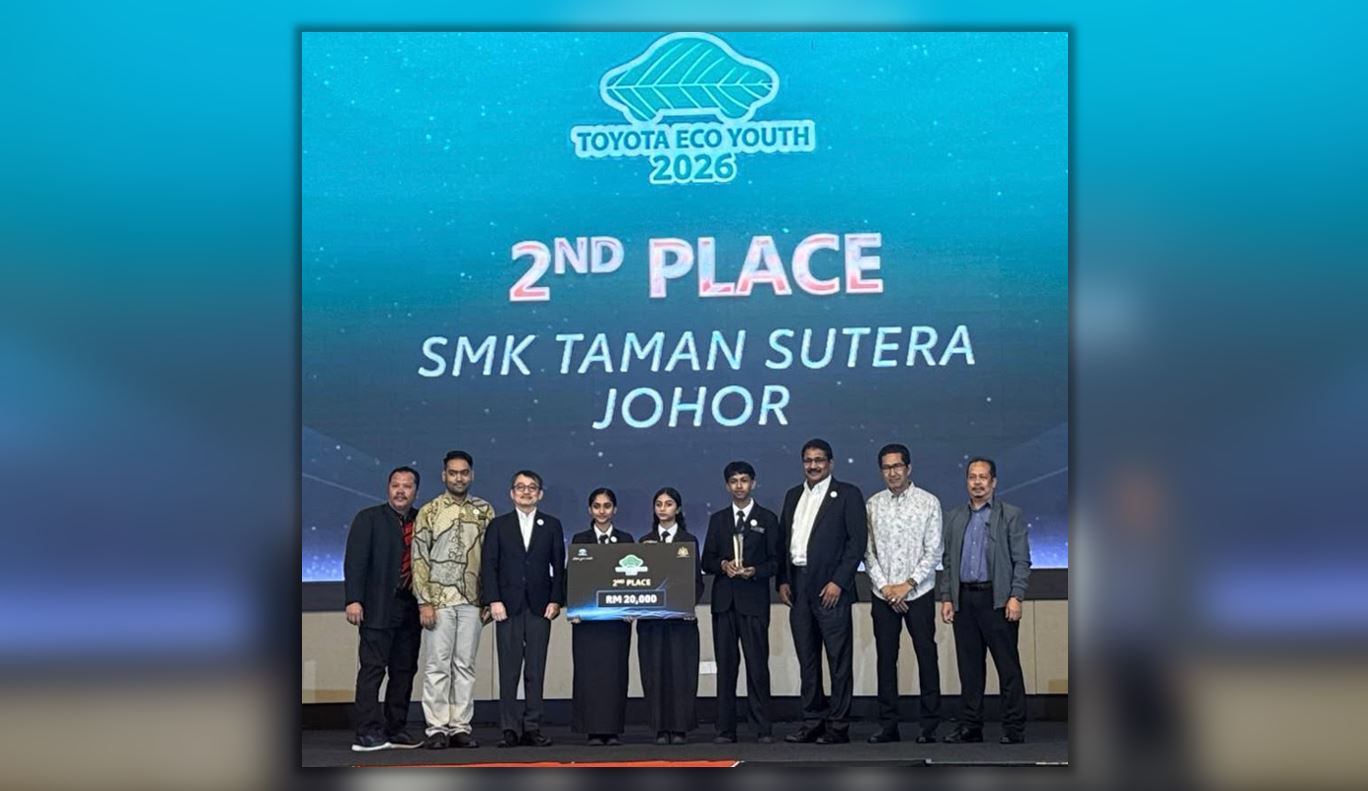
Their team, ALGENIUS, finished second nationally in Toyota Eco Youth 2026, taking home RM20,000 for a project designed to keep oil and grease out of drains and put used cooking oil to better use.
For Thipanraj, the team’s supervising teacher, hearing the school’s name called brought back the hours of work behind the announcement.
“At that moment, I remembered everything we had gone through — the late nights, the failed experiments, the financial challenges and all the sacrifices,” he said.
“Seeing my students standing proudly on the national stage was something I will never forget.”
The team brought together students from different forms. Some took to research, others preferred building prototypes, and those comfortable speaking in public helped explain the project at awareness programmes and presentations.
The work had to fit around lessons, homework and examinations. When experiments failed, the students had to repeat them. As the project progressed, Thipanraj noticed that they were beginning to spot problems and suggest fixes on their own.
“That was when I realised they were growing into young innovators,” he said.
Their project paired a Smart Grease Trap with a natural oil-absorbing material they called AI-ABSORB. The trap is designed to separate and collect oil and grease from wastewater before it reaches the drains.

The students incorporated Internet of Things technology to help monitor the system and used coconut fibre and sugarcane bagasse to develop a material that could absorb oil remaining in the water.
The team also turned collected used cooking oil into ALGENIUS Eco Soap. At awareness programmes, the students used the soap to show how oil that might otherwise be poured down a drain could be collected and made into something useful.
The school management, parents, government agencies, local communities and industry partners helped with funding, materials, technical advice and opportunities to test the project. Sunrise Biomass supported the team’s used cooking oil recycling efforts.
Thipanraj said the team tested the project at school, carried out laboratory water-quality analysis and worked with external partners to explore how the system might be used in practice. He described the early tests as encouraging in demonstrating oil separation and absorption.
The team now wants to make the trap more affordable, reliable and easier to maintain, with school canteens, restaurants and other food operators in mind. Thipanraj hopes the award will help sustain the project and give more students opportunities to develop their ideas, subject to the school’s plans and the competition’s prize conditions.
Some of the students, he recalled, had once been afraid to speak in front of others. By the end of the project, they were explaining the science behind their invention and fielding difficult questions. That change was what he carried away from the prize-giving ceremony.
Near the canteen, it had been the teacher who asked the first question. By the time his students stepped onto the national stage, they had learned to ask questions of their own and trusted themselves to find the answers.
“Never underestimate your students,” Thipanraj said. “Sometimes, all they need is someone who believes in them and gives them an opportunity to try.”
Leave a Reply