
By Vincent D’Silva
JOHOR BAHRU: In the heart of a city shaped by the footsteps of pioneers, a humble black pepper plant took root today — not merely in Johor soil, but in the living memory of generations.
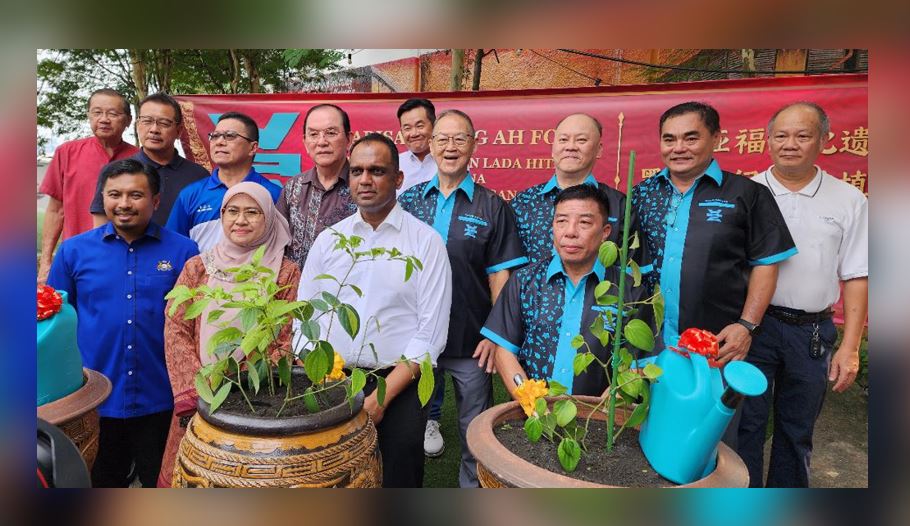
Along Jalan Wong Ah Fook, one of Johor Bahru’s most recognisable thoroughfares, history was given new life through the Wong Ah Fook Black Pepper Planting Ceremony, a commemorative event honouring the contributions of one of the city’s most important early pioneers.
Held under the theme “Rooted in History, Growing for Generations,” the ceremony carried a significance far greater than the planting of a single crop.

It is a symbolic return to Johor’s beginnings — to an era when pepper and gambier helped shape the state’s economy, when communities were being built from the ground up, and when men and women of different backgrounds laboured together to transform a frontier settlement into the city now known as Johor Bahru.
The symbolic planting held opposite Selera Johor @ Segget, with invited guests and media arriving from 2.30pm. The official programme included a lion dance performance, welcoming remarks by Philip Wong who represented Mejar Cina Dato’ David Wong Khong Soon, and an address by Johor Unity, Heritage and Culture Committee chairman P. Pannir Selvam before the planting ceremony.
For those familiar with Johor’s history, pepper is no ordinary plant.
Long before skyscrapers, shopping centres and busy highways came to define the Johor Bahru skyline, pepper and gambier were among the agricultural commodities that powered Johor’s early economic development.
Their cultivation was closely linked to the growth of Chinese settlements and the emergence of organised communities whose enterprise, resilience and labour helped shape the state’s social and commercial landscape.
Against this historical backdrop, the decision to plant black pepper along a street bearing Wong Ah Fook’s name transforms the ceremony into a living memorial.

Born into an era of opportunity and hardship, Wong Ah Fook became closely associated with Johor Bahru’s growth, leaving a legacy that continues to be remembered through the road carrying his name and the historical narratives surrounding the city’s formative years.
The planting therefore becomes a bridge between past and present.
As soil is placed around the young pepper plant, it will symbolise not only Wong Ah Fook’s contribution, but also the perseverance of generations of pioneers who crossed geographical and cultural boundaries to build homes, businesses, schools and communities in Johor Bahru.
The ceremony was jointly officiated by Philip Wong and Pannir Selvam, symbolising collaboration among the authorities, the community and descendants of Wong Ah Fook in safeguarding the city’s historical inheritance.
Philip Wong who read the speech of Dato’ David Wong said the planting of pepper and gambier reminds us of our history and of the early pioneers who worked hard to build this city.
“Heritage is not only about remembering the past, it is our responsibility to carry our heritage forward to the younger generation,” he said.
He went on to say that we are planting a living symbol of our history, adding that, “we are planting our heritage for the future.”

In his address Pannir Selvam said through this symbolic ceremony, I hope that the younger generation, both today and in the years to come, will continue to remember the roots of our state’s progress.
“These traditional commercial crops stand as enduring witnesses to the perseverance, cooperation and spirit of unity across ethnic communities that have long formed the foundation of harmony among the Bangsa Johor,” said Pannir Selvam.
He hoped that this programme inspire us to continue preserving our historical heritage, strengthening racial unity, and enriching the city of Johor Bahru with aesthetic and historical values that remain a source of pride for the Bangsa Johor.
Their participation carried a message particularly relevant in a rapidly modernising city: development need not erase memory.
Instead, progress can grow from an understanding of where a city came from and of the people whose sacrifices made that progress possible.
Adding further historical weight to the occasion was the participation of the Johor Bahru Tiong-Hua Association and five major clan organisations — the Johor Teochew Eight Districts Association, Johor Bahru Hokkien Association, Johor Bahru Hakka Association, Johor Bahru Kwong Siew Association and Johor Bahru Hainan Association.
Also present were Chong Ah Ng, Advisor of the Malaysian Red Crescent Society (MRCS) Johor Bahru branch, and other MRCS officials. Representatives from the Johor Tourism, officials from the Malaysian Association of Hotels and other government agencies were present.
Their presence reflects another important chapter in Johor Bahru’s history.
Early Chinese settlers arrived carrying different dialects, customs and traditions, yet the challenges of building a new community demanded cooperation beyond those differences.
Over time, the five dialect groups worked together and contributed to the development of commerce, education, culture, welfare and community institutions.

Representatives from the Johor Bahru Chinese Chamber of Commerce and Industry, Chinese associations, cultural organisations, the business community, the Malaysian Red Crescent Society Johor Bahru branch and other sectors also witnessed the occasion.
Thousands pass through Jalan Wong Ah Fook every day. Many know the name. Fewer may know the story behind it, or understand how deeply pepper, gambier, migration, enterprise and communal cooperation are woven into Johor Bahru’s beginnings.
The black pepper plant is intended to change that in a small but meaningful way.
It will stand as a living reminder that history does not belong only behind museum glass or within the pages of old books.
Sometimes, history can be touched.
Sometimes, it can be watered.
And sometimes, if lovingly tended, it can grow.
As Johor Bahru continues its march towards a modern future, the ceremony serves as a reminder that cities are not built from concrete and steel alone. They are built from courage, sacrifice, shared dreams and the determination of ordinary people who believed that tomorrow could be better than yesterday.
Today, what is being planted along Jalan Wong Ah Fook is therefore more than black pepper.
It is remembrance planted in earth.
It is gratitude given roots.
And as the young vine reaches towards the Johor sky, it carries with it a quiet hope — that the pioneering spirit of Wong Ah Fook and those who built Johor Bahru beside him will continue to grow, generation after generation.



Leave a Reply