
By Vincent D’Silva
JOHOR BAHRU: Beneath the warm glow of chandeliers and the gentle strains of a string quartet, engineers gathered not merely to celebrate achievements, but to confront a question carrying far greater weight: are they ready to build the future now unfolding before Johor?
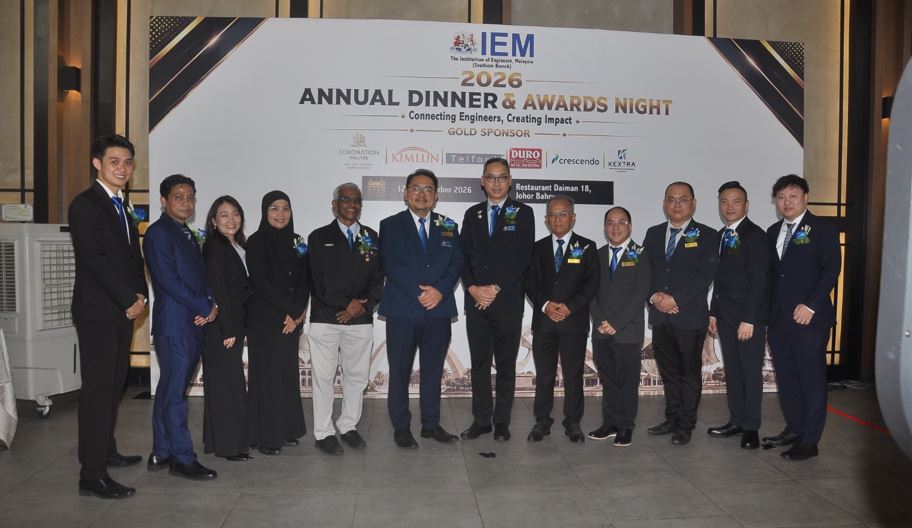
That question formed the heart of the Institution of Engineers, Malaysia (IEM) Southern Branch 2026 Annual Dinner and Awards Night, held at Restaurant Daiman 18 here on Saturday.
The evening brought together engineers, industry representatives, stakeholders and members of the profession for a night of recognition, fellowship and reflection under the theme “Connecting Engineers. Creating Impact.”

Guest-of-honour was Johor Public Works, Transport, Infrastructure and Communications Committee chairman Mohamad Fazli Mohamad Salleh.
Against the elegance of the evening — including a violin performance by a string quartet which lent a graceful and reflective mood to the gathering — came an urgent message from IEM Southern Branch chairman Dr. Kong Weng Keong: engineering can no longer afford to stand still.
“The challenge is change,” Kong told the gathering.
“The question is no longer whether change will happen. It is whether we are changing fast enough.”
Kong said engineers had traditionally been trained to solve problems, manage risks and build for the future, but the accelerating pace of technological, economic and industrial transformation demanded something more.
He identified three areas requiring fundamental change — attitude, direction and the way engineers prepare for the future.
At the centre of that transformation, he said, was artificial intelligence.
While university education and decades of professional experience remained valuable, engineers could no longer assume that yesterday’s knowledge would be enough for tomorrow’s world.

“AI is changing the speed of learning itself,” Kong said, noting that tasks once requiring days or months of research could increasingly be analysed, simulated and optimised within far shorter periods.
“I honestly do not believe that AI will replace engineers. But I firmly believe that engineers who understand and utilise AI will increasingly outperform those who do not.”
He said the engineering profession must move from the mindset of “I already know” to “I need to keep learning”, and from accepting established practices to continually asking whether there was a better way.
That urgency, he said, was particularly relevant to Johor.
The state is experiencing rapid growth in data centres, advanced manufacturing, digital infrastructure, semiconductors, logistics, renewable energy and AI-related industries and services.
Kong said the traditional boundaries between engineering disciplines were also becoming increasingly blurred, with emerging fields ranging from artificial intelligence engineering and biomedical engineering to quantum engineering and human-robot interaction.
“The skills that brought us success yesterday may no longer be sufficient to define success tomorrow,” he said.
Modern data centres, for example, require expertise spanning mechanical and electrical systems, cooling, energy efficiency, structural design, fire protection, digital integration, reliability and commissioning.
Engineers of the future, he added, would also need to understand building information modelling, robotics, automation, digital twins, data analytics and smart infrastructure.
Johor’s proximity to Singapore, the Johor-Singapore Special Economic Zone and continued infrastructure and high-value industrial investments presented extraordinary opportunities, Kong said.

Yet investment alone would not guarantee success.
“We, as engineers, must possess the engineering capability to support this economic growth,” he said.
Reflecting on a recent visit to Kuching for a Federation of Engineering Institutions of Asia and the Pacific event, Kong said he was struck by the energy and confidence of young engineers in Sarawak and by collaboration involving government, industry, academia and the engineering profession.
It prompted him, he said, to consider the role IEM Southern Branch should play as Johor enters a period of major economic transformation.
“IEM Southern Branch must step forward and play a much greater role in shaping the future of Johor,” he said.
“We should aspire to become a trusted professional partner to the state government, industry and academia.”
He said the branch could help policymakers understand emerging engineering capabilities, assist industry in communicating future manpower requirements and work with universities to prepare young engineers for an economy vastly different from that of previous generations.
“Our young engineers must be more than professionally qualified. They must be future-ready,” he said.
“They must understand technology, sustainability, business, governance and leadership. Above all, they must have the confidence and courage to lead and change.”
IEM president Yau Chau Fong, meanwhile, said the annual gathering represented much more than a formal dinner or presentation of awards.
“An annual dinner such as this is more than simply a celebration,” Yau said.

“It provides an opportunity for us to come together as a professional community — to celebrate achievements, recognise excellence, strengthen friendships and, importantly, reflect on how we can contribute more meaningfully to society.”
He said the theme “Connecting Engineers. Creating Impact” reflected a fundamental truth about the profession: engineering advances rarely happen in isolation.
“When engineers from different disciplines, industries and backgrounds come together, we bring diverse experiences, perspectives and expertise,” he said.
“When these connections are transformed into meaningful collaboration and action, we can develop innovative solutions, overcome challenges and create lasting impact for our communities and our nation.”
Yau said the theme was also closely aligned with IEM’s IMPACT 2030 strategic direction, which seeks to strengthen ties between engineers, industry, government, academia, professional organisations and the wider community.
With climate change, energy transition, artificial intelligence, smart cities, infrastructure development and digital transformation reshaping society, he said cooperation across disciplines and borders had become essential.
“These challenges cannot be addressed by one discipline or one organisation alone,” he said.
The evening also saw the presentation of IEM Southern Branch awards and souvenirs, celebrating individuals whose work represented the quiet dedication behind Malaysia’s built environment and technological progress.
For Kong, however, the night ultimately carried a message beyond trophies and applause.
“The future will not wait for us. Technology will not wait for us. Industry will not wait for us,” he said.
“The question is not whether Johor is ready for the future. The question is whether we, as engineers, are ready to build it.”
And as engineers around the ballroom joined colleagues, mentors and young professionals at their tables, his closing words captured the spirit of the night:
“Let us all hold our hands together and create the impact.”
As the dinner drew to a close, the gentle strains of the String Quartet lingered in the hall, their violins weaving a final melody through the evening.
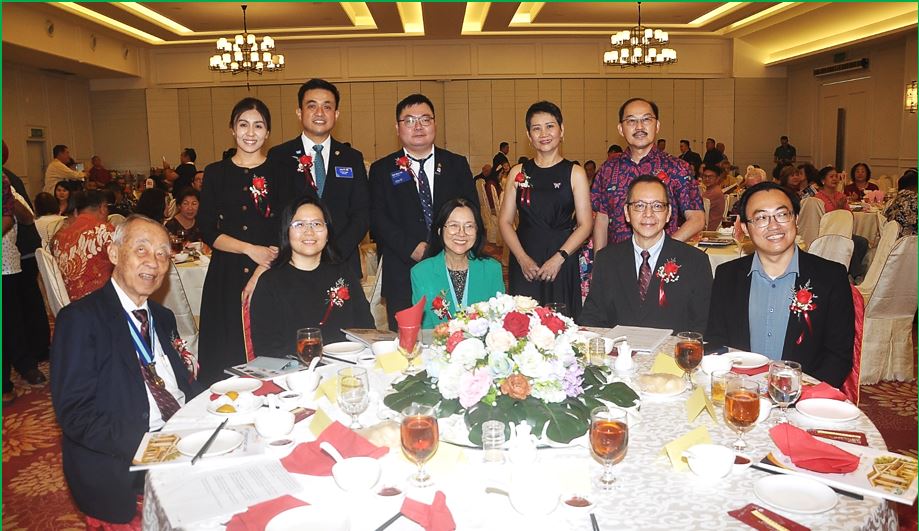
Engineers, colleagues and friends moved from table to table, exchanging handshakes, laughter and memories forged over years of shared purpose.
And as the last notes faded into the night, what remained was more than an awards dinner — it was the quiet harmony of friendship, achievement and a profession united by dreams of building a better tomorrow.


Leave a Reply