
By Vincent D’Silva
KAMPAR: A Malaysian invention may begin as an idea sketched on paper or tested quietly within a laboratory, but its true value is realised only when it reaches the hands of people and improves their lives.
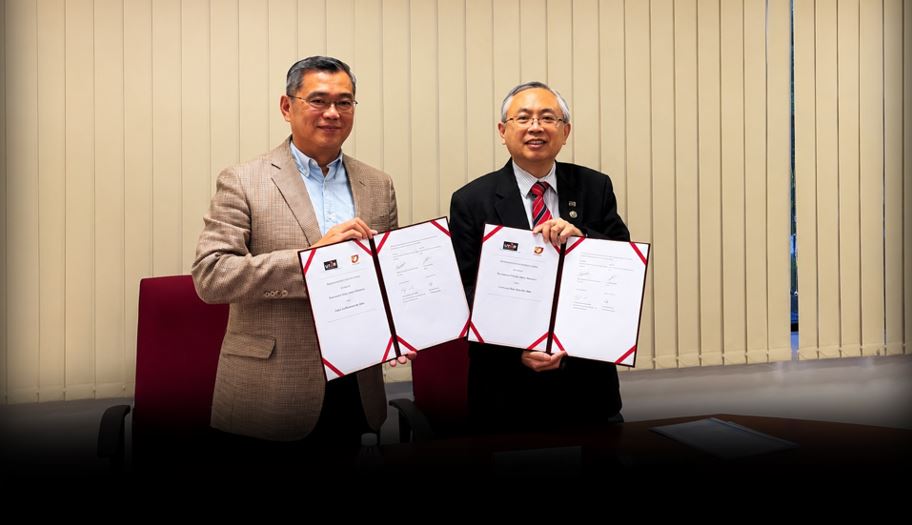
That journey from academic research to practical application received fresh momentum when Universiti Tunku Abdul Rahman (UTAR) and Far East Pyramid Sdn Bhd exchanged a Memorandum of Understanding (MoU) at the university’s Kampar Campus.
The agreement marks the beginning of a partnership that seeks to bring together UTAR’s academic knowledge and research capabilities with Far East Pyramid’s expertise in electronic research, product design and technological innovation.

More than a ceremonial exchange of documents, the MoU represents a shared commitment to transform ideas into useful products, prepare students for the realities of the working world and give Malaysian-grown technology a stronger platform for recognition.
UTAR president and chief executive officer Dato’ Dr Ewe Hong Tat described the occasion as an important milestone in the university’s continuing efforts to strengthen cooperation between academia and industry.
“Having two significant collaboration ceremonies in a single day not only reflects the growing recognition of UTAR’s achievements in research and innovation, but also marks another important step forward in strengthening university-industry collaboration,” he said.
Earlier that morning, UTAR had also conducted a Research Agreement Exchange Ceremony with Lin Bee Eco Honey Farm, making the MoU with Far East Pyramid the university’s second industry collaboration event of the day.
For Ewe, such partnerships ensure that knowledge does not remain confined within lecture halls and research papers. Instead, it can be tested, refined and applied to meet the evolving needs of industries and communities.
Established in 2002, UTAR has remained committed to providing affordable and quality higher education while advancing teaching, research, innovation, international cooperation and industry engagement.

The university has developed an extensive network of collaborations with universities, institutions and industries around the world. At the local level, it has established partnerships with nearly 200 companies and organisations across disciplines closely connected to its academic programmes.
Ewe said local industries played a vital role in national economic development and served as an essential bridge between academic research and industrial practice.
“These collaborations ensure that our curriculum remains relevant to industry needs while providing valuable internship and practical learning opportunities that enhance our students’ employability,” he said.
Under the newly signed MoU, UTAR and Far East Pyramid will explore joint research projects, knowledge and facility sharing, academic and staff exchanges, industrial visits, internships, professional training and collaborative product development.
The partnership will also examine opportunities for patent commercialisation, technology transfer and the conversion of research findings into products with market potential.
Ewe said Far East Pyramid’s capabilities in electronic research and development would open meaningful avenues for knowledge exchange and innovation.
“As an electronic research and development company specialising in product design and innovation, Far East Pyramid’s expertise, technological capabilities and innovative mindset will undoubtedly create many opportunities for meaningful collaboration between our two organisations,” he said.
He added that he was personally encouraged by the possibilities arising from the agreement.

“I believe this MoU marks the beginning of a long-term and mutually beneficial relationship, allowing both parties to deepen our collaboration, expand into new areas of cooperation and jointly contribute to the advancement of industry-academia partnerships,” he said.
Far East Pyramid executive director Lau Teik Hock said the company was grateful for the resources, professional guidance and recognition provided by the university.
He said UTAR’s support had given home-grown innovation an opportunity to step beyond the laboratory, gain wider visibility and earn greater confidence from both the market and industry.
“UTAR’s partnership has given Malaysian-grown innovation the opportunity to gain greater visibility and recognition,” Lau said.
“We truly value our collaboration with UTAR and look forward to expanding our partnership into many more areas in the future. Together, we hope to develop new technologies that create meaningful value and make a positive contribution to society.”
Lau said Far East Pyramid was committed to building a long-term relationship with the university, particularly in helping promising research move towards commercial and industrial application.
“Should the university have future initiatives related to patent commercialisation, technology transfer or market development, we would be more than happy to contribute our expertise and support,” he said.
“Our hope is to help bring research outcomes from the laboratory to industry, creating mutual benefits for both parties.”
The partnership also highlights the often-unseen work behind technological development — the long hours spent testing, evaluating, correcting and validating a product before it can earn public and industry confidence.
Lau expressed special appreciation to Dr Teh and his team for their dedication throughout the product evaluation process.
“Their rigorous and professional assessment has not only further validated the authenticity and reliability of our technology, but has also strengthened the confidence and trust of both the market and industry in our innovation,” he said.
Such validation, he added, was important for a Malaysian company seeking to demonstrate that locally developed technology could meet professional and industrial expectations.

For students, the MoU promises opportunities extending beyond textbooks and examinations. Industrial visits, internships and exposure to real research and development projects could allow them to witness how an initial idea is shaped into a functioning product.
For researchers, it provides a possible pathway through which discoveries can leave the laboratory and address actual challenges faced by businesses and society.
For Far East Pyramid, the university’s academic expertise and research facilities offer additional strength in evaluating and advancing its technological innovations.
The collaboration therefore stands not merely as an agreement between two organisations, but as a meeting of shared aspirations — one rooted in education and research, and the other driven by invention, industry experience and the determination to bring ideas into the marketplace.
Lau said Far East Pyramid looked forward to achieving further breakthroughs alongside UTAR and contributing to Malaysia’s progress in science, technology and innovation.
“We look forward to continuing this meaningful partnership, achieving more innovative breakthroughs together and contributing to the advancement of science, technology and innovation in Malaysia,” he said.
As representatives from both organisations exchanged the MoU, the moment carried a hope larger than the documents in their hands: that a promising idea nurtured in a university or developed by a Malaysian company would not be left unseen on a laboratory table.
Through partnerships such as this, innovation is given a road to travel — from research to industry, from possibility to purpose, and ultimately, from the hands of its creators into the lives of the people it was designed to serve.



Leave a Reply