
By Vincent D’Silva
KUALA LUMPUR: On a busy Friday afternoon at IPC Shopping Centre, shoppers paused between errands to drop used batteries into collection boxes, examine cardboard-built booths and learn how a virtual credit card could replace plastic in their wallets. It was an ordinary mall scene with an extraordinary message: sustainability does not have to be complicated.
That message sits at the heart of Sayang Green 2026, a three-day sustainability showcase running from Jan 16 to 18, which aims to bring green living out of abstract conversations and into everyday Malaysian life. Organised by 180 Degrees Brandcom, the event focuses on simple, practical actions — refilling, returning, reducing and rethinking daily habits — that people can realistically adopt.
“Sustainability is no longer a distant issue; it’s already part of our daily reality,” said Chan Fong, founder of 180 Degrees Brandcom and the initiator of Sayang Green. “Sayang Green was created to make greener living feel doable. It’s not about changing everything overnight, but about empowering people to start with small switches that fit naturally into everyday Malaysian life.”

The urgency is clear. Recent studies show Malaysia ranks among the highest globally for dietary microplastic intake, with plastic particles now commonly found in fish — a staple in local diets. At the same time, the country generates an estimated 39,000 tonnes of solid waste daily and records one of the region’s highest per capita carbon dioxide emissions.
“These are not abstract statistics,” Chan said. “They reflect the cumulative impact of everyday choices — how we shop, how we pay, how we dispose of things. That’s where change has to start.”
A key feature of Sayang Green 2026 is collaboration across sectors to show how sustainability can be woven into existing lifestyles. Alliance Bank Malaysia Berhad, a main partner, is highlighting how digital banking tools can reduce reliance on plastic.
“ Sustainability becomes more effective when it fits naturally into how people already live and bank,” said Gan Pai Li, group chief consumer banking officer of Alliance Bank Malaysia Berhad. “As The Bank For Life, we focus on making sustainable choices practical and accessible through innovation and technology.”

She said solutions such as Virtual Credit Cards eliminate the need for physical card production and delivery, helping reduce material use and associated carbon emissions while offering a secure and convenient payment experience.
Across the exhibition space, sustainability is also reflected in physical design. Much of the event infrastructure is built from recyclable cardboard rather than conventional plywood.
“Sustainability is not just about choosing a ‘green’ material,” said Ji Ken Loo, managing director of De Carton. “It’s about how products are designed, structured and used over time. Here, people can see and touch how cardboard structures can be durable, practical and visually engaging, while significantly reducing waste.”
Unlike many green-themed events, Sayang Green has measured its environmental footprint. Its carbon emissions were calculated in accordance with ISO 14064-1 standards, totalling 12.56 tonnes of carbon dioxide equivalent within the defined project boundary.

By adopting lighter, modular cardboard-based structures, organisers estimate emissions could be reduced by up to three to four times compared to conventional plywood setups, due to lower transport, construction and disposal impacts.
“This is about applying sustainability at the design level, not just talking about it,” Chan said.
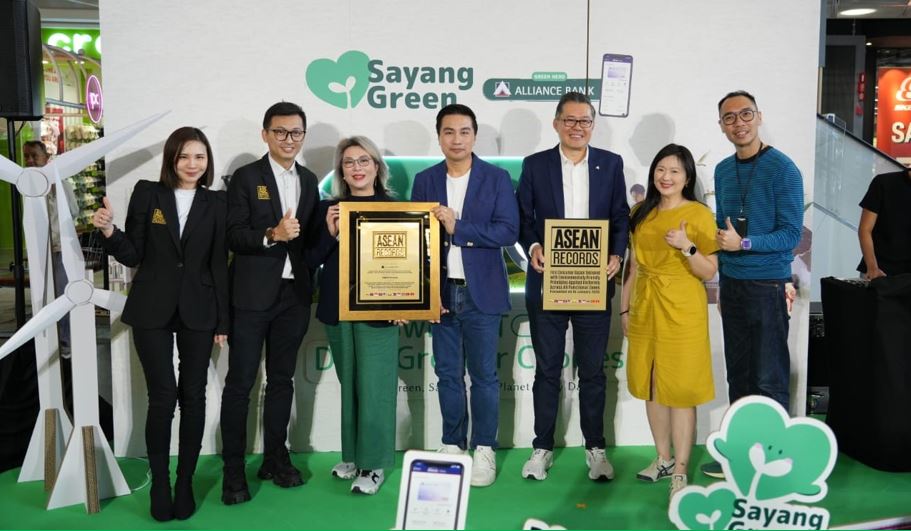
That approach has earned regional recognition. During the launch, Sayang Green 2026 received ASEAN Records acknowledgements for sustainable event design.
Alliance Bank was recognised for creating the first consumer bazaar designed with environmentally friendly principles applied uniformly across all functional zones, while De Carton was listed for constructing the first ESG consumer bazaar using recyclable cardboard-based infrastructure planned around circular economy principles.
Hosting the event at a shopping centre was a deliberate choice.

“Shopping centres are shared spaces where daily routines happen,” said Karyn Lim, general manager of IPC Shopping Centre. “By hosting Sayang Green at IPC, sustainability becomes something families can experience together — making it more relatable, inclusive and easier to adopt as a habit.”
Throughout the weekend, visitors can take part in hands-on activities that translate awareness into action. These include battery return programmes by Elexer, refill-and-return demonstrations by ReadyCare, recycled plastic workshops by NatureLoop, and showcases of clean energy solutions, electric motorcycles and sustainable township planning.
From household products to mobility and urban development, the emphasis remains the same: progress through participation, not perfection.
“Greener living doesn’t require people to be ideal,” Chan said. “It just requires a willingness to start.”
As shoppers drift back into the mall’s usual rhythm, the hope is that they leave with more than brochures or discounts — but with one or two small habits that, multiplied across thousands of people, could add up to meaningful change.




Leave a Reply