
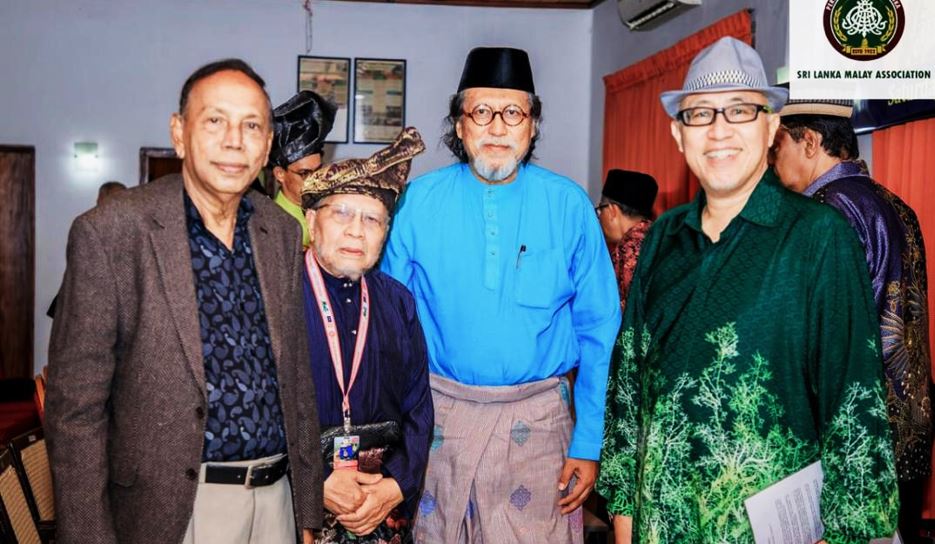

Mohamed Fareen Ghafoor greeted us at Colombo’s Bandaranaike International Airport on 3 August last month. He is a Sri Lankan Malay. A retired banker (with the Commercial Bank of Ceylon), and a committee member of the Kandy Malay Association, Fareen, 58, was our tour guide.
I was at the island nation, together with six others for the International Forum on Diaspora and Sri Lankan Malays.

The forum, held at the Colombo Malay Cricket Club premises, was organized by the Sri Lankan Malay Association (SLMC) and the World Malay-Polynesian Organization (WMPO). A major theme was on the concept of the Malay World and the diaspora, focusing on the Malays in what was then Ceylon.
The Club, the oldest Cricket club in the Ceylon, is called the Padang Complex, located at Jalan Padang, Off Kew Road in Colombo.
It was established in 1872. The Guest of Honour was the Malaysian High Commissioner to Sri Lanka, His Excellency Badli Hisham Adam. I moderated the keynote session by Prof Emeritus Dato’ Dr. Wan Hashim Wan Teh from Nationa Defense University Malaysia and historian Prof B.A. Hussainmiya.
Hussainmiya who has produced voluminous works on the Sri Lankan Malays, is perhaps best known for his book Orang Regimen: The Malays of the Ceylon Rifle Regiment (1990). The Malays form the major group in the Ceylon Rifle Regiment. Members of the Malay community have the tradition holding senior positions in the regiment.
The Malays in Sri Lanka had their origins some 500 hundreds years ago, mainly descended from Java and Madura, and in particular the community around Jakarta. Over the centuries, inter-marriages are common – between the Malays and the Moors (of Arab or Indian origin), and between the majority Sinhalese community.
These tended to blur the Malay identity there. While their Malay sounds ‘foreign’ to us, ‘self-identification seems to be the only basis of Malay identity in Sri Lanka. This category is used in the national census and birth certificates.
It has been assumed that before the 17th century, Sri Lanka was the staging post for Malays sailing to Madagascar. The Portuguese would have encountered the Malays there. But clear records of Malay presence on the island began in about 1640 when the Dutch ousted the Portuguese, both from Sri Lanka and Madagascar.
In his book, Hussainmiya tells us that the Dutch in the East Indies deported “recalcitrant chiefs and dignitaries” to Sri Lanka if they posed a threat.
The close-knit Malay community now comprises about 70,000 people out of a total of 18 million. Their ancestors are described as Malay/Javanese soldiers led by princely families who served in the regularly army of the Dutch.
Hussainmiya describes the list as a long one – from Rajas and nobles for Central Java, Goa in the Celebes, Tidore, Ternate, and other spice islands. There are many political exiles in Sri Lanka so much so that in Indonesia, the word ‘disailankan,’ came to mean ‘to be sent to Ceylon’ or banishment.
The other place of exile was Cape Town in South Africa which emerged in later years. The original Malay population of Sri Lanka were preponderantly of Javanese origin. Others were Sundanese, Madurese, Bugis, Minangkabaus, Amboinese, Balinese, and Tidorese. Dutch records refer to the exiles as Oosterlingen (or Easterners).
Hussainmiya, who was with the Department of History, University of Brunei Darussalam from 1988 to 2016 tells us of the Malays living in “their own kampongs around the fort of Batavia (now Jakarta)…When the Dutch fought wars in Sri Lanka and in the Malabar Coast these kampongs became depopulated due to heavy recruitment to serve in the Dutch army.”


The Batavians, although speaking a variety of dialects within their own communities, use a lingua franca, the Batavia Malay, or Pasar Melayu to interact among themselves. Islam is the common religion.
Hence, language and religion are the principle identity markers, facilitating the emergence of a strong Malay community in Sri Lanka. It is this community that the British encountered when they occupied Ceylon in 1796.
The British not only ‘martialized’ the Malays like the Gurkhas to serve in their native army, but also took steps to strenghten their population in Sri Lanka by inviting Malay families from the Peninsular Malaya.
Hussainmiya notes that in 1802, the Sultan of Kedah had sent a contingent of his Malay subjets to serve in Sri Lanka. Others came from Melaka and Singapura.
In a 2012 paper written as a tribute to Professor Ismail Hussein, Husseinmiya raises identity issues facing the Malays there. The Malay in Sri Lanka were left to their own devices as well as self-motivation to initiate efforts to preserve their cultural life.
We are told that in the 20th century, the community has to struggle for its cultural survival. There was no state support. Hence the close-knit nature of the present community is the legacy of their early leaders who rallied to promote togetherness and cohesion through various means.
As Muslims, Malays are a minority within a minority as compared to the Tamil-speaking Moors who outnumber the Malays by 9 to 1. The Sri Lankan Malay identity is also forged through interactions between the Tamil-speaking Moors and the Sinhalese.
Both have their own representatives in the country’s legislature. It is related that the division between the Moors and the Malay surfaced at the political level.
This further reinforce Malay consciousness. In the process, the Malay endeavour to define their identity more clearly as the scions of an ‘Eastern civilization’ rather than the inheritors of a Muslim civilization claimed by the Tamil-speaking Moors who are descendants of the Arabs and Indians.
Malay ethnic consciousness is resonated in their recognition in the legislature, rendering dignity and equality, expressed in the most important forum in the country.
The various associations and the vocal representatives of the community had made efforts to revive and maintain Malay language and culture by collecting oral and written literature, and preserving music and performance, in addition to the wearing of the Malay traditional attire; and consumption of Malay dishes such as satay and baabath (beef tripe curry) and dodol.
We experienced these in Colombo and in the coastal town of Kirinda, more than 280 km south of capital, where we visited a school and a Malay family. The town has the largest concentration of Malays in Sri Lanka, with about 600 families.
Specifically on the linguistic, literary and journalistic side, a significant legacy of the Sri Lankan Malays is the first Malay-language newspaper in the world – the fornightly Alamat Langkapuri published from 1869 to 1878 in Colombo.




Leave a Reply