
By Chaizani Mohd Shamsudin
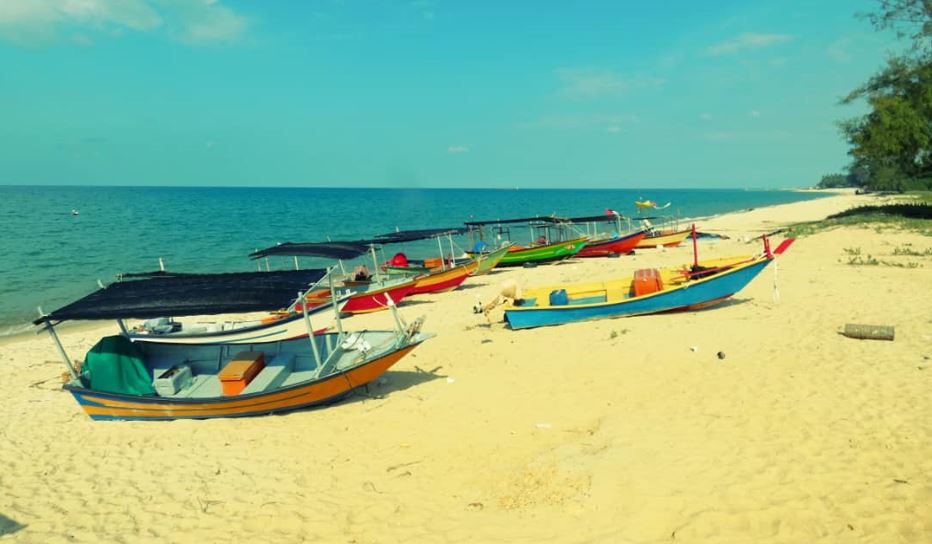
There is a beautiful beach called Pantai Sauh in Terengganu which is a state that has been known for its maritime tradition for generations.
As sauh means anchor, you might think that Pantai Sauh was named after the large anchor of a shipwreck, laying at the bottom of the bay.
You’d be wrong.
It was in fact named after something completely non-maritime, with had absolutely nothing to do with ships at all.
This might be hard to believe because not far from Pantai Sauh, there is a place called Mengabang Kapal. In fact, there is no shortage of ship-related names of places in the state of Terengganu.
Pantai Sauh’s name, however, was coined thanks to a singular trait in the local dialect.

Probably not too many people think about it when speaking, but we often use a particular kind of linguistic shorthand when we mesh familiar words together.
Like when we call out to someone “What’s up?”, it might sound like we are saying “’Sup?” We might say that we use a mic rather than a microphone, ride bikes instead of motorbikes, and use a key instead of a hanky or, even more formally, a handkerchief.
The tendency to shorten words or phrases has resulted in one very common word used all over the country: “spital”. Perhaps saying “hospital” just sounds so terribly formal and stilted.
Of course, this tendency will manifest itself differently in different languages and dialects.
In the dialect of the states lining the northeastern coast of Peninsular Malaysia, it is quite common for words that end with a consonant to be combined with a proceeding word if it begins with a vowel.
Let’s say for example the phrase “post office” might be pronounced as “pos topih”. This is comparative to the very familiar phrase known to all Malaysians as “gostan” which in fact originated from a maritime term: “go astern”, as well as its counterpart gohek, born from a combination of the phrases “full steam ahead” and “go ahead”.
The state of Terengganu has a unique and distinctive dialect compared to that of other areas in Malaysia. It is far enough from Thailand to not have the lilt of the Kelantan dialect, but then it does have many similarities with the latter in terms of vocabulary and intonation as compared to other dialects.
Put all these elements together, and phrases such as these are born:
“Pe ye te?”, meaning “Siapa dia kata?” (Says who?)
“Kang sik mok lu” meaning “Makan nasi lemak dulu”
Another factor behind the name Pantai Sauh is the fact that adjectives come before nouns in English, but they come after nouns in Malay.
For example, a beautiful beach is pantai (beach) cantik (beautiful) and not cantik pantai, which means something else entirely. A pretty lady might wear a kebaya nyonya, and not a nyonya kebaya, while we wear jam tangan to tell time, not a tangan jam, which in English might refer to the hands of a clock.
But because English metaphorically walks side by side with all the other languages spoken in Malaysia, we also get phrases such as “pergi market” or “pakai blazer” or even “certain-certain tempat” (meaning certain places, obviously).

These phrases become quite confusing because you can’t be sure which word should precede the other.
This evolution of languages and dialects are an extension of the inexorable march of human history.
However, in the case of Pantai Sauh, the meaning evolved not from the usual type of evolution, where a word’s pronunciation might change or transform into something else. Instead, the name was born from two different parent languages and the different interpretations of specific structures.
So how did Pantai Sauh get its name?
From the word “resthouse” – pantai resthouse (resthouse beach in Malay) which was then shortened to “pantai sthouse” and ultimately became Pantai Sauh.
According to Zabiah Muda, 66, who was born and brought up in Batu Rakit, the rest house was a popular retreat for British officers during the colonial era and in the early years of Malaysia’s independence.
“It was a sprawling wooden building on stilts, much like the design of government clinics in rural areas back then.
Just like the omputih (a short form for orang putih, or white people), us locals called it resthouse, the only difference is that we shortened it to sthouse,” she said.
She added that as the Terengganu dialect often replaces the S sound at the ending syllables with the H sound, sthouse was pronounced sthouh, and later on transitioned to just sauh.

“When I was growing up in the 1960s and 70s, the beaches of Batu Rakit especially the one in front of the rest house were the focus of social events and festivities held by the Batu Rakit Thai community,” she said, adding that the rest house became disused in the 1980s and soon succumbed to the elements.
Now, only the concrete gateposts of the rest house are still standing. A Thai restaurant, complete with Thai flags, now stand where the rest house once was, perhaps as a reminder that a sizeable Thai community once lived here.
Gone are the troupes of Thai menora performers from the beach, replaced with rows of colorful fishing boats.
If the story of the rest house is not told, younger generations cannot be blamed for thinking that the rusty steel anchors on the bow of the fishing boats were the namesake of Pantai Sauh.
New ideas need new words and sometimes existing words take on new meanings. Bugs and viruses are examples of old words that took on new meanings during the advent of the computer age.
Pantai Sauh is unique in the sense that its name was born after the transformation of an English word which took on the mantle of an existing Malay word.
Stories like how Pantai Sauh got its name through the vagaries and special traits of languages is part of the reason why I love studying and comparing languages as it can pave the way for us to create, understand and spread new ideas.
There are many more intriguing stories related to languages and I look forward to writing them.
See you in the stories about languages at play!
The author is a teacher at Universiti Malaysia Terengganu’s English Language Centre and specializes in comparative linguistics, philosophy of science, and scientific language. A graduate of Universiti Sains Malaysia and Universiti Malaya, she has been teaching for over 20 years. Among her published books are Meownglish and From Out-er Space.




Leave a Reply