
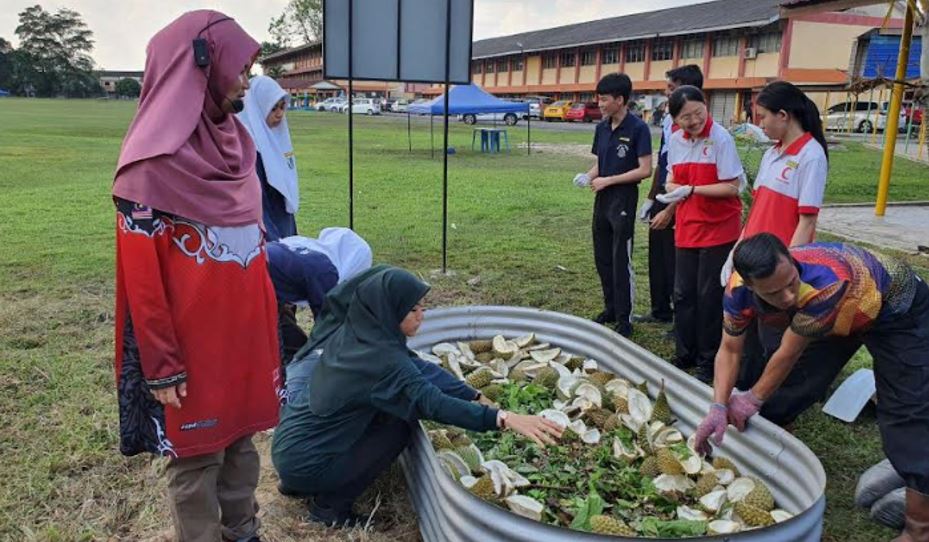

JOHOR BAHRU: Hugelkultur is a composting method that uses large pieces of rotting wood as the centerpiece for long term humus building decomposition.
The decomposition process takes place below the ground, while at the same time allowing you to cultivate the raised, or sunken, hugelkultur bed.
This allows the plants to take advantage of nutrients released during decomposition and water reservoir.

Hugelkultur, in its infinite variations, has been developed and practiced by key permaculture proponents such as Sepp Holzer and Masanobu Fukuoka for decades.
SMK Skudai has embarked on the Hugelkultur compost-making project as part of the ongoing “Development of Roselle Organic Product using green Extraction Technology”.
Some 50 students and 15 teachers participated in this hands-on approach learning.
The compost-making session marked the beginning of phase one of the project, which involves Hugelkultur compost-making and planting Roselle.
Phase two will include harvesting, extracting, and producing Roselle products using green extract technology.
Senior lecturer at the Faculty of Science at Universiti Teknologi Malaysia (UTM) Dr Huszalina Husin said composting fruit residues, especially peels, can be an effective way to manage waste and enhance plant growth by returning essential nutrients such as nitrogen (N), phosphorus (P), and potassium (K) to the soil.
Dr Huszalina said durian, mangosteen and rambutan peels contain significant amounts of these nutrients, with N ranging from 0.76g to 1.4g/kg, P from 0.13g to 0.16g/kg, and K from 0.7g to 1g/kg, making them highly beneficial for plant growth.

“Composting food scraps and fruit peels can also contribute to efficient waste management and reduce the carbon footprint,” she said.
She pointed out that one method for composting is the Hugelkultur technique.
She said this involves layering fruit residues with landscape waste such as twigs, dry leaves, grass, and soil to create an organic raised bed.
She then went on to say that this method not only enhances nutrient recycling but also promotes sustainable gardening practices.
SMK Skudai principal Rostena Ismail said the Roselle planting project was first implemented in 2023 under the Iskandar Puteri Low Carbon Community Grant 3.0, concluding in January 2024.
She said this year, the project continues with a collaboration offer from Dr Siti Pauliena Mohd Bohari, a recipient of the Knowledge Transfer Programme (KTP) UTM grant.
“The project aims to expose school students to composting knowledge, green technology extraction, and entrepreneurial skills,” she said.
She went on to say that it seeks to enhance cooperation and networking between the school, the Parent-Teacher Association (PTA), higher education institutions, local authorities, and the surrounding community through Roselle planting activities and product production.
“The hugelkultur compost-making event not only provided experience for students but also strengthened the collaborative efforts between the school and various community stakeholders,” said Rostena.

According to Rostena it was a successful kick-off for a project poised to yield significant educational and environmental benefits.
She also expressed her enthusiasm for the project stating, “This project benefits students by providing direct knowledge transfer from UTM academics, giving students the opportunity to apply what they have learned from books to hands-on activities such as making compost and producing Roselle-based cosmetic products.”
Dr Siti Pauliena said this KTP (Knowledge Transfer Programme) is an initiative by UTM at sharing and contributing knowledge to the community.
She said the objective of this programme is to educate students and teachers on the process of composting, cultivating the Roselle fruit.
She noted that consumers today have a tendency to opt for environmentally friendly and organic cosmetics products for their daily needs.
“I anticipate that this project will serve as an inspiration for establishing a long-term partnership with SMK Skudai and the community,” she added.
For SMK Skudai this project benefits the students by providing direct knowledge transfer programme from UTM academics, giving students the opportunity to apply what they have learned from books to hands-on activities such as making compost and producing Roselle-based cosmetic products.
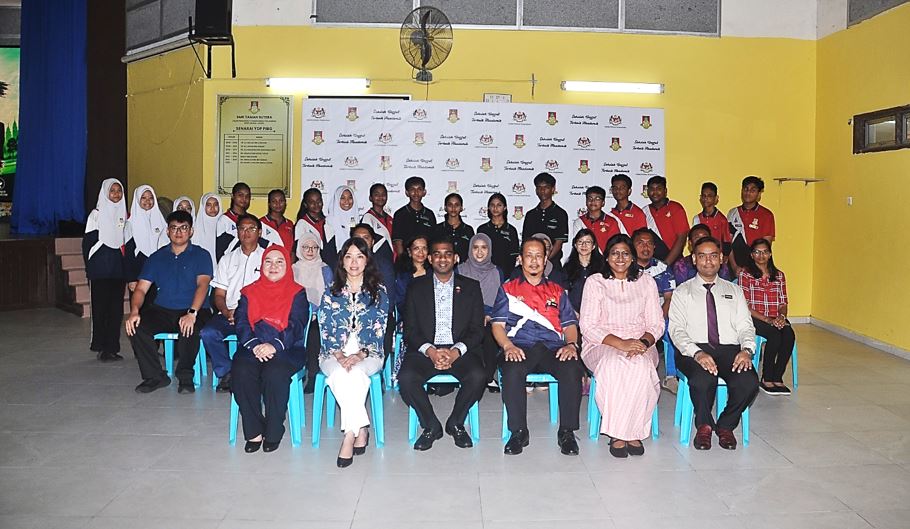
Present for the event were Shahril Izwan, assistant director of the Community Development Department, Iskandar Puteri City Council (MBIP), Raziman Rahmat, MBIP officer, Mohd Razaduan Hamzah, officer from the Landscape department, MBIP, Aizat Osman, officer from SWM Environment, Dr Huszalina Husin, Dr Siti Pauliena Mohd Bohari and Dr Nurliyana Ahmad Zawawi, senior lecturers from Faculty of Science UTM.
Also present were officials from the UTM Centre for Community and Industry Network (CCIN).
Leave a Reply