

THE call to prayer for Subuh echoed. Semael prepared to go to the nearby surau in his village in Dusun Nyior, Narathiwat, Southern Thailand. He grabbed his worn-out black songkok, which he had been using for about eight years.
His wife, Rokiyah, had also woken up for the Subuh prayer. Semael’s two children, aged 3 and 5, were still curled up in bed. Their ancestral home had a tiled roof but zinc walls.
Semael descended the stairs. Suddenly, he heard three gunshots coming from the direction of the surau. Semael ran, wondering, “What happened? Gunshots? Who got shot?”
In the surau compound, the caretaker Khossim was supporting Imam Doloh, who was lying lifeless. “Allahu Akbar… when will incidents like this stop… when will there be peace,” said Semael.

Southern Thailand continues to be in turmoil… the light of peace seems elusive. The peace process that has taken years has not shown success. Despite the local residents’ worries, daily life must go on. Tourists, however, are starting to stay away… who loses out?
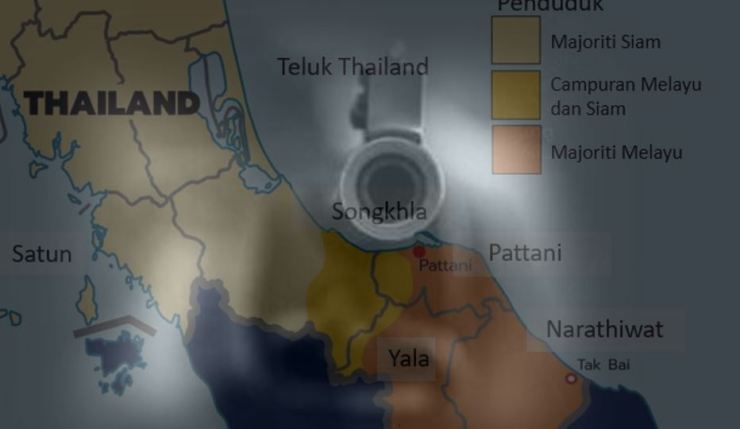
Murders, shootings, and bombings by irresponsible parties have become more frequent in Southern Thailand recently, especially in the three provinces – Yala, Narathiwat, and Pattani.
The victims, whether killed or injured, include villagers, armed groups, and Thai security forces.
Women, children, young and old alike, have died from shootings or bomb explosions or have suffered permanent injuries that will be lifelong memories.
Meanwhile, wives, husbands, mothers, siblings, brothers, sisters, and fathers lose their loved ones, whether they are civilians, security forces, or armed groups.
Why are there parties willing to disrupt peace and order? Can’t the predominantly Muslim population in Southern Thailand live in peace? Don’t they feel anxious or fearful every time they step out of their homes heading to work, mosques, or suraus?
Recently, a bomb exploded on a motorcycle parked in a crowded area at night in Narathiwat city – a place known as the ‘birdcage’.
The writer has been in Southern Thailand for over a year. It can be said that almost every day there are incidents of shootings and bomb explosions, either targeting individuals or damaging public property, including electricity and communication poles.
Last night (May 10, 2024), even as this article was being written, a bomb planted on the main road in Belukar Samok (the route from Simpang Jerai to Kapho) in Bacho district, Narathiwat, exploded.
There are claims that the bomb was planted by armed groups targeting Thai security forces who would be passing through the area.
However, due to heavy rain, the security forces canceled their patrol, and the timed bomb’s explosion did not cause any injuries.
Imagine if, at that time, innocent civilians, villagers, or tourists were passing through the area when the bomb’s timer was active.
For the writer, the armed groups in Southern Thailand can be categorized into four types: independence fighters, drug syndicates, groups of individuals seeking revenge, and those who do not want to see Yala, Narathiwat, and Pattani peaceful.
Most of the previous incidents occurred in rural areas or small towns in Narathiwat, Yala, and Pattani. The writer once drove in Yala province – getting lost and entering villages far from the city.
Google Maps marked red and black on the roads the writer traveled. Elsewhere, red means the road is congested with traffic, but the writer was told that red or black marks in Southern Thailand indicate that the route is in the most dangerous area – a red zone.
The most dangerous means there is no guarantee of safety in the area besides frequent bombings or clashes between security forces and armed groups.
For the writer, the armed groups in Southern Thailand are categorized into three: freedom fighters, drug syndicates, and individuals seeking revenge.
However, the writer cannot ascertain which party carried out the attacks on security forces or bombings in public places that injured people, as happened in Narathiwat on May 6th.
Was it the fighters? Or drug syndicates? Or individuals seeking revenge against the security forces? Could be. Or are there other parties deliberately acting to keep the South unstable?
For the fighters, they have long been fighting Thai security forces to demand independence. However, efforts have been made – with Malaysia as the intermediary – for the peace process with the Thai government.
However, there are no signs that the struggle will be halted. Similarly, the peace process, as the writer sees, has never succeeded in reaching a decision that benefits the Muslims of Southern Thailand.

As for the drug syndicates, they act to create chaos because their activities are often exposed by security forces. For example, the attack on Thai security forces in Sungai Golok on April 28th.
Thai authorities believe the incident occurred following the arrest of four men suspected of being members of a drug smuggling syndicate earlier. Through the arrests in the town of Sungai Golok, the police also seized over 600,000 pills, the largest seizure in recent years.
Surely the syndicate wanted revenge. As a result, they attacked four Thai police officers with gunfire and bombings.
Meanwhile, the third category that often causes unrest are those seeking revenge against the Thai security forces, allegedly causing the death of their relatives. This vengeful nature is deeply ingrained in the Malays of Southern Thailand.
The fourth category consists of those with personal interests who deliberately want to create unrest. This group is difficult to identify.
Sometimes the writer thinks, “It’s better for Malaysian tourists to go straight to Hat Yai… no need to come to an unsafe area… fearing a repeat of what happened to the two Malaysians from Kelantan in the motorcycle bomb explosion in Narathiwat three days ago.”
But from another perspective, we want more Malaysian tourists to visit interesting places around Yala, Narathiwat, and Pattani. At least with such visits, the local economy can be further encouraged.
According to Malaysia’s Consul General in Songkhla, Ahmad Fahmi Ahmad Sarkawi, he explained that the three provinces have the potential to become among the famous tourism centers.
“These five Southern Thai provinces – Yala, Narathiwat, Pattani, Songkhla, and Satun – actually have great potential to attract investors from Malaysia,” he told Apa Khabar TV recently.
He believes that several incidents in Southern Thailand previously occurred because some parties wanted to show that they still exist.
The writer does not want to say who is right, who is wrong. Each – the fighters, drug syndicates, individuals, or the authorities themselves – has their reasons.
However, the writer urges all parties to think – what good comes from such incidents? Doesn’t it trouble the residents and the local economy? What if the Thai government declares a state of emergency in certain areas? Wouldn’t it be troublesome?
No matter who, please stop… everyone wants peace…
After the burial of Imam Doloh, Semael returned home. Sitting by his house door while rolling a leaf cigarette, Semael gazed at his two children playing by the stream in front of his house.
“When will there be peace… what will be the fate of my children,” Semael sighed.


Leave a Reply