

By Makadir Ajam
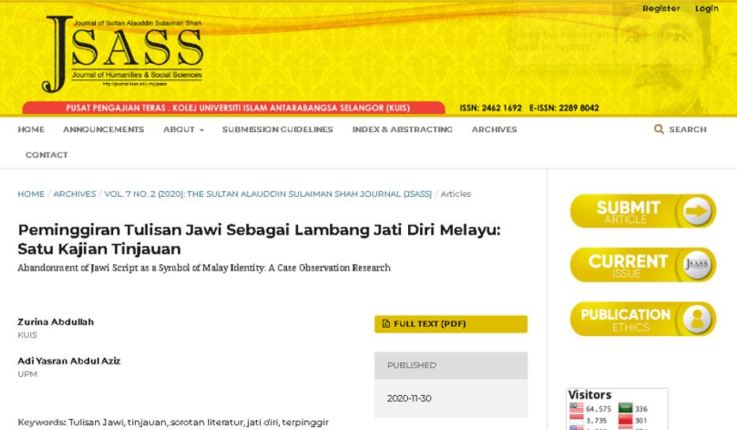
IN the scholarly article published in The Sultan Alauddin Sulaiman Shah Journal by Abdullah and Aziz in 2020, a poignant narrative unfolds, highlighting a cultural dilemma faced by the Malay community in Malaysia.
The subject at hand is the gradual marginalization of the Jawi script, an emblem of Malay identity that has been eclipsed in the wake of modernization and the widespread adoption of the Roman alphabet.
The story begins with the historical significance of Jawi, once the predominant script for all official and educational writings in Malaysia, deeply intertwined with the Malay identity and Islamic teachings.

This script, which beautifully combines Arabic calligraphy with Malay linguistic needs, represents a bridge between the past and the present, linking the community with its rich history and traditions.
However, as the winds of change brought globalization and technological advancements, the Roman script became more prevalent, leaving Jawi sidelined and perceived as less relevant.
This shift is not just a change in writing but symbolizes a deeper cultural shift that may lead to an erosion of identity and heritage.
Abdullah and Aziz, through their survey, uncover layers of this transformation, revealing how newer generations are increasingly detached from the Jawi script.
Their findings echo through the academic halls and beyond, suggesting a disconnection from a cultural cornerstone that once unified the Malay-speaking world.
The article weaves a narrative of concern, calling for a reflection on how modernity is reshaping cultural identities. It challenges the reader to consider the implications of losing such a script—not just the loss of a writing system but a fading link to historical consciousness and cultural uniqueness.
The call to action is clear: it’s crucial for policymakers, educators, and cultural advocates to reevaluate how heritage languages and scripts are integrated into national curriculums and public life.

This isn’t just about preserving a script but about maintaining a vibrant culture in an increasingly homogenized world.
Through their rigorous analysis, Abdullah and Aziz invite us to a critical examination of what is at stake if the marginalization continues.
Their study isn’t merely academic; it’s a narrative about identity, change, and the choices a society must face to either reconnect with its cultural roots or risk losing a part of its soul.
This story of Jawi is a narrative shared by many cultures around the world, making it a universal tale of tradition and transformation.
READ MORE
1. Script and Identity: The Enduring Legacy of Jawi in Southeast Asia
2. The Impact of Jawi Script on Malaysian Currency: Cultural Significance and Broader Implications
3. Revitalizing Jawi Script: Preserving Malay Intellectual Heritage in the Modern Era



Leave a Reply