
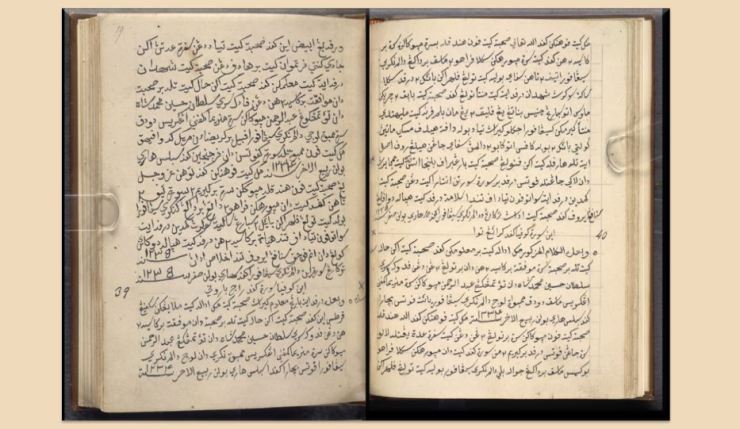
By Makadir Ajam
THE Jawi script is a writing system used for writing several languages in Southeast Asia, including Malay, Acehnese, Banjarese, Minangkabau, Tausūg, and several others. It is derived from the Arabic script but includes several additional letters to accommodate the phonetics specific to these languages.
The creation of the Jawi script was not the result of a single inventor; rather, it evolved over time as a result of the adaptation of Arabic script to local linguistic needs, influenced by the spread of Islam in the region.
Historical Background and Development
Origins in Arabic Script: The origins of Jawi can be traced back to the spread of Islam in the Southeast Asian region, particularly among the Malay people, around the 12th to 13th centuries. Arab traders and missionaries played a pivotal role in introducing the Arabic script, which was then adapted for the Malay language, which is significantly different from Arabic in terms of phonology.
Adaptation for Malay: The Arabic script was initially used to write Arabic only. However, as Islam spread through the Malay Archipelago, there was a need to use the script for writing in local languages. To accommodate the sounds specific to Malay and other local languages that are not present in Arabic, several modifications were made. For instance, new characters were added to represent the sounds /p/, /ch/, and /ng/, which do not exist in Arabic.
Role of Religious Scholars: Religious scholars, or ulama, who were well-versed in Arabic and Islamic teachings, were instrumental in adapting the script for Malay. These scholars often wrote religious texts, legal documents, and literature in Jawi, which helped in disseminating the script throughout the Malay-speaking Muslim communities.
Formalization and Spread: The use of Jawi script became more formalized as it began to be used in royal courts, religious education, and administration across the Malay Sultanates. Its use was further bolstered by the production of manuscripts, religious texts, and later, printed books.
Influence of Colonialism: The advent of European colonial powers, such as the British and the Dutch, introduced the Latin alphabet, which eventually became predominant in many parts of Southeast Asia. Despite this, Jawi remained an important cultural and educational component among the Muslim communities.
Jawi is not just a simple transliteration of Arabic script but a product of cultural synthesis that reflects the adaptation of Islam and its practices to local Southeast Asian contexts.
Its invention is a testament to the dynamic interplay between language, religion, and culture in the Malay world, showcasing the flexibility of the Arabic script and the innovative capabilities of Southeast Asian Muslim scholars.




Leave a Reply