
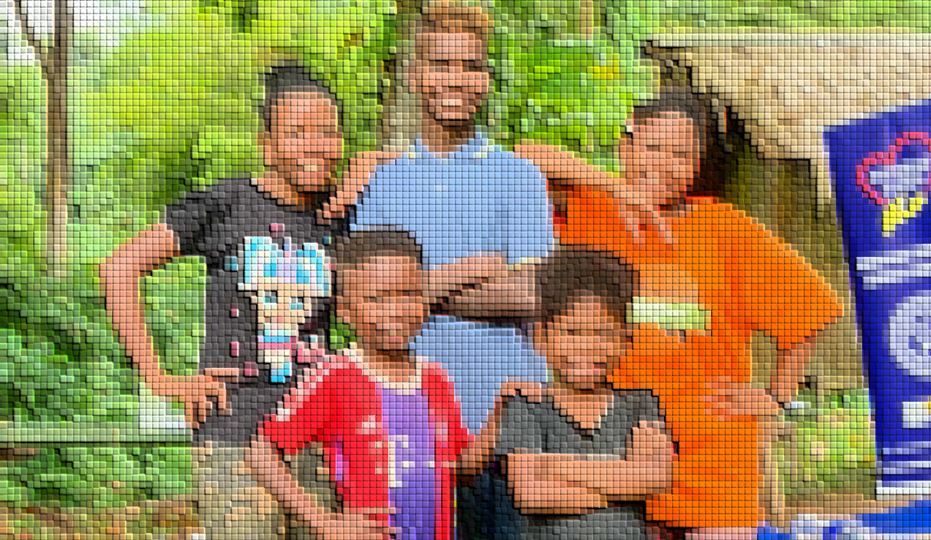

Unlike other days, on Sept 10 there was absolute silence in the class after one of the volunteer teachers said she had an important announcement for them.
The usually boisterous Bateq tribe children of Kampung Cangkung stayed in their seat, their eyes focused on their teacher who was squeezing her hands together, as if the words of her announcement were hidden in her palm.
“Izan is no longer with us..” was all she could blurt out before the class burst into tears.

Being one of the oldest in the weekly Kelas Rimba Bateq (KRB) Izan a/l Sam, 17, was chosen as the class monitor right from the start of the KRB a few years ago.
Teaching the Bateq kids reading, basic mathematics and personal hygiene was no easy task for the volunteer teachers and the weekly travel by boat into Taman Negara Pahang where Kampung Cangkung is situated only added to the challenges they have to face.
KRB is an initiative by Sahabat Jariah Malaysia (SJM), Bird Group Taman Negara (BGTN), Ikhlas.com and Yayasan Food Bank Malaysia (YBFM).
The tears of the students drove home the sad reality that the bright, easygoing and cheerful boy who was always there to guide the younger kids and help the volunteer teachers had passed on.

The teachers tried their best to console the students, even as their own tears flowed.
Izan had been rushed to the Jerantut hospital the previous week after he had fallen severely ill and later transferred to the Temerloh hospital, where he died from tuberculosis meningitis (TBM) complications.
TB can attack the meninges, the membranes that surround the brain and the spinal cord. Infection of the meninges is called meningitis.
According to SJM advisor Prof Dr Maketab Mohamed, there were three more cases of deaths due to TBM in Kampung Cangkung in the last four years.
Although these deaths and TBM cases in general have not been featured in the media, the illness is not uncommon in Malaysia.
In the research paper titled Prevalence and characteristics of tuberculous meningitis in Malaysia 2015-2020 by Saraswathiy Maniam, Siti Roszilawati Ramli, Asmah Razali and Norazah Ahmad of the Institute for Medical Research, it was stated that there were 2,072 TBM cases from 2015 to 2020, which represent 1.38% of total TB cases within the six years.
Out of the 2,072 cases, 42.7 percent (885) of the patients died due to the disease.
Maketab said the Jerantut Health Department should be commended for their efforts to monitor the health of the Bateq tribe in Kampung Cangkung.
“They sent a team to Kampung Cangkung in July and conducted health screening of the villagers, treating those who were ill and also giving BCG vaccination,” he said.
BCG is the acronym for Bacillus Calmette-Guerin, the vaccination against TB.
The general population of Malaysia received their BCG vaccinations for TB in primary school, but the children of the Bateq tribe in Kampung Cangkung did not get to go to school until recently, and that too is not on daily basis.
Not going to school, coupled with their unfamiliarity with modern medicine, plus the remoteness of their village mean that most of them did not receive the vaccinations that the general population take for granted.
During the Covid 19 pandemic, the Bateq tribe of Kampung Cangkung ran off into the jungle.
That is neither surprising nor an isolated incident. I was told that even the Kanaq tribe in Sungai Selangi, Kota Tinggi, Johor who were not as isolated as the Bateq tribe in Kampung Cangkung, ran off and hid in a nearby palm oil plantation when the medical team tasked with giving them Covid 19 vaccine arrived at their village.
When even the standard vaccinations given to primary school students were foreign to the Orang Asli communities that live in isolated areas, there is not much hope of them standing in line to receive a new vaccine for a disease they had never heard of.
On World TB Day (March 24) this year, Health minister Dr Zaliha Mustafa said that in 2022, the number of TB cases in Malaysia had risen 17 percent to 25,391, with TB deaths also increasing 12 percent to 2,572.
And TB does not only cause deaths.
As the new semester opened on 9 Oct, the media carried a story about Universiti Sains Malaysia (USM) first year student Nursyuhaila Abdullah, 21, who is paralysed from the waist down after suffering from TB when she was 15 years old.

The fact that Mycobacterium tuberculosis, the discovery of which was announced by Dr Robert Koch on March 24, 1882 (which was why the date was chosen as World TB Day) not only attack the lungs but can also spread to the central nervous system (CNS) should be made a common knowledge among the people of Malaysia.
We have seen how knowledge helped the fight against Covid19.
Without the causes, countermeasures and statistics of Covid19 being blasted daily by the media, such information would not have become common knowledge and the fight against it would have been much harder.
Something along the same line should be done for TB so that the public will be more aware about its dangers.
Everyone should be made aware that TB is not just dry cough as the Malay name for it (batuk kering) suggests. There should be more news and information about TB in the media.
We are nearing the end of 2023 and with the advance technology at our fingertips, no news is not good news.
No news about a disease as dangerous as TB is a recipe for disaster.


Leave a Reply