
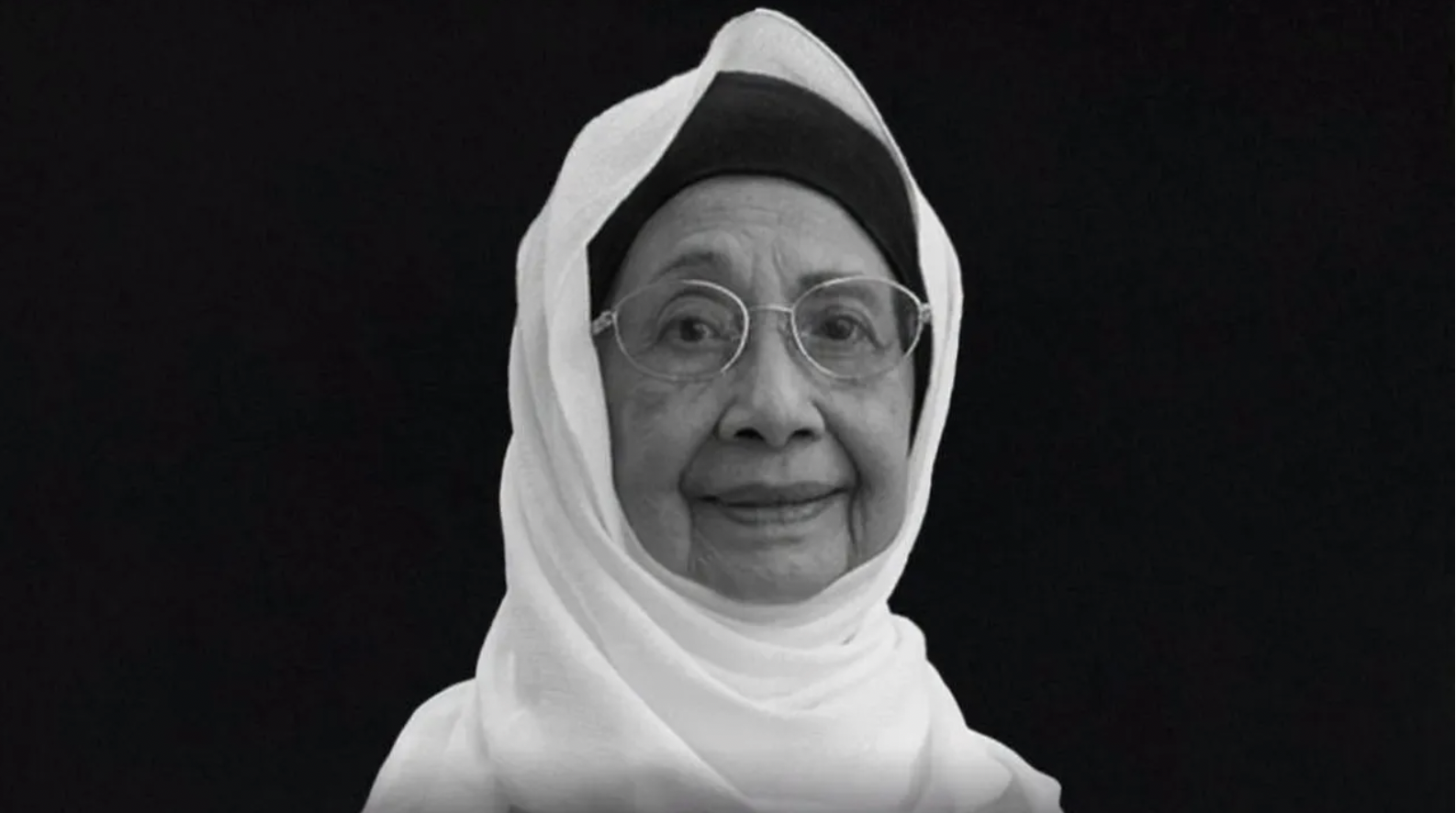
By M.A Kadir
The passing of Tun Dr Siti Hasmah Mohamad Ali at the age of 100 has generated something more complex than a conventional outpouring of condolences.
Across Malaysian and international newsrooms, official statements and social-media platforms, a quiet contest of framing is taking place: Who was Siti Hasmah to the world?
The first answer, particularly in international headlines, is familiar.
She was the wife of Tun Dr Mahathir Mohamad, Malaysia’s former prime minister and one of the country’s most internationally recognisable political figures.
Reuters, for example, introduced her through that relationship, describing her as the wife of Malaysia’s longest-serving prime minister. Other international reports adopted similar formulations.
It is a logical journalistic shorthand. Mahathir is the immediately recognisable reference point for an international audience.
Yet the more closely one follows the coverage, the more that initial frame begins to change.
Behind the headline identifying her as “Mahathir’s wife” emerges another Siti Hasmah: a physician, public-health advocate, pioneer among Malay women in medicine, campaigner for maternal and child health, and a public figure whose influence extended well beyond the political career of her husband.
That evolution in the coverage may ultimately be more revealing than any single headline.
From political spouse to public figure
The international media’s initial framing is largely functional.
For readers unfamiliar with Malaysia, identifying Siti Hasmah through Mahathir immediately establishes her place in the country’s history.
But this shorthand also carries an unintended limitation.
It places her identity in relation to a man before introducing her own professional and social contributions.
As reports develop, however, the emphasis broadens. International coverage begins to mention her medical education and career, her public-health work and her involvement in social causes.
The narrative therefore moves subtly from:
“Mahathir’s wife”
to:
“doctor and public-health advocate who was also Mahathir’s wife.”
That distinction may appear small, but in media discourse it matters.
The first formulation explains who she was through another person.
The second restores some of the biographical agency to Siti Hasmah herself.
Malaysia tells a more intimate story
The Malaysian media environment adds another layer.
Here, Siti Hasmah is not an unfamiliar figure requiring introduction through her husband. She has occupied the country’s public consciousness for decades.
Consequently, the domestic narrative moves more quickly from reporting her death to remembering her life.
News reports and social-media posts have circulated photographs, personal recollections and stories of encounters with her. Her character — particularly her warmth, gentleness and maternal qualities — has become an important part of the public remembrance.
The result is a distinctly Malaysian form of mourning.
It is not simply mourning for a former first lady.
It is mourning for a familiar national figure.
Social media is particularly important in this transformation. An obituary normally belongs to the newsroom. But on Facebook, Instagram, TikTok, X and Threads, the public can contribute its own archive.
A photograph taken years ago.
A meeting remembered.
A brief conversation.
A personal impression.
A story about her kindness.
Each contribution adds another fragment to the collective portrait.
The woman in the official biography becomes the woman remembered by people who encountered her.
The emotional image of the Mahathir-Siti Hasmah partnership
Another powerful strand of the international coverage is the couple themselves.
For many observers outside Malaysia, Siti Hasmah’s death is also the story of Mahathir losing his wife after seven decades of marriage.
This is particularly evident in coverage from Indonesia, where reports have focused on Mahathir’s grief, the funeral and the extraordinary length of their marriage.
Photographs become crucial here.
Images of the couple together, and particularly images of Mahathir mourning at the funeral, create an emotional narrative that words alone cannot easily reproduce.
The story is no longer simply about the death of a public figure.
It becomes a story about companionship, ageing, loss and the final chapter of a partnership that accompanied much of Malaysia’s modern political history.
Singapore sees another Siti Hasmah
Singapore offers an especially interesting perspective.
Siti Hasmah’s connection with Singapore predates her life as the wife of a Malaysian prime minister. She studied medicine there and met Mahathir during their student years.
That history gives Singaporean coverage a different entry point.
She is not merely a Malaysian political spouse being remembered by a neighbouring country.
She is also part of a shared regional history.
Singapore’s official and media tributes have consequently highlighted her contributions to healthcare, education and social causes, as well as her personal qualities.
In this framing, Siti Hasmah becomes less a supporting character in Malaysian political history and more a regional figure whose life intersected with Singapore’s own history.
Indonesia sees the human story
Indonesian coverage, meanwhile, appears to place greater emphasis on the emotional dimensions of the story.
Headlines and reports have focused on Mahathir’s grief, their long marriage and scenes from the funeral.
This is a different form of storytelling from the more biographical international wire reports.
The question is not only:
Who was Siti Hasmah?
It is also:
What does her death mean for the man who shared most of his adult life with her?
That distinction illustrates how national media cultures can take the same event and construct different emotional centres around it.
The international media paradox
There is an interesting paradox in the foreign coverage.
The international media may initially reduce Siti Hasmah’s identity by introducing her as Mahathir’s wife.
Yet those same reports can ultimately help restore her individuality by documenting her career and public contributions for audiences who may not have known them.
In other words, the headline may begin with Mahathir.
The story does not necessarily end there.
This is especially significant because Siti Hasmah belonged to a generation of women whose public influence was often mediated through the identities of their husbands.
Her life complicates that model.
She entered public life alongside one of Malaysia’s most consequential political figures, but she also built a professional identity in medicine and public health.
Her position as Malaysia’s first lady brought visibility, but it does not fully explain the respect attached to her name.
Social media changes the obituary
Perhaps the most important development is happening outside conventional newsrooms.
Social media has effectively turned the obituary into a participatory document.
Traditional media decides what deserves emphasis.
Social media users decide what they want to remember.
And those choices are not necessarily the same.
A newspaper may lead with her relationship to Mahathir.
A social-media user may post an old photograph and write about meeting a gracious woman.
A news organisation may document her public-health achievements.
A former acquaintance may remember her smile.
A political figure may remember her contribution to Malaysia.
A family member may remember the private person behind the public image.
Together, these fragments produce something no single obituary can contain: a distributed biography.
From “wife of” to “who was”
Perhaps this is the most significant shift visible across the media landscape.
At the moment of breaking news, Siti Hasmah’s identity is often relational:
wife of Mahathir.
As the story develops, it becomes descriptive:
doctor, public-health advocate, social figure.
And in social media, it becomes experiential:
the Siti Hasmah people remember.
These are not competing versions necessarily. They are different layers of the same historical figure.
Her relationship with Mahathir is an essential part of her story.
So is her medical career.
So are her public-health initiatives.
So are the decades she spent as a national figure.
And, increasingly, so are the memories of ordinary people who encountered her.
A final chapter, but not merely an ending
There is also a generational dimension to the reaction.
Siti Hasmah’s life spanned a century of extraordinary transformation — from colonial Malaya to independent Malaysia and through decades of political, economic and social change.
Her passing therefore carries a symbolic weight beyond the loss of one individual.
It marks the disappearance of someone who personally inhabited several chapters of the country’s modern history.
That may explain why the reaction has been broader than a conventional political obituary.
For Malaysia, she was part of the national story.
For international media, she was initially introduced through one of Asia’s most recognisable political figures.
For neighbouring countries, she was a regional figure whose life crossed national boundaries.
And for social-media users, she increasingly becomes something more intimate: a person remembered through photographs, encounters, stories and affection.
The most revealing development in the coverage may therefore not be the number of headlines or condolences.
It is the gradual change in the question being asked.
At first, the world asks:
Who is Siti Hasmah?
The answer is:
Mahathir’s wife.
Then comes the fuller answer:
A doctor, public-health advocate and national figure.
And finally, through the millions of fragments that make up public memory, another answer emerges:
Siti Hasmah was Siti Hasmah — a historical figure whose identity cannot be entirely contained by the shadow of the man beside her.
Apakhabartv.com extend our deepest condolences to Tun Dr Mahathir Mohamad and his family and share their grief during this difficult time.
May Allahyarhamah Tun Dr Siti Hasmah be remembered as someone who was close to people (qarīb), gentle and kind-hearted (hayyin), soft and compassionate in her manner (layyin), easy-going and accommodating in dealing with others (sahl)

Leave a Reply