

The Austronesians have been described as fantastic seafarers. Their command of the seas is awesomely prodigious.
Europe has been slow and reluctant to recognize this. The Malay Archipelago, central to the extraordinary seamanship, holds the key to the Malay maritime civilization.
The Tanah Air also extends itself across two huge bodies of water – the Indian Ocean, and the Pacific Ocean. The vast expanse of the former was a challenge to European sailors.
The system of winds and currents were complicated and difficult. That those from the Malay Archipelago had crossed the Indian Ocean in traditional vessels was incredible to many.
But Ann Kumar, in her 2012 paper titled “Dominion over Palm and Pine: Early Indonesia’s Maritime Reach” argues, there is too much evidence to allow any reasonable doubt.
The first mention of a relationship between Malagasy, the language of Madagascar and the Malay languages was by the Portuguese priest Luis Mariano.
In his description of a voyage to Madagascar in 1613-14, Mariano says that the inhabitants must have come from Melaka.
Then, William Marsden, a scholar of the Malay language, two centuries later, describes the relationship of Malagasy with Indonesian (Malay) languages as one of the most extraordinary facts in the history of language, considering the immensity of the intervening ocean.
After an examination of the vocabulary at the opposite coast of Madagascar, Marsden in The Miscelleneous Works of William Marsden (1834) finds that the Malay language had been thoroughly disseminated, in a remarkably uniform way.
One scholar argues that Malagasy was a Southeast Asian Barito language, claiming that Maanyan was its closest relative.
This can be found in Otto Dahl’s 1951 monograph Malgache et Maanjan. Malagasy has quite numerous Malay and Javanese loanwords. The DNA of Madagascar suggests a geographic origin, revealing approximately equal African and Malay contributions.
Kumar, citing M.E. Hurles et al. from the American Journal of Human Genetics (2005) finds that the most likely origins of the Indonesians (Malay) ones is Kalimantan.
The Malay Archipelago population closest to the Malagasy is that from Banjarmasin (in South Kalimantan, Indonesia).
It was stated that the pooled Borneo population (including the second sample from Kota Kinabalu) is significantly closer to the Malagasy than is any other “Island Southeast Asian” population studied.
To strengthen the link, one finds that the double outrigger is found only in the Malay Archipelago and its outskirts; and in Madagascar and East Africa.
Before the 7th century, we do know that inhabitants of the Malay Archipelago had very large, fast boats. Kumar cites a 3rd century Chinese account as saying that the boats, described as po, are more than 50 meters long and stand out of the water four to five meters.
The account said that they carried from six to 700 persons with 10,000 bushels of cargo – according to different interpretations anywhere between 250 to 1,000 tons.
The ships may have as many as four sails which do not face directly forward but are set obliquely and so arranged that they can all be fixed in the same direction to receive the wind and to spill it.
An 8th century account says the po can carry more than 1,000 men besides cargo and are over 60 meters long, lying six or seven feet deep in the water. China itself does not possess ocean-going ships before the 8th or 9th centuries CE.
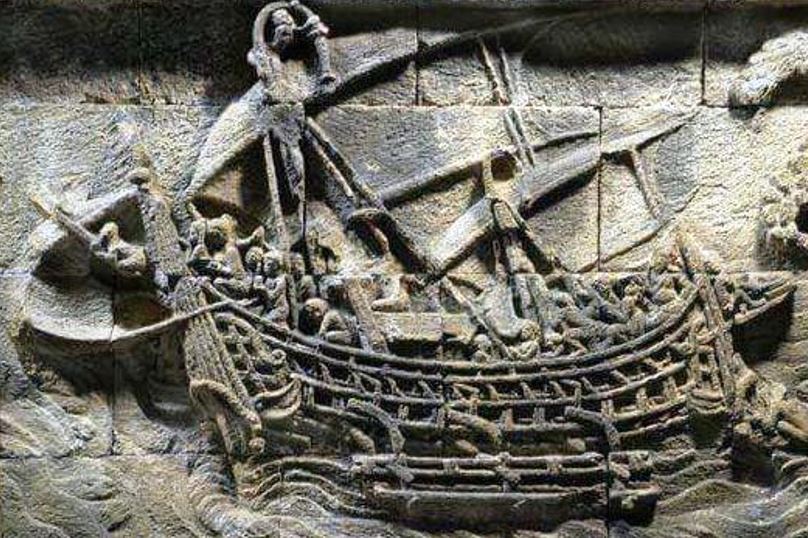
Carved in the 8th-century Buddhist temple, the Borobudur, are a total of 11 boats. These range from a simple canoe with upturned ends to several large ships with outriggers.
Five of these are bas-relief depictions of large vessels with outriggers, probably illustrating a distinct type of boat.
Unlike ships of the ancient world or modern sailing ships, the hulls of the Borobudur boats have outrigger floats supported on paired outrigger booms.
Further, the Borobudur boats are described as having tripod masts supporting tilted rectangular sails; with lateral rudders and a superstructure built up with poles, which probably were at times covered with mats – resembling the kora-kora the fighting ship of the Moluccas, encountered by early European colonizers.
Some have described the Borobudur vessels as fighting ships.
A question remains to be asked: Could Malays from the Archipelago have sailed to Madagascar on ships like the ones depicted on the Borobudur with their “towering hulls?” Probably.
Or on other vessels available at that time. We cannot as yet be certain. In 2003-2004, a replica of a Borobudur ship, the Samudra Raksa, built according to the ratios of a 19th century kora-kora, sailed across the Indian Ocean and around the Cape of Good Hope.





Leave a Reply to fernzthegreatCancel reply