
By Rashid Yusof
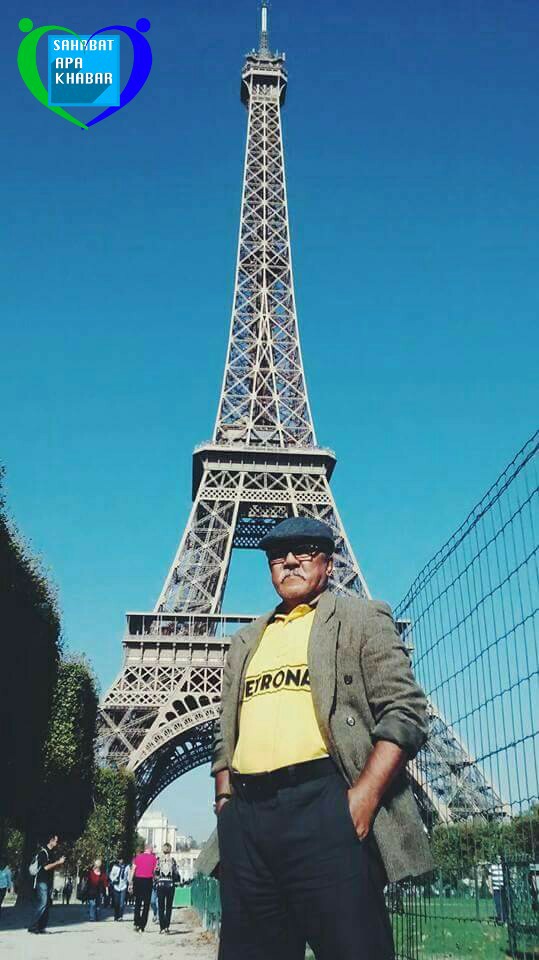
IN 1976, Asraf Dahari grabbed his football boots and set off on a journey that seemed, to his family, altogether reckless.
Had friends of his father’s not halted his ambition by the time he reached Tehran, the 20-year-old would have gone to England to attend trials with professional football clubs, sensibly, to “try my luck with their junior teams”.
He did not pause to measure the political pulse of his intended destinations. “I was not reading anything other than the Sport pages.”
Asraf arrived in Bangkok weeks before the return of exiled military strongman Field Marshall Thanom Kittikachorn had fueled a student protest that was later crushed in a bloody military takeover. India was under a 21-month emergency rule.
This story gets progressively better.
Asraf must have read about the “Hippie overland trail” to be planning this sort of adventure.
He surely met the hippies in places like Kabul.
King Zahir was deposed three years previously. Three years after Asraf was in Kabul, the Russians arrived. Malaysians condemned the invasion and boycotted the Moscow Olympics of 1980. Our football team had qualified for the Olympics having beaten South Korea 2-1 in a nail-biting qualifying match.
Asraf was not fussing about geopolitics. He just wanted to announce himself in the UK, and to do so with aplomb. It is certainly time to commit to print his experience.
Asraf was, to highlight his sense of timing, in Pakistan en-route to Kabul just when Presidents Zulkifar Ali Bhutto and Mohamed Daoud Khan (of Afghanistan) were exchanging state visits.
Considering that Iran, too, was three years before the Revolution and the return of Ayatollah Khomeini, Asraf did not quite realise he was inspecting future war zones and major faultlines. And, he did not take pictures.
Pak Dahari Ali
Not recording the moments for posterity, did trouble Asraf later. He has, since, also spoken about the travails he had brought upon his father.
This writer has been trying to convince him these two regrets have been cancelled out by events he had a hand in shaping.
Nine years after Kabul, Peshawar and all that, his picture won a Malaysian Press Institute’s award. It was something his father, Dahari Ali, the famed journalist-politician must have cherished.
For impact, this story would have “Pak Dahari” introducing himself to present-day readers with a great quote.
This is a reenactment of a father-son conversation, at the end of the son’s truncated journey.
It was true that it had been a frightful experience for Pak Dahari as he sought to track his son’s movement, at times along treacherous routes.
The son had informed Pak Dahari he was going to Penang!
Executing the Escapade
There were two others with him in this expedition, his friends Eddie and Ismail. Asraf planned the escapade.
“We took the train from Penang to Bangkok. That was August 1976.”
The idea was to hitch a ride with a cargo plane to New Delhi. Someone advised Asraf and friends against attempting this. It would have been too dangerous. They bought Thai Airways tickets instead, at student’s rate.
Delhi is pretty warm in August these days, but not as Asraf remembers it 41 years ago. He arrived in a T-shirt and had to quickly get himself a leather jacket. He acquired a pair of boots too, to go with his bootcut jeans.
This does sound jarring, now. It is true that there were buses taking passengers to Europe from Delhi, to and fro.
“We went to the transit point but found the fare too expensive.” The alternative was to travel by bus to Peshawar.
It was in Delhi that Asraf decided to call home. His craziest moment ever was discovered by Pak Dahari, the journalist. He had merely directed a few questions at his son’s best friend at school, Mohsin Abdullah who, later, yes, went into journalism.
There was hardly time for a conversation, let alone a cross-examination, when he called home. It was a urgent request for money, to be delivered via telegraphic transfer.
With the cash injection, an emboldened Asraf Dahari mapped the next leg of his overland conquest.
As it happens, Tan Sri Hamzah Abu Samah arrived in the Indian capital a day or two after Asraf left Delhi. The then Cabinet Minister was attending a conference. His other mission, at the request of Pak Dahari, was to put this excitable young man on the very next flight back to KL.
This task fell to another personality, Yusof Rawa of Pas who was serving as Malaysian Ambassador to Iran. Pas was then a member of the Barisan Nasional. Dahari Ali, too, was in politics for a spell, winning the parliamentary seat of Kuala Selangor in 1959. He served for a single term before returning to journalism. Crucially for Asraf in this instance, Yusof and Dahari belonged to the Rawa clan.
Passing the Khyber-Test
Hamzah Abu Samah and Yusof Rawa were not the only ones tracking down Asraf Dahari. Asraf’s brother and brother-in-law went looking for him in Penang. By then Asraf thought he was a million miles away from Rawa-land.
He was on a bus to Peshawar via Islamabad and Lahore. Other than the excessive checks imposed by the Pakistani officers at the border checkpoint, Asraf did not remember anything spectacular from the Delhi-Peshawar leg. The next phase, the 225km bus ride from Peshawar to Kabul left him pretty shaken. “I read the other day the Khyber Pass has been closed. A permit is required.”
That journey seemed to go on forever. The bus company kindly provided spittoon. And, it was being passed around. “The journey threw out all kinds of unfamiliar noises.” It was a multi-national variety of vomitting and dealing with extreme nausea. Asraf must have stayed strong for he was describing the endless depth of the gorges and the meandering narrow road.
The Khyber-test was followed by a scene he lived to tell his grandkid (one so far). Afghanistan was peaceful. But, the bus passengers witnessed a gunfight. Men on horseback duly ignored the bus as irrelevant to their cause.
Kabul wasn’t the most prosperous location then. But, the well-heeled gentlemen were smartly dressed. Getting intoxicated on “Afghan coke” was not an unfamiliar occurrence. There were also Westerners on prolonged stays.
Asraf was not planning to write a book-length manuscript, so he journeyed on. On reaching the Iranian border, he was treated to, after a long while, a train ride to Iran.
In Tehran he had to get his passport stamped. Malaysians in the Iranian capital are required to report their arrival to the Embassy. That was when the High Commissioner Yusof Rawa intervened.
“He spoke to me in Rawa, asking to screen my passport for the number of places I had been to.”
Asraf was ordered to stay at the High Commissioner’s residence for a week. The High Commissioner held his passport. His two friends journeyed on, up to Austria. Two officers of the Embassy escorted him to his seat. The flight took him back to KL.
On arrival, Pak Dahari offered encouraging words. “I salute you.”
Leicester City
With his football career halted, Asraf had to figure out his future. Arrangements were made for him to go to Leicester Polytechnic. He was there during the 1977-80 period.
Upon his return, Asraf took up photography in a career that saw him serving a number of publications. An unexpected high-point came when Leicester City won the English Premier League title in the 2015/16 season. Asraf was the lone voice celebrating. The victory elicited memories of his 1976 mission, filling up the long hours of our own trips to Perak, reporting for a magazine.
Note: This article was published on Apakhabar TV FB page in 2017. It is uploaded here in conjunction with the World Cup 2022 fever.



Leave a Reply