
By Vincent D’Silva
KULAI: For many children, the classroom is a place of discovery — where letters become words, numbers become meaning, and dreams slowly begin to take shape.
But for dozens of pupils across the Kulai district, the blackboard had long appeared blurred and distant, turning simple lessons into daily struggles hidden behind silent smiles and quiet perseverance.
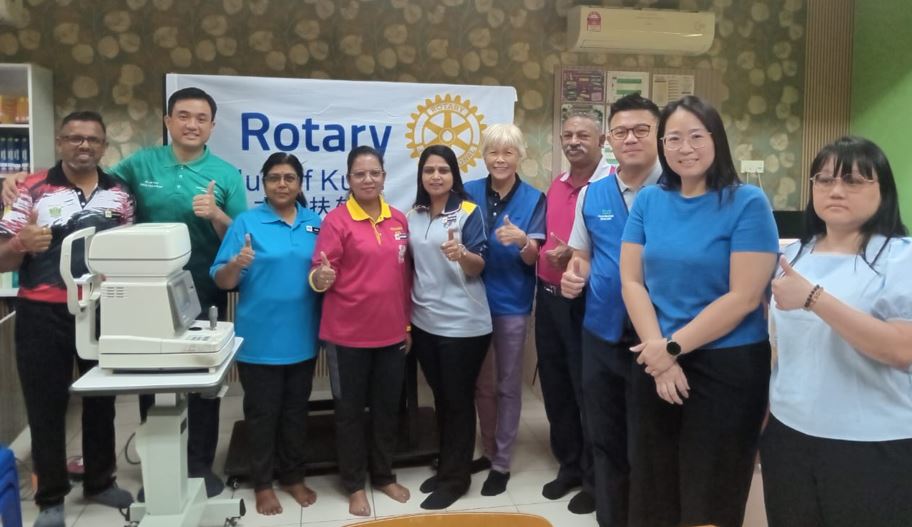
On a heartfelt mission to bring clarity back into young lives, the Rotary Club of Kulai stepped forward to provide free spectacles to 74 underprivileged students after a district-wide eye screening programme uncovered alarming vision problems among schoolchildren.

The initiative, which screened more than 214 pupils from six primary schools in Kulai, revealed that nearly 34 per cent of the students were suffering from vision-related issues that could potentially affect their academic performance, confidence and quality of life.
For many of the children, it was the first time they realised the world was not meant to be seen through a haze.
Teachers involved in the programme shared that some students had unknowingly spent months struggling to read classroom materials, copy notes from the board or concentrate during lessons — challenges often mistaken for poor academic ability or lack of focus.
Instead, many were simply unable to see clearly.
The screenings were carried out across several schools, including SJKC Air Bemban, SJKC Sedenak, SJKT Sedenak, SJKT Oil Palm, SJKC Sengkang and SJKT Kelan.
Among the schools screened, SJKT Kelan recorded the highest number of students with vision difficulties, with 33 children identified as needing eye care support out of about 70 pupils screened, including students recommended by teachers.

At SJKC Sedenak, 18 out of 50 students were found to have vision problems, while SJKT Oil Palm recorded 11 affected pupils out of 30 screened.
SJKC Air Bemban detected vision issues among 10 students from 37 screened, while SJKT Sedenak found two students needing assistance from a screening of 10 children, with one still undergoing medical treatment.
Meanwhile, SJKC Sengkang recorded one student with vision problems from 21 pupils screened.
Moved by the findings, the Rotary Club of Kulai took immediate action by sponsoring spectacles for all 74 students identified during the programme.
Club members described the initiative as more than simply distributing glasses.
“It is about restoring confidence and giving children the opportunity to learn without barriers,” said one of the organisers.
The moment many students first wore their spectacles was described as deeply emotional.

Some children broke into smiles as distant words suddenly became sharp and readable, while others quietly looked around in amazement at details they had never clearly seen before — from classroom posters to the faces of their teachers and friends.
Parents, too, expressed gratitude, especially those who could not afford regular eye examinations or prescription spectacles for their children.
For families struggling with rising living costs, the assistance lifted a heavy burden while offering renewed hope for their children’s future.
Educators noted that untreated vision problems among schoolchildren often go unnoticed, despite having a direct impact on learning, concentration and self-esteem.
They said early intervention can dramatically improve a child’s academic journey and emotional well-being.
The programme also underscored the growing importance of community-driven healthcare initiatives, particularly for children in underserved communities.
Through a simple pair of spectacles, the Rotary Club of Kulai may have done far more than improve eyesight.
For these children, the gift represented a clearer window to education, confidence and possibility — allowing them, perhaps for the very first time, to see both the classroom and their future with greater clarity.



Leave a Reply