
By Vincent D’Silva
KUALA LUMPUR: A community library given a new lease of life, the voices of elderly residents preserved for another generation, and an invitation to look beyond the labels that divide people — these were among the efforts that carried Raffles University students to national recognition.
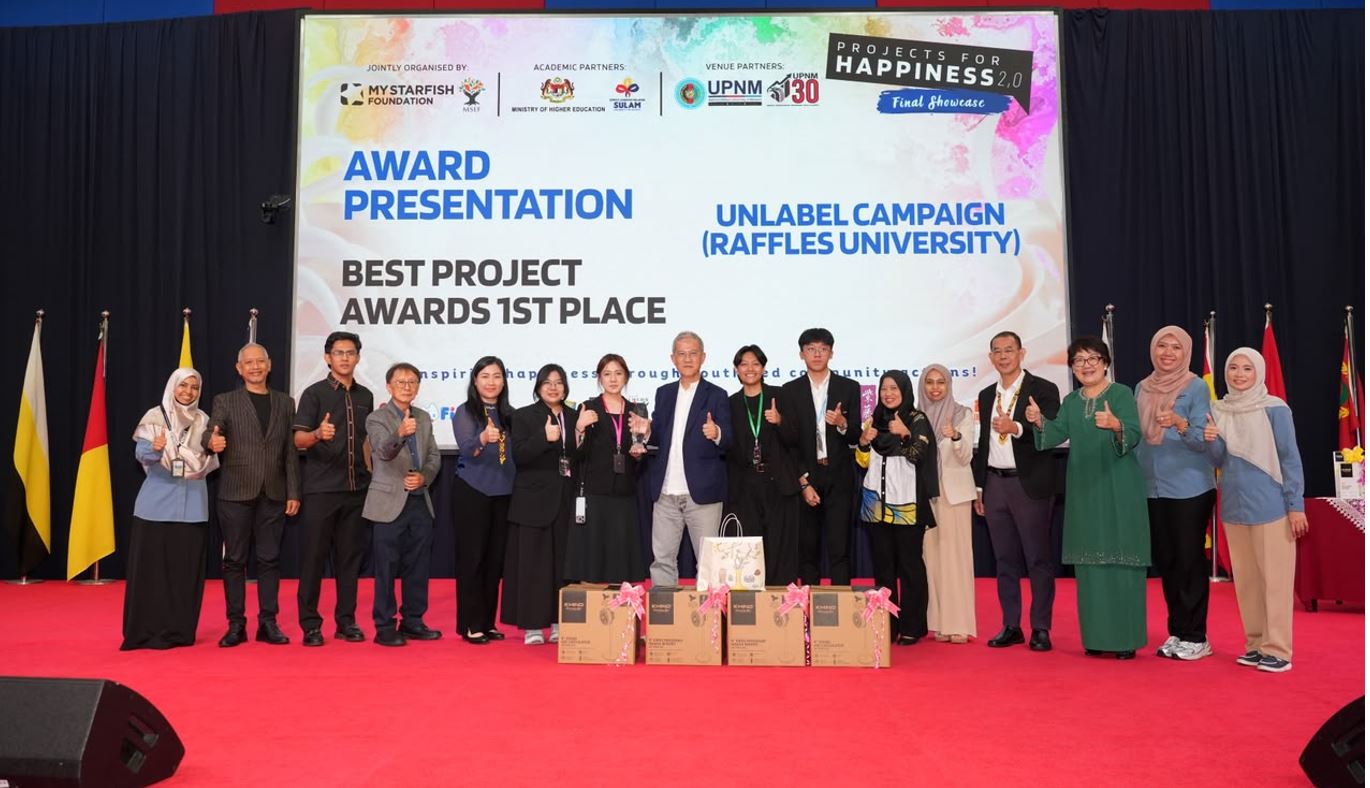
Turning classroom knowledge into projects rooted in the lives of others, the students helped the university emerge as the biggest winner at the My Starfish Foundation – Projects for Happiness 2.0 Final Showcase on Nov 14.
Held at Universiti Pertahanan Nasional Malaysia (UPNM), the showcase brought together initiatives from public and private universities across the country. Against a field of 211 projects, Raffles University secured three major awards across different categories.

Behind the honours were efforts to address quieter needs within communities: the need to belong, to be understood, to have a place to gather and to know that the stories of an earlier generation would not disappear unheard.
“This achievement reflects our students’ creativity, commitment to social responsibility and ability to translate academic knowledge into meaningful community impact,” Raffles University Assoc. Prof. Dr Alex Tan Wei Kian said.
Leading its award-winning entries was UNLABEL, which took first prize in the Best Project Award category for promoting empathy, inclusion and awareness of social stereotypes.
Bringing together Design and Psychology, the interdisciplinary initiative encouraged participants to consider how assumptions can shape the way people see and treat one another.
The project reached 301 beneficiaries, recorded 252 participant engagements and trained 49 facilitators, extending its work through people equipped to carry its message forward.

Assoc. Prof. Dr Alex said the initiative demonstrated the value of combining creative and psychological approaches to encourage a more inclusive society.
Its second major success came through THE THIRD PLACE, which secured second prize in the Best Project Award category for revitalising an underutilised community library in Senai, Johor.
Over five months, students worked alongside residents, volunteers and community partners to transform the library into a welcoming setting for reading, gathering and social interaction.
The work gave renewed purpose to a shared space. Just as significantly, the process brought people together to help shape a place they could call their own.
For a community, a library can hold more than books. It can offer room for conversation, companionship and the small encounters through which neighbours become familiar faces.
“The true impact of placemaking goes beyond transforming physical spaces; it lies in bringing people together and building stronger communities,” said Assoc. Prof. Dr Alex.
Through that collective effort, THE THIRD PLACE strengthened community relationships and nurtured a sense of ownership and belonging.

Senai’s cultural identity also found expression through (Loi Ah, Cim Ziak Hi), which won the Best Social Media Award.
Combining AI-assisted cultural tourism, interactive heritage routes and creative storytelling, the interdisciplinary project explored ways to bring local heritage to wider attention.
It documented eight cultural heritage stops, engaged 63 direct participants and reached approximately 90 to 100 people.
Collaborations with local community organisations and elected representatives helped build support for cultural preservation and community engagement. The initiative also attracted news media coverage, drawing attention to the role digital technologies can play in heritage tourism and community-based cultural development.
Alongside the three award recipients, two other Raffles University initiatives were successfully presented at the final showcase.
Among them was The Second Voice of Senai, a student-led effort to preserve the town’s cultural heritage and collective memories through the voices of its older generation.
Officially launched on Oct 25, the initiative documented personal stories and life experiences through oral history recordings and digital voice archiving. It also created an interactive listening space at the Senai Community Library.
The project directly reached more than 200 community members, including elderly residents, families and local children.

At its heart was an effort to bridge generations — allowing younger people to encounter their town through the memories of those who had lived its changes.
By giving those recollections a place to be heard, the students sought to reconnect younger generations with their local identity and preserve a record of lives that form part of Senai’s shared history.
Heartventure, another student-led initiative from the Faculty of Arts & Design, also successfully presented its work at the showcase. Lecturers were involved in the project, which reflected the students’ creativity, dedication and commitment to meaningful community impact.
The Projects for Happiness initiative supports work across five key areas: helping the underprivileged, quality education, environmental protection, arts and culture, and racial harmony and animal welfare.
For Raffles University, the showcase offered recognition of what students could achieve when academic learning met a willingness to listen, collaborate and serve.
The awards marked a moment of national success. Yet the deeper significance of the students’ work rests in the communities it reached — in a library made welcoming again, an older person’s memories given a listening ear, and the possibility that someone once judged by a label might instead be met with understanding.
Long after the showcase has ended, it is in these ordinary human moments that their efforts can continue to matter: when a neighbour finds a place to belong, a young person discovers the story of home, and a voice once at risk of fading is heard again.



Leave a Reply