
By Vincent D’Silva
JOHOR BAHRU: For families already counting every ringgit and stretching every packet of rice to last another day, the approach of Deepavali can bring mixed emotions — the warmth of celebration shadowed by the quiet worry of whether there will be enough food on the table.
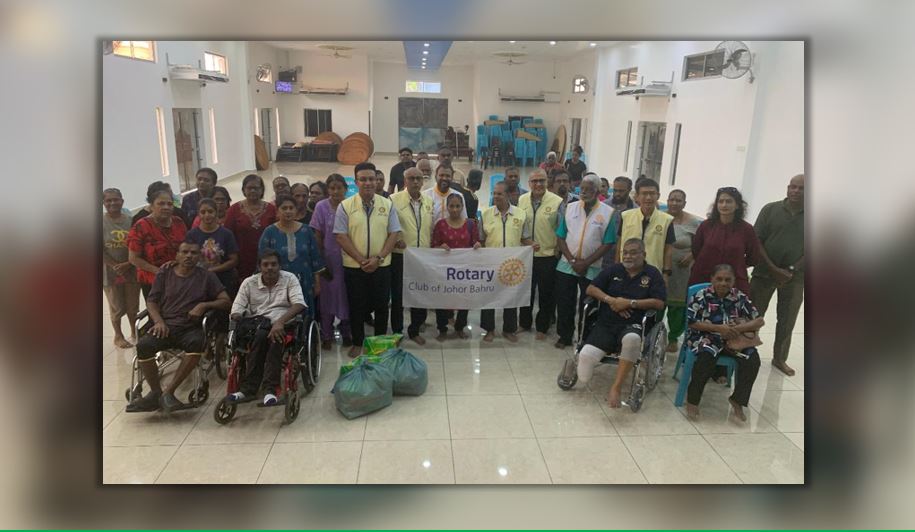
For 30 underprivileged and B40 families in Johor Bahru, however, that burden was eased when the Rotary Club of Johor Bahru (RCJB) reached out with food provisions and financial assistance ahead of the Festival of Lights next month.
The recipients, comprising mainly single mothers, families from broken homes, sole breadwinners and those struggling with unemployment, received essential household provisions including rice, cooking oil, Milo, sugar, milk and other daily necessities.

Each family was also presented with an “ang pow” as additional financial assistance to help them prepare for the coming Deepavali celebrations.
The aid was presented by RCJB president Saravanan Krishnan during a simple yet meaningful gathering at a temple in Taman Universiti.
Also present for the occasion were Rotarians from the club and invited guests.
For many of the recipients, the packages represented far more than groceries stacked neatly inside bags.
They carried the reassurance that, amid difficult circumstances, someone had remembered them.
Smiles broke across tired faces as families received the provisions, some clutching the bags closely as though holding not merely food, but a small measure of certainty for the weeks ahead.
Saravanan said the initiative reflected Rotary’s enduring commitment to reaching families who often struggle quietly beyond public attention.

“Deepavali is a celebration of light, hope and the triumph of goodness, but we must remember that not every family enters the festive season with the same sense of joy or security,” he said.
“For some, the weeks before a festival are filled not with thoughts of new clothes or decorations, but with very simple worries — whether there will be enough rice at home, whether the household bills can be paid, or whether their children can enjoy even a modest celebration.
“If what we give today can remove even one of those worries, then this programme has served its purpose.”
Saravanan said the plight of single mothers and financially vulnerable households was particularly moving, as many carried the responsibility of raising children while struggling with uncertain incomes.
“Some of these mothers are the sole breadwinners of their families. Others may have lost their jobs or depend on irregular work simply to survive from one month to the next,” he said.
“They carry responsibilities that are often invisible to the rest of us. Behind every household facing hardship is a story of sacrifice — a mother skipping something for herself so that her children can eat, or a parent wondering how to stretch a small income until the end of the month.”
He said festivals should also serve as moments for society to look beyond personal celebration and remember those living on its margins.

“With Deepavali approaching, we hope these families will be able to celebrate with a little less anxiety and a little more joy,” Saravanan said.
“A festival becomes truly meaningful when its light reaches beyond our own homes. The brightest lamp is not merely the one we place at our doorway, but the kindness we carry into another person’s life.”
He added that RCJB had been extending similar assistance to needy communities over the years as part of its continuing humanitarian and community-service efforts.
Such programmes, he said, were intended not merely to provide temporary relief but also to remind vulnerable families that they remained part of a caring community.
“We may not be able to solve every hardship they face, but we can stand beside them,” Saravanan said.
“Sometimes dignity is restored through something as simple as knowing that people care. Sometimes hope begins with a bag of groceries, a helping hand and the knowledge that one has not been forgotten.”

The atmosphere during the presentation was warm and understated, without ceremony overshadowing the purpose of the occasion.
For the recipients, especially those whose household budgets leave little room for festive expenses, the assistance came at an especially meaningful time.
Deepavali traditionally symbolises the victory of light over darkness and hope over despair.
For these 30 families, that symbolism took on a deeply personal meaning.
There may still be bills waiting to be paid, jobs yet to be found and difficult days ahead. But for one mid-morning in Taman Universiti, kindness entered quietly through the temple doors — carried in bags of rice and groceries, tucked inside an ang pow, and offered with the simple message that no family should have to face hardship entirely alone.
And as Deepavali draws nearer, perhaps that is where the truest light of the festival begins — not in rows of glowing lamps, but in one human heart choosing to brighten another.


Leave a Reply