
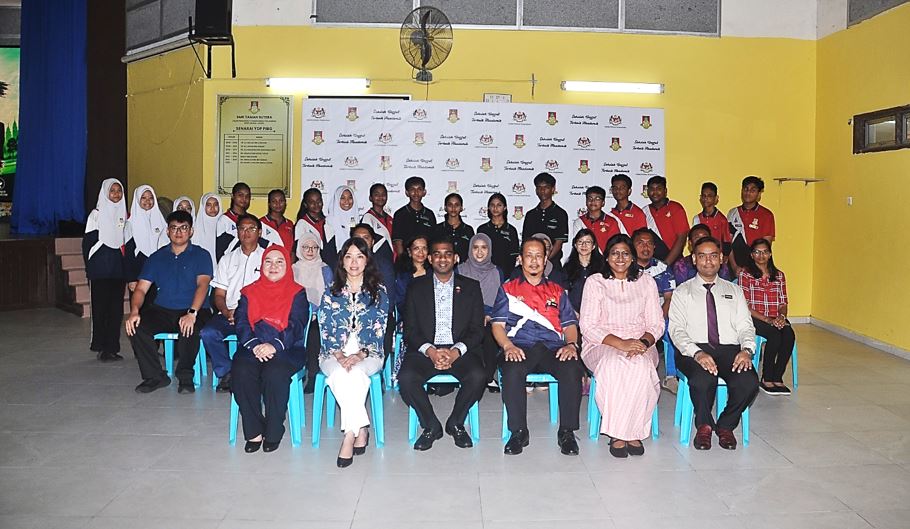
By Vincent D’Silva
JOHOR BAHRU: It began not in a gleaming laboratory, but beside the drains and kitchens of a neighbourhood food court — where used oil, grease and wastewater told a quiet story of an environmental problem waiting to be solved.
For a group of students from SMK Taman Sutera, that problem became a question.
The question became an experiment. And the experiment has now grown into ALGENIUS, an ambitious environmental innovation blending natural fibres, solar energy, sensor technology and the Internet of Things (IoT).
Developed under the Toyota Eco Youth (TEY) 2026 programme, ALGENIUS represents the school’s attempt to turn everyday waste into practical solutions for cleaner drains and a greener future.

SMK Taman Sutera’s ALGENIUS Sutera team is among the schools shortlisted for this year’s national programme.
Toyota Eco Youth, a collaboration between UMW Toyota Motor and the Ministry of Education, encourages secondary school students to tackle environmental problems in their communities through a structured problem-solving approach.
At the heart of the students’ work is a Smart Grease Trap, designed to intercept fats, oils and grease before they enter the drainage system.
But this is no ordinary grease trap.
The system incorporates agricultural waste such as sugarcane bagasse and coconut fibre as natural oil-absorbing materials, while sensors monitor grease or oil levels. An ESP32-based system processes the data and sends notifications when levels become high, reducing the need for constant manual inspection.
A solar panel supplies power to the monitoring system, marrying environmental protection with renewable-energy thinking.
Project supervising teacher Thipanraj Katigasu said ALGENIUS was born after students were encouraged to investigate an actual community concern instead of being handed a ready-made problem and solution.

“I did not want to simply give my students the problem and the answer. I wanted them to go out themselves, observe the problem, ask questions and find solutions,” he said.
The team visited Shun Bang Medan Selera, conducting observations and interviews and examining how cooking oil and grease were managed.
From those investigations came a widening circle of ideas.
Students explored bagasse and coconut fibre as natural absorbents, tested water quality and Biochemical Oxygen Demand (BOD), investigated grease-trap performance and developed the smart monitoring system.
Their experiments with natural fibres have also expanded into what they call BioSorb-AI, which uses test data and fibre-condition monitoring to assess absorbent performance and help determine when materials should be replaced.
Yet ALGENIUS did not stop at wastewater.
Used cooking oil collected through the project has been given a second life through soap-making activities, including programmes involving other schools. Students have also ventured into ink production and participated in EM Mudball activities aimed at environmental education and improving awareness of water-resource protection.
For Thipanraj, these activities allow young people to see science not merely as something written in textbooks, but as something capable of changing the world immediately around them.

“We want the students to experience the complete journey: from a problem to an idea, from an idea to research, from research to a product, from a product to the market, and from the market to creating an impact on society,” he said.
One important milestone came when Sunrise Bayumas Sdn Bhd purchased three sets of the project for installation at food premises, giving students the experience of seeing their school-based innovation move towards real-world application.
“That demonstrated to the students that what they had built in school was no longer merely a prototype for competitions, but something with real users,” Thipanraj said.
The project is now looking beyond experimentation towards entrepreneurship, with plans to establish a school-based company centred on ALGENIUS and to seek industry collaboration for larger-scale production and further refinement of its products.
SMK Taman Sutera principal Heriyan Jumadi in his speech said the project’s strength lay in how it had grown from one environmental concern into a broader ecosystem of research, technology, education and community participation.
He said students had not only developed the Smart Grease Trap using natural absorbent materials, but had also integrated IoT technology for monitoring while participating in used cooking oil management, water-quality testing and environmental awareness activities.
The school, he added, had benefited from cooperation involving Toyota Eco Youth, the Department of Environment, Iskandar Puteri City Council, Indah Water Konsortium, Universiti Teknologi Malaysia, Yayasan Penyayang Iskandar Puteri, Sunrise Bayumas Sdn Bhd and Shun Bang Food Court.

The journey is also taking physical shape with the launch of the ALGENIUS Greenovation Garage, envisioned as a permanent space where future students can experiment, recycle, research and develop sustainability projects long after the current competition has ended.
“This project must not come to an end after the competition,” Heriyan said, expressing hope that ALGENIUS would continue benefiting both the school and surrounding community.
Johor State Education and Information Committee deputy chairman Rugendran Vellayan, praised the students for seeing possibilities where others might simply see waste.
He noted that used cooking oil, coconut fibre and sugarcane bagasse had been transformed into resources, while solar energy, sensors and IoT technology had been brought together to produce a practical environmental solution.
“They did not merely identify the problem, but had the courage to build the solution,” he said.
His message to the young innovators was to carry the work beyond the school gates — from their community to Johor and, potentially, across Malaysia.
For the students of ALGENIUS, perhaps that is the project’s most enduring lesson.

A grease-stained drain became their classroom. Agricultural waste became their raw material. Technology became their tool.
And somewhere between the bagasse, circuitry, water samples and youthful determination, they discovered that innovation need not begin with something grand.
Sometimes it begins with simply noticing a problem everyone else has learned to walk past.
From one problem came an idea. From one idea came a solution. And from that solution, a group of students is learning how small acts of invention can help build a cleaner tomorrow.


Leave a Reply