
By Vincent D’Silva
JOHOR BAHRU: In the soft hum of a working hotel — where footsteps echo down corridors, front desks glow through the night, and first impressions are made in seconds — words matter.
They matter not just for transactions, but for trust. And for Charanita Gill, a hotel general manager who has spent years listening to guests from near and far, the ability to communicate in English is no longer optional in hospitality — it is essential.
Speaking candidly about recruitment challenges in the industry, Charanita said she has seen a growing gap between impressive résumés and real-world communication skills.

“Many candidates come with excellent academic records,” she said. “But when it comes to interviews, they struggle to communicate. Some immediately ask if they can speak in Bahasa Malaysia.”
While she stressed that Bahasa Malaysia is always respected and welcomed, Charanita believes basic English competence must be non-negotiable in hotels that serve an international clientele.
“We allow it, of course,” she explained, “but at the very least, they must be able to communicate in simple, basic English — with guests and even with their own colleagues.”
Her concern is not rooted in elitism or exclusion, but in realism. Malaysia’s hotels today host travellers from across Asia, Europe, the Middle East and beyond. English, she said, remains the common bridge language — the one that carries requests, resolves misunderstandings, and shapes how a guest remembers their stay.
“These candidates have completed Form Five, many have their SPM, which means at least 11 years of schooling,” she said firmly. “So they should have mastered the English language at a basic level. There really should be no excuse.”
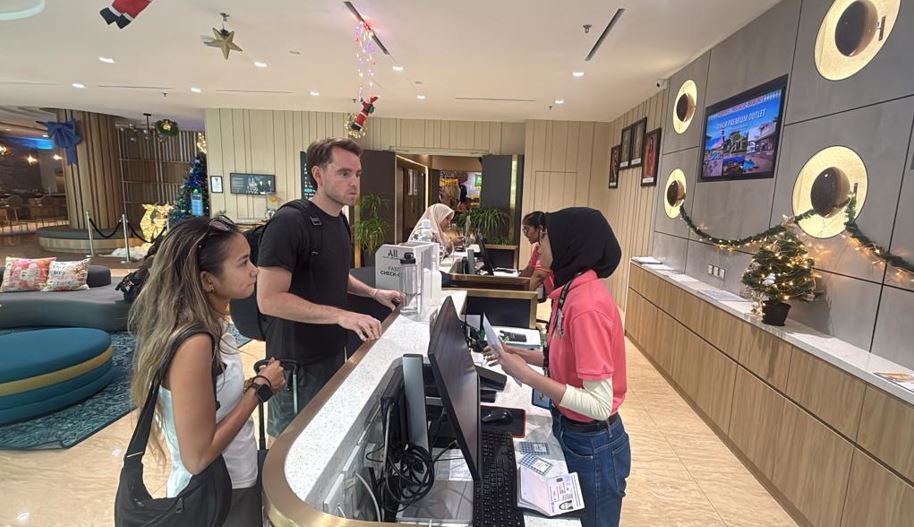
Charanita’s words are shaped by experience — by moments at the front desk when confusion replaces comfort. She has seen guests grow visibly uneasy when hotel staff struggle to understand simple requests or explain services clearly.
“Sometimes guests are not happy,” she said. “Not because the staff are unkind — they are trying very hard — but because communication breaks down. And when that happens, it reflects badly on the hotel.”
In hospitality, she added, perception is everything. A warm smile can open a door, but language keeps it open.
“If you cannot communicate with guests in English, it doesn’t look good for the hotel,” she said. “It creates a less favourable impression, and guests may decide not to return.”

Across the industry, many hotel employees are non-native English speakers, and that reality brings predictable challenges.
Common mistakes — missing articles or subjects, verb tense confusion, or phrases like “married with” instead of “married to” — can seem small, but they can cause real misunderstandings.
Accents, too, sometimes create barriers, especially for first-time visitors unfamiliar with local speech patterns.
Yet Charanita is quick to defend frontline workers. “They are polite, they try to speak clearly, they use simple sentences and the right tone,” she said. “Their intentions are always good.”
The problem, she noted, lies not in effort, but in preparation. Many staff members have never received proper English-for-Hospitality training — the kind that prepares them for complaints, emergencies, cultural sensitivities, or emotionally charged situations.
“General English is not enough,” she said. “Hospitality English is different. You need the right words, the right confidence, and the right understanding of guest expectations.”
Without that training, staff often retreat into overly simple language, avoiding complex explanations and hoping gestures will fill the gaps. While technology — such as translation apps — can help bridge moments of confusion, Charanita cautioned against relying on them entirely.
“Apps are helpful, but they cannot replace human connection,” she said. “A guest wants to feel heard, not processed.”
She also called on guests to play their part. Patience, she believes, goes a long way. Speaking slowly, using simple phrases, and recognising the effort being made can transform an awkward exchange into a shared human moment.
Still, the responsibility, she stressed, lies primarily with employers.
“Hotels must invest in communication skills training,” Charanita said. “When staff feel confident speaking English, service quality improves, stress levels drop, and everyone benefits — staff and guests alike.”

In her view, these so-called “mistaken English moments” should not be a source of embarrassment, but a call to action. With proper training, encouragement and practice, they can become stepping stones rather than stumbling blocks.
“At the heart of hospitality is connection,” she said softly. “And connection begins with being able to speak, listen, and understand one another.”
In a world where travel is increasingly global and competition increasingly fierce, Charanita’s message is clear: English is not about perfection — it is about possibility. The possibility of welcome, of return visits, and of turning a stay into a story worth remembering.




Leave a Reply