
By Vincent D’Silva
JOHOR BAHRU: Malaysia stands at a pivotal moment in its political journey, and as the next general election looms just two years away, civil society leader Thomas Fann has called on Malaysians to reflect deeply on what truly constitutes “a good and effective government.”
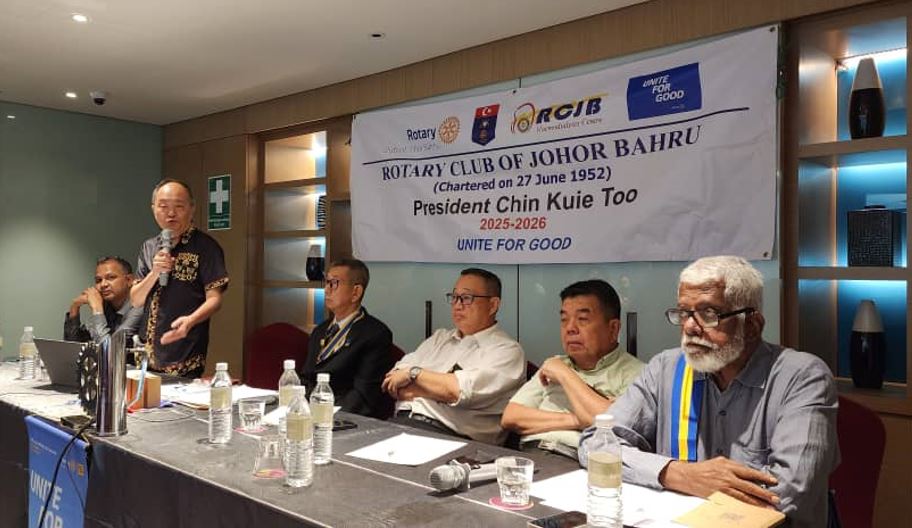
Delivering a forthright and historically grounded lecture to a packed hall of Rotarians and invited guests at the Rotary Club of Johor Bahru (RCJB) weekly meeting at Amari Hotel, the former Bersih chairperson traced the nation’s political arc — from six uninterrupted decades of UMNO-Barisan Nasional rule to the sweeping political upheavals that continue to redefine its democratic landscape.
“Malaysia lived under a hegemonic one-party system for almost 60 years,” Fann reminded the audience. “For decades, nobody imagined that would change.”

What triggered the shift, he stressed, was not elite manoeuvring but public outrage during the Najib Razak administration.
“Corruption was always there — but never so blatant, so vulgar, so in-your-face. A RM120 million pink diamond, a superyacht… it became too much for Malaysians to stomach,” he said, recalling the national anger that fuelled the Bersih movement.
He described Bersih’s mass rallies as one of the purest expressions of Malaysian civil consciousness.
“All we did was set the date, time, and place,” he said modestly. “It was a people’s movement from the ground up.”
The massive mobilisation contributed to the historic 2018 general election, which saw Malaysians deliver an outcome even Bersih organizers had once considered unimaginable.
Not mincing his words, he said,“We knew how skewed the electoral boundaries were. It would take a miracle to overcome that manipulation — and yet a miracle did happen.”
But that miracle was short-lived. The Sheraton Move in 2020 — a defection-driven political realignment — brought down the Pakatan Harapan government, plunging Malaysia into one of its most tumultuous political periods.
In just five years, Fann witnessed four prime ministers come and go.
“It wasn’t just COVID that hurt us — it was political instability. Confidence in Malaysia as a nation was shaken.”
For the first time publicly, Fann also revealed why Bersih did not mobilise a major protest against the Sheraton Move.

“Had we protested, it would have been framed as non-Malays against Malays. I would not be the Bersih chairperson who divides Malaysians. Bersih was always about unity,” he said firmly.
Instead, Bersih pushed relentlessly for an institutional safeguard — the anti-hopping law.
“No political leader supported it initially — not a single one. Because they all benefited from frogs.”
It was sustained public pressure, amplified by the media, that eventually compelled Parliament to act. The anti-hopping amendments came into force just days before GE15, helping pave the way for Malaysia’s first genuine coalition government.
Fann went on to outline the forces he believes will shape GE16: identity anxieties, economic pressures and regional dynamics — all of which politicians have learned to weaponise.
“These fears are genuine, real or not. And politicians exploit them,” he stressed.
Citing GE15 data, he highlighted the overwhelming swing of Malay voters towards Perikatan Nasional (54–57%), compared with UMNO (30–32%) and Pakatan Harapan (11–13%).
“This explains why the government feels compelled to pander,” he said. “The Malay-Muslim vote is the decisive battlefield.”
He also pointed to the growing political clout of Sabah and Sarawak, especially around MA63 commitments.
“Their demands are louder than ever. And no party can form government without them,” he asserted.
He cautioned that some voices in East Malaysia are now openly questioning their place in the federation.
“That is a real concern — and none of us want to see another Singapore.”
To strengthen national cohesion, Fann proposed a structural solution: reforming the Senate to give Sabah and Sarawak meaningful representation.
“Give them 35% plus one seats in Dewan Negara. Give them a real veto — not dilute the votes of Peninsular Malaysians four-to-one. Strengthen the federation without weakening democracy.”

On the economic front, Fann warned that identity politics may overshadow performance — a trend seen in democracies around the world.
“Identity politics may override even superb economic performance. We see this globally — look at the United States.”
Still, he noted that Malaysians expect structural change, not one-off handouts.
“Changing the colour of school shoes will not fix a broken education system. Real reform takes 20 to 30 years — and consistency.”
He added that corruption, though less visible today, remains embedded in institutions.
“It’s hidden under the rug, but still there. We need strong laws and independent institutions.”
Fann also expressed deep concern about Malaysia’s brain drain.
“When people lose hope, they vote with their ballot — or with their feet. And many of our brightest have left.”
Looking ahead, he believes coalition governance is now a permanent fixture in Malaysian politics.
“We are not going back to one-party dominance. The cat is out of the bag.”
For coalition governments to work, Fann outlined several essentials: formal coalition agreements, devolution of powers, boundary reform, political financing laws, stronger parliamentary oversight and more independent institutions.
“Manifestos are meaningless today. A coalition agreement, negotiated openly, is what gives stability.”
He argued that Malaysia’s highly centralised federal system is no longer sustainable.
“Why should Putrajaya decide where a bus stop is placed in Johor Bahru? Devolve power. Let states and cities solve their problems.”
In his closing remarks, Fann issued a clear reminder that democracy is not a five-year ritual.
“Democracy is not a spectator sport. We must vote, speak up, stay informed and hold leaders accountable every day.”
His final words drew nods and applause across the room:
“I should not be an anomaly. Every Malaysian should feel responsible for this country. We — the rakyat — are the boss. Every day of the five-year term.”
As Malaysia moves steadily toward GE16, Fann’s message was unmistakable: the coming election is not simply about which party forms the next government — but about the political culture Malaysians are prepared to uphold, protect and shape for generations to come.


Leave a Reply