
By M.A.Kadir
In a decisive move to bolster Malaysia’s defense capabilities and reaffirm its commitment to national security, the Ministry of Defense (MINDEF) today sealed a comprehensive suite of procurement agreements worth RM11 billion at the Langkawi International Maritime and Aerospace Exhibition (LIMA) 2025.

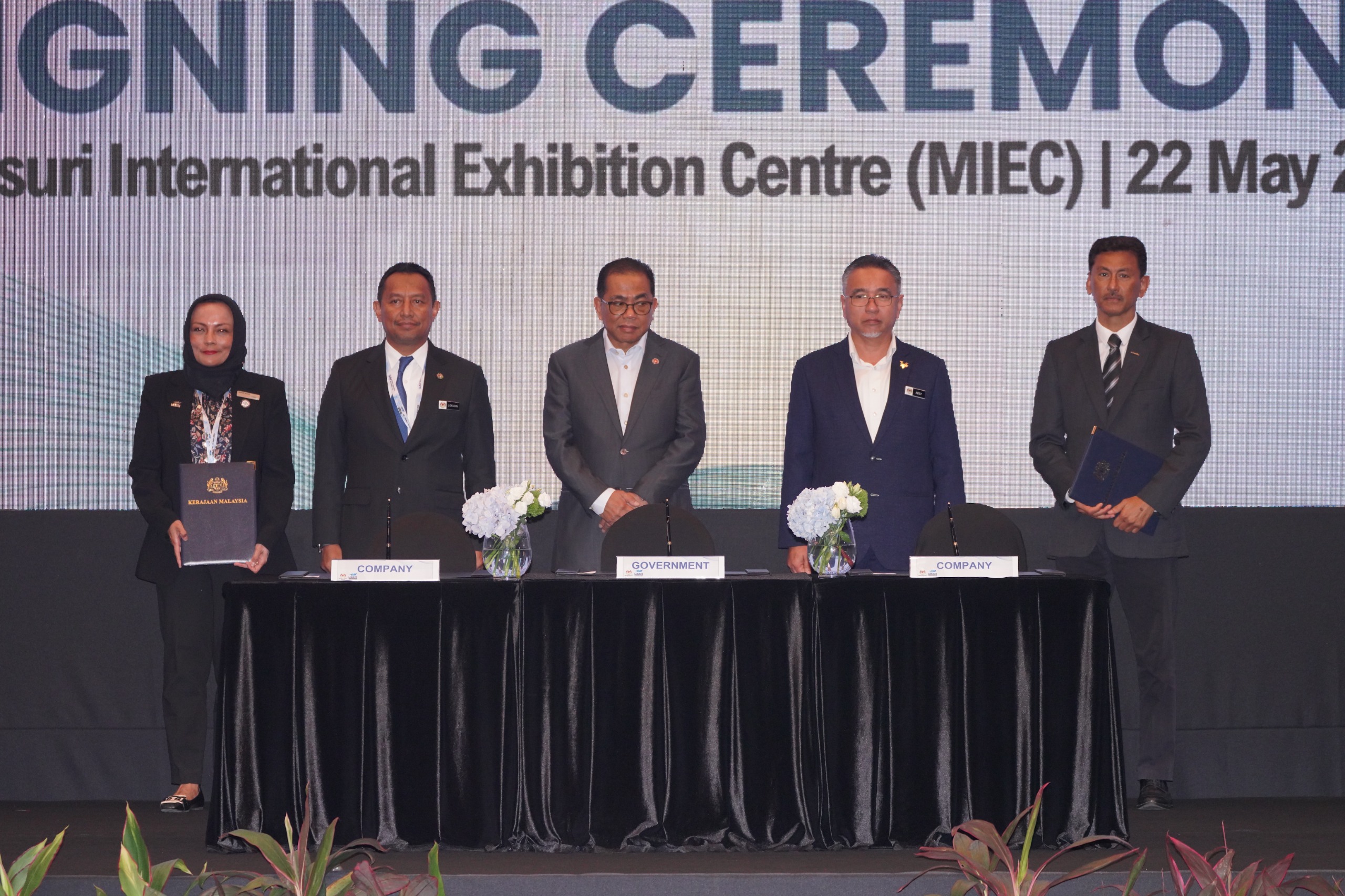
Announced during the high-profile Contract Signing and Document Handover Ceremony officiated by Defense Minister Dato’ Seri Mohamed Khaled Nordin, the deals mark a strategic leap forward in the modernization of the Malaysian Armed Forces (MAF) across land, sea, air, and cyber domains. The total value represents an uptick from the RM10.1 billion committed at LIMA 2023, underscoring the government’s resolve to enhance both hard power and technological sophistication.

The scope of the procurement is extensive. It includes 85 Letters of Acceptance (LOA) or contracts, two Letters of Intent (LOI), and six Memoranda of Understanding (MoU). Of the 85 LOAs, 40 exceed RM30 million each, totalling RM7.54 billion, while the remaining 45—each below RM30 million—amount to RM783 million.
Among the most notable deals is a RM1.88 billion LOI with local firm Mildef International Technologies Sdn Bhd for the supply of 136 Armoured Vehicles (Kenderaan Perisai Jenis A), a project that also includes the development of supporting infrastructure. Another major LOI worth RM800 million was inked with Lumut Naval Shipyard Sdn Bhd (LUNAS) to provide integrated logistics support and trial assistance for Malaysia’s Littoral Combat Ships (LCS).

In the air defense sector, two Long Range Radar (LRR) systems will be installed in Terengganu and Johor at a cost of RM277 million. Other notable acquisitions include 178 Light Anti-Tank Weapons (LATW) worth RM49 million, 18 Mortar 81mm systems (RM30 million), 12 million rounds of 5.56mm Ball ammunition (RM32 million), and Naval Strike Missile (NSM) launchers.
A significant share of the defense budget will be channelled into sustaining and upgrading existing assets. This includes RM1.02 billion for maintaining the Perdana Menteri-class submarines, RM187 million for F/A-18D fighter jet support, RM392 million for A400M aircraft spare engines, and RM378 million for EC725 helicopter maintenance.
These initiatives, supported through Industrial Collaboration Programs (ICP), reflect MINDEF’s dual focus on asset longevity and local capability development—particularly in technical knowledge transfer and joint servicing.

The contracts highlight a strong emphasis on empowering local industry players. Among the beneficiaries are BHIC Submarine Engineering Services (submarine maintenance), Weststar Aviation Services (helicopter leasing), Global Turbine Asia (engine spare parts), and AR Eastern (X-Band satellite support). Zetro Services was also tapped for replacing the air traffic management system at RMAF Butterworth.

Simultaneously, MINDEF is pursuing new frontiers in national cybersecurity and advanced telecommunications through satellite and AI-powered systems. The National Defence University of Malaysia (UPNM) signed five MoUs/NDA agreements focused on research collaboration, AI integration, technology transfer, and military certification and training.
Reinforcing the human dimension of defense, RM320 million has been allocated for the construction of a new Armed Forces Hospital at Kem Terendak, Melaka. The modern facility will replace the aging infrastructure currently in use and is expected to significantly enhance healthcare delivery for MAF personnel and their families.
The signing ceremony was attended by top military leadership, including Chief of Defense Forces General Datuk Hj Mohd Nizam Hj Jaffar, Army Chief General Tan Sri Dato’ Wira Muhammad Hafizuddeain Jantan, Navy Chief Admiral Datuk Dr. Zulhelmy Ithnain, and Air Force Chief General Tan Sri Dato’ Sri Mohd Asghar Khan Goriman Khan. Also present were Deputy Defense Minister Adly Zahari and Defense Secretary-General Datuk Lokman Hakim Ali.

In his closing remarks, Minister Khaled Nordin reiterated the government’s strategic focus on enhancing national security, growing the domestic defense ecosystem, and fostering long-term technological innovation. “These investments not only equip our Armed Forces for current challenges but also position Malaysia for future readiness—both militarily and industrially,” he said.
As LIMA 2025 unfolds, it stands as a testament to Malaysia’s evolving defense ambitions: a blend of military preparedness, industrial resilience, and forward-looking innovation.




Leave a Reply