
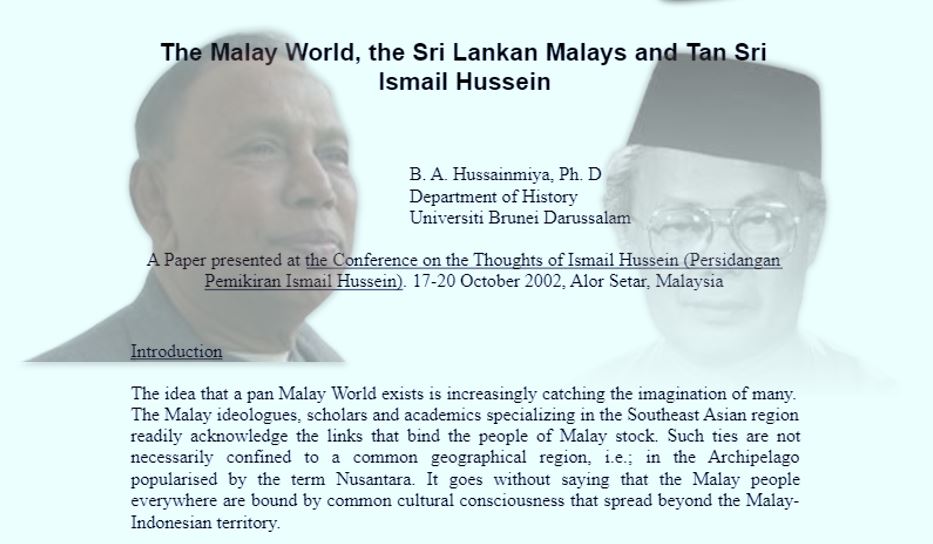

In 2012, Sri Lankan Malay scholar, Dr. B.A. Hussainmiya, then with the Department of History, Universiti Brunei Darussalam, brought our attention to the idea on the existence of a pan Malay world , that it “is increasingly catching the imagination of many.”
This can be seen in “Malay ideologues, scholars and academics specializing in the Southeast Asian region (who) readily acknowledge the links that bind the people of the Malay stock.” He makes these observations with reference to the late Professor Ismail Hussein’s ideals and vision.
Hussainmiya remarks that in the recent past, “no one has contributed so much in strengthening a world Malay identity as Tan Sri Professor Ismail Hussein has done.” Since the 1970s, Ismail Hussein has dedicated himself to promote the cause of a common Malay brotherhood, through his writings and speeches, advocacy and activism.
Hussainmiya acknowledges that Ismail Hussein has acted “with the zeal of a missionary in injecting a common cultural consciousness among the Malays of the world.” The Kedah-born Leiden educated pendita (sage) has been a forgotten figure in the national imagination.
In his 2012 paper titled “The Malay world, The Sri Lankan Malays and Tan Sri Ismail Hussein,” Hussainmiya dedicates a section titled ‘Tan Sri and I’. He begins by recalling a meeting with “Tan Sri by chance in early 1975 when I was passing through Kuala Lumpur on a journey from Colombo to Melbourne.”
Hussainmiya was then a doctoral student attached to the Indonesian and Malay Department at Monash University, Australia. He was on a field trip to his home country in search of Malay manuscripts. Prof Cyril Skinner, the Department’s chairman, was excited “to hear of my unexpected discovery of more than hundred odd Malay manuscripts.”
Hussainmiya’s meeting with Ismail Hussein at University Malaya that year was due to the introduction by the late Prof Dato’ Shahril Talib in the Arts Faculty senior common room.
He explained to “Tan Sri and showed my hand list of Malay manuscripts, he almost hit the ceiling.” Ismail Hussein had earlier known about the Sri Lankan Malay people, “but he would not know that they have inherited a Malay literary culture of (a) classical kind,…” Ismail Hussein then immediately photocopied the hand list of manuscripts and requested Hussainmiya to give a seminar to his students in the Malay Studies department.
The news media, RTM and the newspapers were also contacted to publicise the discoveries, perhaps for “the entire Malay world to be aware of the cultural achievements of the Sri Lankan Malays.” That was the beginning of the relationship between Hussainmiya and the professor. Since then, Ismail Hussein maintained sustained interest in the community in keeping with “his principles of uniting the Malay world.”
Hussainmiya tells of his regular correspondence and exchanging of views on Malay affairs and “especially on literature.” It seems that Ismail Hussein was “truly stunned” to see the wide variety of the literary and religious texts in his possession. Beginning from 1980, Hussainmiya was invited to address several Malay literature symposiums, and held regular meetings in Malaysia. Then many began to take notice of both their efforts in publicize the culture of the Sri Lankan Malay community.
In November of 1982, Hussainmiya was invited to attend the First Malay World Synposium in Melaka. During the opening ceremony, Ismail Hussein arranged him to go on stage to present a Sri Lankan Jawi Malay manuscript to the then Prime Minister Mahathir Mohamad.
That hit the headlines and was a front-page story in the Malaysian newspapers. The subsequent conference was in Sri Lanka. Ismail Hussein visited Sri Lanka on several occasions beginning from the early 1980s to meet Malay groups there. He was well received by Malay social and family organizations. One finds families like the Saldins, Drahmans, and Lyes.
According to Hussainmiya, the pendita’s Sri Lanka visits between 1982 and 1985 was also at “a high point in my public career.”
At that time, Hussainmiya was the president of the National Council of the Young Men’s Muslim Association from 1981 to 1984, and the president of the Federation of Muslim Youth of Sri Lanka, an umbrella organization of Sri Lankan Muslim Youth , from 1983 to 1985.
He therefore was in such a position to maintain close relations with some Sri Lankan leaders. The occasion of the Second Malay World Symposium was also facilitated by the newly established umbrella organization called Sri Lanka Malay Confederation (SLAMAC) – instrumental in handling logistics and publicity as well as generating a consensus among the major leaders of the community.
Hussainmiya also acknowledges the role of the oldest Malay association in the country, the All Ceylon Malay Association, and the Malay Cricket Club. Moor associations were also supportive in the channeling of funds.
The Second Malay World Symposium in August 1985 was officiated by Sri Lankan President J.R. Jayawerdana. The Speaker of the Sri Lankan Parliament was chief guest on final day of the main symposium, to mark the end of the proceedings.
According to Hussainmiya, this was when Ismail Hussein was honored by the award of the title Pendeta. This was unanimously decided by the island-wide Malay representatives who wanted to show their appreciation “for the recognition he had brought upon on the Malay community of Sri Lanka.”
In conjunction with the Symposium, a cultural show cum reception was organized at the Padang, the home of the Malay Cricket Club. Delegates from Malaysia were moved that the Sri Lankan Malays “were still performing items belonging to the yesteryears of Indonesian and Malay theater entertainment of the period of P. Ramlee and before!”
Hussainmiya describes the Symposium as a ‘grand success’ resulting in reviving a national cultural pride among the Sri Lankan Malays. Subsequently, Ismail Hussein facilitated the movement of Hussainmiya from Peradeniya University to Univerisiti Kebangsaan Malaysia (UKM) for his sabbatical.
There Professor Wan Hashim Wan Teh, now the president of the World Malay-Polynesian Organization (WMPO) encouraged the publication of his doctoral thesis on the Ceylon Malay Regiment.
Hussainmiya spent nearly 16 months in 1985/86 attached to then IBBKM (the Institute of Malay Culture, Language and Literature) at UKM. The Institute has been reorganized as the Institute of Malay World Civilization (ATMA). In Bangi, he was also able to publish a monograph titled The Lost Cousins: The Malays of Sri Lanka.
It was noted that the 1985 Symposium created a new wave of cultural consciousness among the Sri Lankan Malays. It was an ‘epoch-making event’ according to Hussainmiya.
The hype in organizing the symposium gave birth to SLAMAC, also known as KORAMEL (Konfederasi Rakyat Melayu Langkapuri). Hussainmiya also notes that that the founder-editor of a Sri Lankan Malay periodical Terang has acknowledged that “The Second Symposium Dunia Melayu 1985” was “without doubt the main inspiration for the birth of the Terang.”
The periodical provided a vehicle for the dissemination of ideas of the Symposium Dunia Melayu. It carried news and views about the community.
Hussainmiya further related on other periodicals such as the Suara, the journal published by the Malay Youth League in the 1960s, and CEMRO (Ceylon Malay Research Organization) newsletters and magazines published by Al-Haj Murad Jayah in the 1960s.
In terms of other publications, the post-1985 era occupies a significant phase whereby a corpus of extensive literature on the community emerged in the our consciousness. These include two major monographs, a couple of theses, a wide variety of travel articles by Malaysian journalists, and research publications from various universities, especially UKM.
There were also efforts by Sri Lankan Malays like B.D.K. Saldin who came forward to document their findings on the community. Hussainmiya suggests a detailed bibliography be compiled on the writings on the Sri Lankan Malay community.
After all, stretching the vision of the pendita makes the Sri Lankan Malay community an integral part of the larger Malay world – an extension of the geography of the Tanah Air.

Leave a Reply