

JOHOR BAHRU: Artificial Intelligence (AI) is rapidly transforming various sectors, and education is no exception.
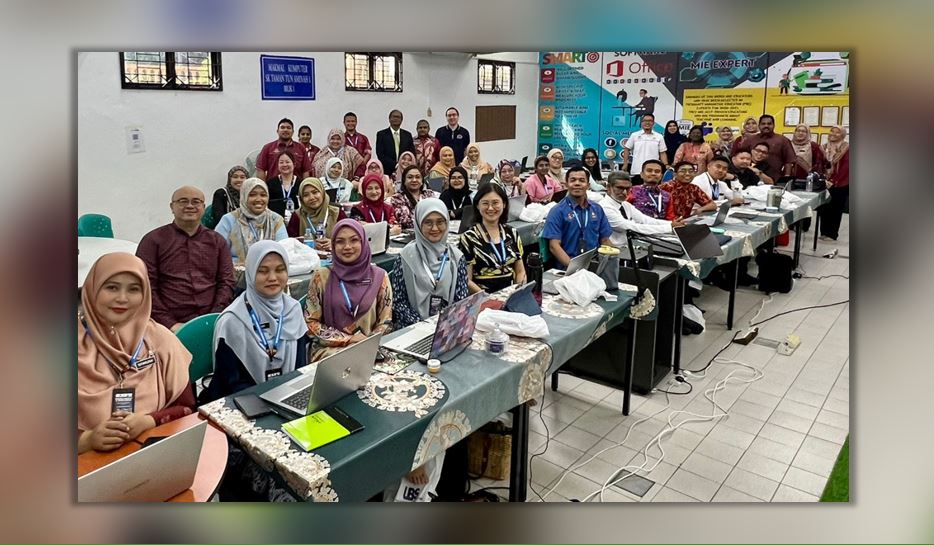
Recognizing the importance of AI in shaping the future of learning, a workshop on “AI in Education” was conducted for 30 primary school teachers held at SK Taman Tun Aminah, Skudai.

The one-day event themed “Beyond Immersive Goals (BIG) 3.0” was organized by the Johor Education Department (JPN).
It was hosted by SK Taman Tun Aminah in collaboration with Universiti Bookstore Malaysia (UBSM), Johor English Language Teaching Association (JELTA) and Raja Zarith Sofiah Foundation.

Coordinator for the programme Muhammad Hilmi Ismail told Apa Khabar TV that the Integrating Generative AI in Education under the Beyond Immersive Goals 3.0 programme is a workshop tailored to empower teachers with essential skills in using digital learning platform for them to introduce in their classroom.
“The usage of these modern technology approaches to create interactive teaching materials and activities is a way forward especially in promoting the usage of English Language in schools,” stressed Muhammad Hilmi.
He said the workshop caters the aims to increase digital literacies among the teachers through Continuous Professional Development (CPD) and promotes capacity building of the Highly Immersive Programme (HIP) coordinators in Johor.
He pointed out that the mandate by the director general of education Azman Adnan on Digital Education Policy made this workshop aligned with the Ministry of Education roadmap to equip teachers and students with digital literacies by integrating AI tools and applications in their teaching and learning sessions.
In the first presentation on the “Significant role of AI in the classroom” Keith Thong Yuet Sheng highlighted the latest advancements in EdTech through four key products: EnglishCentral, Scholastic Literacy pro, Pickatale, and Edusynch.

He explained that EnglishCentral focuses on enhancing English Language learning through interactive video lessons and speech recognition technology, offering personalized feedback to learners.
Elaborating further, he said Scholastic Literacy Pro, provides a comprehensive reading programme that assesses students’ reading levels and suggests books that match their abilities, fostering a love for reading and improving literacy skills.

Keith and his co-presenter Ivan Oon Chun Hao, both from UBSM also touched on Pickatale, an innovative platform that not only engages children with interactive books and audiobooks but also leverages AI to create personalized stories.
“This AI-driven feature allows users to generate unique books tailored to their interests and reading levels, making learning both fun and deeply customized,” he claimed.
He stressed that Edusynch is introduced as a cutting-edge assessment platform that tailors test preparation to individual needs, offering customizable practice tests and revolutionizing education by making learning more personalized, interactive, and accessible to a global audience.
In addition to EdTech, Keith and Ivan’s presentation explores the role of broadcasting and media production in education.
This section, according to Keith highlights how educational content is being delivered through various media channels, making learning more accessible and engaging.
“Products like Newsbites and BBC magazines are central to this discussion, providing high-quality educational content that keeps learners informed and inspired,” he expounded.
The presentation also introduces ilovereading, a platform designed to ignite a passion for reading among students.
“ilovereading offers a curated collection of stories and articles tailored to different age groups and reading levels, making it easier for educators to encourage consistent reading habits,” he added.

In his presentation themed “Introduction to AI for teacher productivity”, Franklin Styne Iyadurai from UBSM introduced educators to the potential of AI tools in enhancing their teaching methods and streamlining administrative tasks.
In his one-and-a half hour workshop participants gained insights into leveraging AI for creating lesson plans, assessments and quizzes.
In his session he showcased how AI could assist in generating exam questions and even aid in the grading process.
While the workshop’s duration limited extensive hands-on activities, it provided teachers with valuable ideas on incorporating AI into their daily teaching practices.
One of the key focuses of the workshop was demonstrating how AI could be used to personalize learning experiences for students.
He said AI-powered adaptive learning platforms could tailor content and pacing to individual student needs, potentially revolutionizing the way differentiated instruction is delivered in Malaysian classrooms.
He went on to address concerns about the ethical use of AI in education, emphasizing the importance of maintaining a balance between technological assistance and human touch in teaching.

“The enthusiasm and engagement demonstrated by the teachers were remarkable,” he said, adding that, many expressed their surprise at the accessibility and user-friendliness of the AI tools presented.
Several teachers shared innovative ideas on how they planned to implement these tools in their specific subject areas, ranging from language arts to mathematics and science.
This exchange of ideas fostered a collaborative atmosphere and highlighted the potential of AI to not only assist individual teachers but also to create a more connected and innovative educational community.
Speaking on the “AI Dilemma: Addressing Challenges and Ethical Issues in Education”, Associate Professor Dr. Hariharan N Krishnasamy from Universiti Utara Malaysia (UUM) said in an increasingly digital world, the rise of artificial intelligence (AI) presents both opportunities and significant challenges, particularly in the field of education.
The speaker then delved into the complexities of AI’s role in education which was explored in depth.
“AI has the potential to revolutionize teaching and learning, offering personalized educational experiences and innovative tools for both teachers and students,” he said.
He then went on to say that the integration of AI into the classroom raises critical ethical issues such as data privacy, algorithmic bias, and the potential for technology to replace human interaction in education.
Teachers at the session were encouraged to think critically about the use of AI in their classrooms.
As the teachers reflected on the implications of AI in their teaching practices, the talk served as a reminder that while AI can be a powerful tool, its application in education must be guided by ethical considerations and a commitment to fostering equitable learning environments.




Leave a Reply