
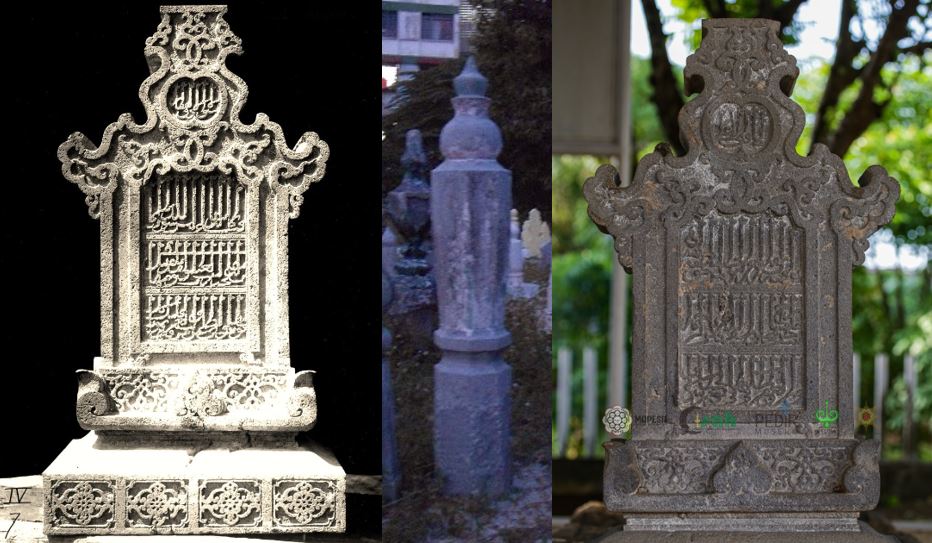

Yan in Kedah is known for its orang Aceh. This is to remind us of the fluidity of movement of peoples residing in the Malay Archipelago. It is not migration and does not carry that meaning.
They are not ‘migrants’ from Aceh, but perantaus, the natural movement of the various Malay ethnic groups from one place to another within the region.
The perantauan is happening to this day. The only difference is that the present gateway are through the airports – either Pulau Pinang or KLIA. Then, the journey crossed the Andaman sea to Pulau Pinang or by-passing the island to Yan.
But of course, Yan may or may not be related to Batu Aceh; nor can one assume that the presence of Batu Aceh is equivalent to the presence of Orang Aceh.
But the presence of Batu Aceh in Pulau Pinang, in fact, Kedah, given that Pulau Pinang is/was a Kedah island, just like Pulau Langkawi is integral to the history and historiography of Kedah-Pulau Pinang.
In a paper published in 2022, researcher Muhammad Nabil Ahmad Nadri writes on the Aceh gravesetones in Pulau Pinang. His paper titled “Batu Aceh: An Archaeological Analysis of the Muslim Gravestones in Pulau Pinang” notes the discovery of a sizeable number of Batu Aceh on the island.
Based on an archeological field survey conducted from 2016 to 2019 in Pulau Pinang, Muhammad Nabil discovered the Aceh gravestones in urban and semi-urban areas in Tanjong, in the Northeast district of the island and in the coastal and river valley zones of Seberang Perai Tengah.
These are nucleus sites for what can be termed as the study Kedah-Pulau Pinang history. The study discovered eight sites and 23 Batu Aceh artefacts on the island and Seberang Perai.
These are in Bagan Jermal (Perai) 1, Kampong Terus (Perai) 1, Datuk Keramat, Tanjong (4), Kebun Lama, Tanjong (8), Lebuh Aceh, Tanjong (5) and Bagan Dalam, Perai (4). The Batu Aceh in Pulau Pinang constitutes some 4.7 percent of the total number of Batu Aceh discovered throughout Malaysia.
Generally, almost all the sites are attached to wakaf properties, maintained by the masjid mukim administration which in turn is supervised by the Majlis Agama Islam Pulau Pinang. According to Muhammad Nabil, the largest and oldest burial area containing Batu Aceh (four units) were found at Datuk Keramat, situated at Sungai Pinang area.
The Al-Tarikh Silsilah Negeri Kedah (Muhammad Hassan, 2018) mentions that the place Datuk Keramat has existed as early as the 12th century, “as a fishing retreat for Maharaja Darbar Raja II, who would be the first sultan of Kedah.
The area has been populated ever since. It was said that between 1690s and 1710, Datuk Keramat had around 2,000 to 3,000 inhabitants. According to some accounts “ the Sultan of Kedah decided to oust them on accusation of committing piracy in the 1760s.”
Around 1790s, the area of Datuk Keramat was claimed by a certain Maharaja Setia, believed to be a descendant of Datuk Keramat. He demanded from the British that the land be returned to him as the rightful heir of his “great grandfather, the Datuk Keramat Tua.”
In the 1860s, Datuk Keramat was endowed by one of Maharaja Setia’s inheritors, by the name of Hashim Yahya Merican. There is a mosque known as Masjid Wakaf Hashim Yahya together with a vast Malay-Muslim graveyard surrounding it.
My paternal grandfather, many of his siblings, my great grandmother and other ancestors were buried there.
The area is said to be the oldest continuous Malay-Muslim settlement since earlier on. According to Muhammad Nabil, there are four Batu Aceh artefacts at Datuk Keramat. Apart from the grave of Datuk Keramat, marked by the batu Aceh, there is another batu Acheh grave.
This was said to belong to Tunku Muhammad Sa’ad, who passed away in 1847 and buried at the Perak Road cemetery.
According to Muhammad Nabil, the Batu Aceh at Bagan Jermal, Seberang Perai is the oldest Islamic artefact found in Kedah-Pulau Pinang. He describes it as a unique and rare find not only in Malaysia, but also in Indonesia.
The typology and epigraphy of the gravestone do not provide concrete information on the identity of the deceased. However, it appears that he (or she) lived around the 15th to the 16th centuries. The area was Kedah, coinciding with the kingdoms of Samudera-Pasai, and Melaka.
The style of the typology and epigraphy suggests that the deceased must be related to the royal family which ruled Kedah and perhaps Samudera-Pasai.
Muhammad Nabil finds that the similarity with the typology with the grave of the Kedah royal family members at Kota Sungai Emas may indicate a familial tie. According to the Al-Tarikh Silsilah Negeri Kedah, that area was ruled by Tunku Mansur, then the Raja Muda of Kedah.
From here we know the administration of the area at the mouth of the Perai River was delegated by the Sultan of Kedah, The Perai River is well known to be the medium of transportation of various trading commodities from the Kedah hinterland as well as from the Patani Sultanate.



Leave a Reply