
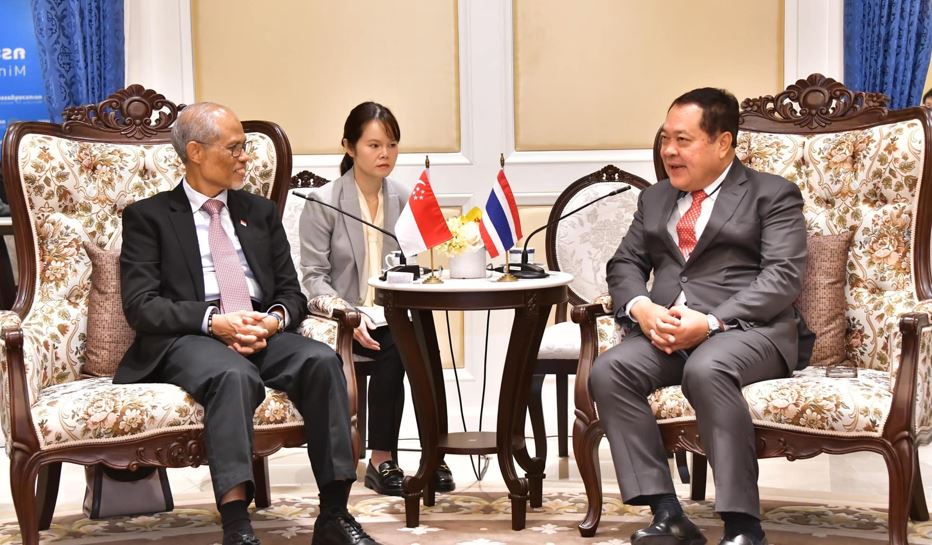

For the first time, Thailand has asked Singapore to review and recommend guidelines for resolving the issues and conflicts plaguing the three southern provinces of Thailand, known as the ‘deep south’ – Yala, Narathiwat, and Pattani, as well as four districts in Songkhla.
The request from the Chairman of the Special Commission on Education to Promote Peace in Thailand’s Southern Border Provinces, Chaturon Chaisang, was conveyed by Thailand’s Justice Minister, Pol Colonel Thawee Sodsong, to Singapore’s Minister for Social and Family Development & Second Minister for Health, and Minister-in-charge of Muslim Affairs, Masagos Zulkifli, during their recent meeting in Bangkok.
Previously, the Southern Thailand Peace Process involved only three parties: the Barisan Revolusi Nasional Melayu Patani (BRN) representing the armed groups, the Peace Dialogue Panel of the Royal Thai Government (PEDP/RTG), and Malaysia as the facilitator.
Singapore has never been invited to participate in the Southern Thailand Peace Dialogue.
According to the Southern News Center, Masagos arrived in Bangkok to attend the 14th Civil Service Exchange Program (CSEP) organized by Thailand’s Ministry of Foreign Affairs.
Thawee reportedly stated that Thailand is ready to cooperate and use Singapore’s approach as a model to resolve the issues in the three southern border provinces.
There are approximately three million residents in the three provinces, with 70 to 80 percent being Muslims.
The report further states that this is the first time there has been coordination and cooperation between Thailand and Singapore regarding conflict resolution in the three southern border provinces.
Thawee reportedly extended an invitation from Chaturon Chaisang to encourage the process of establishing peace and resolving conflicts in the three southern border provinces.
The report states that three other topics were also discussed by the two leaders in efforts to reduce conflicts:
- Building relationships with all religions;
- Connecting relationships between various government agencies, the private sector, communities, and religions; and
- Building confidence in all religious communities through regulations and laws linked to religious principles and adhering to principles of equality.
The issues of Uyghur and Rohingya refugees and the drug epidemic in Thailand, which serves as a transit point for international drug trafficking groups, were also highlighted.
The Southern Thailand Peace Dialogue Process between the Thai government and the armed groups is now in its 10th year.
The process began when Yingluck Shinawatra, then Prime Minister of Thailand, asked Malaysia to mediate in resolving the conflict in Southern Thailand.
Following this, a General Consensus between the Thai government and the BRN was signed on February 28, 2013.
Recently, the 10th Joint Technical Committee Meeting of the Joint Working Group on the Peace Dialogue Process (JWG-PDP) in the Southern Border Provinces of Thailand between the BRN and the PEDP/RTG was held in Kuala Lumpur from May 19, 2024, to May 21, 2024.
On May 30, BRN spokesperson Ustaz Khalid Abdullah explained that during the recent negotiations in Kuala Lumpur, they agreed to reduce or temporarily halt violence, even though the Joint Comprehensive Plan towards Peace (JCPP) has not yet been finalized.


Leave a Reply