
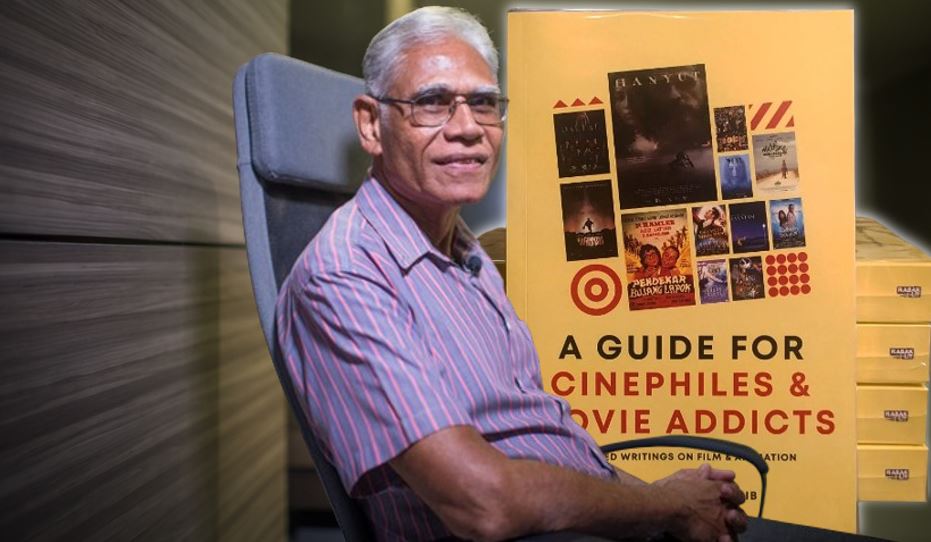

THE cinema is spiritual. Thus I began my Foreword to Hassan Abd Muthalib’s latest book A Guide to Cinephiles & Movie Addicts: Selected Writings on Film and Animation.
Hassan knows this. He speaks the language of the cinema. Rather, he is the cinema. It was utter pleasure in reading the manuscript for the Foreword. I have known, rather heard of Hassan before I met him.
He is a master storyteller, ever conscious of the story, both as subject and object. He moves seamlessly on the cinematic canvas – that ‘three-dimensional’ discourse on reality. He is after all the pioneer of Malaysian animation.
When he approached me to write the Foreword, I was more than happy. But I have to remind him, send me a complete draft. I cannot put together bits and pieces of ‘reality’ from disparate chapters. I need the story before me as a whole. I am not a film director. Nor am I a consumer of the cinema.
But I am a consumer of Hassan’s narrative. He has indeed brought cinema to me, to my senses and world view. It was indeed a challenging moment when he explained to us – then on the side lines of the KL Book Fair on Malay semiotics, with reference to P. Ramlee’s films. It so happens that what I heard, and consumed some weeks earlier, appear in the book.
Hassan is not just a film critic. He imagines, creates, choreographs and consumes cinema. This book is about that avatar. This book is also the study of society.
One can use Hassan’s observations and criticisms for glimpses of Malay sociology. Hassan describes the depictions of the Malays- the shift away from idyllic South Seas scenarios to the new social milieu Malays faced and their attempts to negotiate modernity.
In S. Ramanathan’s Juwita 1951, and Kechewa 1954, and B.S. Rajhans’ Hujan Panas 1953, we see nightclubs as their main setting, signifying the new environment that modern Malays faced, modernity versus tradition, alienation and the questions of values.
One cannot be kecewa after reading Hassan’s concerns. We can only be kecewa if we cannot see through the artificial, the fake, the outer and the materiality of things. But is the past artificial?
I remember some 15 years ago, one newspaper editor and columnist made the remark that P. Ramlee is a man of the past. I reminded him a few days ago while writing this Foreword. He responded by explaining that what he meant was that the (film) industry must move on – “We can’t use P Ramlee as the ONLY marker of cinematic excellence.” “Lupakan P. Ramlee”? Perhaps not.
P. Ramlee is a legend – an understatement I suppose. Through the grammar of the cinema, P. Ramlee provides a realistic commentary of Malay society and modernity. As echoed by Russian artist and theorist, Wassily Kandinsky (1866-1944), a pioneer in the movement to free art from its traditional bonds, “every work of art is a child of its age and, in many cases, the mother of our emotions.”
P. Ramlee’s work is the child of its age. But his cinema evokes objective and non-objective knowledge of society, both at the same time.
Like P. Ramlee in his films, and Hassan in his writings, we cannot escape from resonating morality and the spiritual atmosphere – in truth, ideals, logic and form.
Certainly much has been said and written about what film is (and also as to what it is not): that film is philosophy; it is art; it is memory; it is spiritual; it is a representation of reality, or it is just propaganda. In truth, it is all of that but it is also much more. Hassan contends that film defies any particular definition.
On many occasions, Hassan would express his affinity to Kurosawa and his Rashomon – on how the human ego influences everyone’s version of a story. The same story can be said of a book. Film director Andrei Tarkovsky says in this book, that a book read by a thousand different people becomes a thousand different books.
How then shall we get as close as we can to what a filmmaker intends with his text – and more important, through the subtext of his film? It is the director that makes a film and tells his/her story cinematically. And the depth of meaning is always there, in the silent narrative.
The meaning of life’s episodes is more in what goes unsaid, compared what is spoken; or as Noam Chomsky on the media, on how things are presented, by implication, it is also on how things are not presented.
This book comprises Hassan works written between 2006 and 2020. It is eclectic. Some have been published in journals. Hassan has promptly shown that works published in academic journals can also be for the intelligent public. Certainly it benefits the academic, students, film reviewers, film critics, social critics and the scholar.
He hopes that his observations and thoughts about and of the cinema will inspire “film students, novice filmmakers and all those who love film to look at films a little more critically.” It can also be more than that. His ruminations should enlighten society. His earlier experience evokes a grammar of “infinite difference” in creating and consuming cinema.
If there is no diversity, “there will surely have been no Rashomon!”
It is instructive to recall that the cinema is an extension of the shadow play, the bangsawan, the wayang kulit. The cinema is an extension of ourselves, in the manner of the McLuhanian axiom that media is the extension of man. The cinema itself is also the message. Hassan has wonderfully stretched his discourse over space and time.
Finally, I would record my observation on Hassan’s concerns on localizing a concept in the humanities. And this is firasat, aptly translated from the modern study of semiotics. It is the Malay art of interpretation of signs and symbols.
To reemphasize, the cinema is not a Western intervention, but a continuous narrative art form and symbolic traditions from the penglipur lara – the storyteller, centering on orality and aurality, the makyong (classical court dance) practitioners, the wayang kulit dalang (shadow play puppeteer), the tok selampit (singer with lute), and the bangsawan (Malay opera) actors.
These express the whole world, the inner expressions of its practitioners. And the master practitioner is the director, the true artist, the budiman. If Kadinsky paints music, Hassan paints the cinema. The spirituality of Hassan’s cinema may subsequently be too subtle for words.
- A Guide to Cinephiles & Movie Addicts: Selected Writings on Film and Animation published by Rabak-Lit was recently launched in Shah Alam.



Leave a Reply