
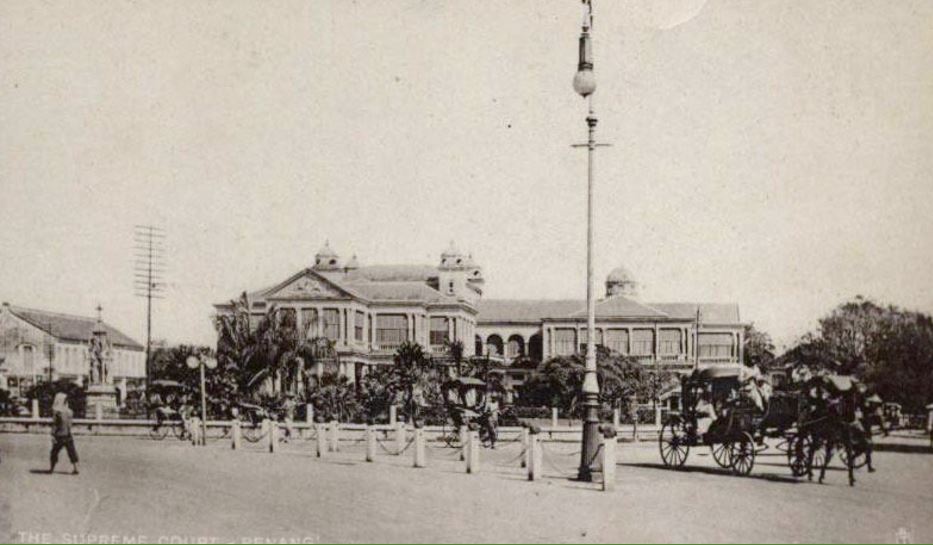

William Hackett in his judgement said: “It appears to me that this position is untenable. In l786, Penang being then a desert and uncultivated island, uninhabited except by a few itinerant fishermen, and without any fixed institution, was ceded by the Raja of Quedah to Captain Light…”
Hackett then continued by stating that “Here we have the fact that an island virtually uninhabited, is occupied and settled by British subjects in the name of the King of England. The case therefore would seem to fall within the general rule laid down in our law books…..”
The case referred to by Hacket says that “When Englishmen establish themselves in an uninhabited or barbarous country, they carry with them not only the laws, but the sovereignty of their own State: and those who live amongst them and become members of their community, become also partakers of and subject to the same laws.” Hackett argued that the island was “not altogether vacant of inhabitants;” and “secondly, because it was taken possession of on behalf of the East India Company and was therefore not directly subject to the English Crown.”
But it can scarcely be seriously contended, he said, “that the few wandering fishermen who were found on the shores of the island, could be regarded in the same light as the inhabitants of a settled country with laws of their own, and who are entitled to the benefit of them until changed by competent authority.” And the colonizers concluded that the island was “practically uninhabited,” unsettled and lawless.
The colonial narrative states that “When first taken possession of, the place was practically uninhabited, there being but a few itinerant fishermen living on it. It might naturally be supposed therefore, that the Island, on being taken over, became de facto an English Settlement, and that consequently our own laws prevailed, as written in Kyshes Reports Volume 1 (Civil Cases).
The story of “itinerant fishermen,” and elsewhere pirates and wild natives, to justify their claim on land. Their attitudes toward the Other was, and is, brutally inhumane. The “facts” are conditioned by the colonizer’s attitude toward their Other. The existence of the Other, to reiterate, colors the fact.
Kyshe’s Reports refer to cases heard and determined in the Supreme Court of the Straits Settlement between 1808 to 1884, published in three volumes and printed in Singapura in 1885. These were cases that had gone unpublished and rescued from obscurity by Barrister James William Norton Kyshe, acting Registrar of the said court.
But opinions differ as we noted above with reference to the Charter of 25th 1807 which says “wholly uninhabited.” Citing judge William Hackett “It appears to me that this position is untenable. In l786, Penang being then a desert and uncultivated island, uninhabited except by a few itinerant fishermen, and without any fixed institution, was ceded by the Raja of Quedah to Captain Light…”
Another opinion was adopted by Sir Benson Maxwell, in his judgement in Regina v. Willans, viz, that the island was inhabited by four Malay families. Such being the state of affairs at the time of the acquisition, what was the lex loci?
Subsequent questions asked was that did the settlers bring with them the law of England then in being on the ground that the settlement was acquired by occupancy? Or was the Malay law of the Kingdom of Kedah to be enforced, on the ground that it was a ceded country and had formed a part of that Kingdom? The Privy Council decided that the former is the correct answer. The Privy Council lied. This was because, even though the Regina v. Willans (1858), the judgement recognized the existence of four Malay families, “yet it could not be said to be inhabited.”
Maxwell described Pulau Pinang as a “desert island.” In his judgement, to justify the illegal occupation, “it is clear that for 20 and more years after the founding of the Settlement, no known body of laws was in fact recognized as the law of the place…” I would describe the judgement as “incestuous.” The judge lied in his own court. If there are “four Malay families” and the Malay families was on an island under the sovereignty of Kedah, whose law then was applicable?
Had it been an island off England, the judges would claim the law of England. In this case it is the law of Kedah, which is adat temenggong (temenggong customary law) modified by the Qanun Kedah. Maxwell’s judgement is not a matter of interpretation. It was perjury in his own court.
Another lie by the British is on the protection of Kedah. The question was on the morality of the EIC – was it bound or otherwise, to defend the Sultan against his enemies, and “above all Siam?” This is more than an academic interest, because in 1821 Siam invaded Kedah and expelled the sultan, the Company refusing to assist him. In consequence a bitter controversy arose, which raged in the Straits Settlement until about 1845.
The Sultan contended that the Company had broken its word. According to the narrative in Kyshe’s Report, when the company “accepted” Pulau Pinang, it knew that the grant was made almost entirely with a view of obtaining its assistance against Burma and Siam. By continuing to hold the island, the directors of the EIC, they were implicitly bound to render assistance in consideration of which it was granted.
The Company should either assume moral obligations or else evacuate the island. In L.A. Mills’ (1925) British Malaya 1824-67 (1925) Swettenham stigmatized the Company’s conduct as:
Cowardice…ending in a breach of faith which sullied the British name and weakened its influence with Malays for very many years.
When the Company accepted the cessation of Pulau Pinang in 1786, it negotiated with Kedah as an independent state, not under Siam, as claimed. More over the Government of India was well aware that in principal, and in fact the sole, reason for which the grant was made by the Sultan, was to obtain the armed assistance of the Company.
But it was contrary to the Pitt’s India Act, which forbade the Company to enter into alliances. But later, an agreement was arrived at on the demands made by the Sultan. Therefore in 1787, the Government of India decided not to make a defensive alliance with Kedah. Nevertherless the Sultan continued to push for an alliance, only to be refused by the Company on any political commitment.
Swettenham’s contention is that after the Indian Government decided in 1787 not to give assistance in case of invasion, the retention of Pulau Pinang was a breach of an implied, though not a written, obligation. The refusal to form a defensive alliance should have been followed by the evacuation of the territory which had been ceded in the hope of obtaining protection.
In another case, Fatimah v Logan and others (1871) Hacket, disagreed with Maxwell in holding that the island was ‘virtually uninhabited,’ and as such that the case fell under the general rule that “when Englishmen stablish themselves in any uninhabited or barbarous country they carry with them the laws and sovereignty of their own country.”
It is clear that the courts and the colonial judges see the law in their own paradigm. Again in Ong Cheng Neo v Yeap Cheah Jeo and others (1872), the Privy Council was of the opinion that in either view the “law of England must be taken to be the governing law as far as applicable to the circumstances of the place, and modified in its application by these circumstances.” The legal history of Malaysia must be re-read. Our law books thoroughly revised.
To reiterate, there is no treaty of cession in 1786. But the likes of R.O. Winstedt in A History of Malaya (1935) maintain the argument that there was “an indefinite letter,” a reading more on the “indefinite” history of Pulau Pinang.



Leave a Reply