

The social and intellectual history journalism in Malaysia and the Malay Archipelago has yet to be told. There is a misplaced notion of journalism in Malaysian society. Journalism schools, media organizations and the profession do not help either. The press suffers from a bad press.
Recently, on 29th November last month, I convened the first of a series of talks themed Journalism, Reform and Society at the International Institute of Islamic Thought and Civilization, International Islamic University Malaysia (ISTAC-IIUM) in Kuala Lumpur.
This is a collaboration with my colleague, Associate Professor Mehmet Ӧzay to deliberate on the societal and civilizational role of journalism in the Malay Archipelago. The narrative that journalism brought about the consciousness of modernity in the Malay Archipelago deserves another story.
But briefly, Malay journalism played a critical role in the formation of identity and nation in the Malay Archipelago. They, editors and journalists, including proprietors and funders, used newspapers and periodicals as instruments for change and reform.
In many ways, Malay journalism, understudied and much misunderstood, were agents of Malay modernity, and modern civilization in the region. Between 1876 to 1941, there were more than 250 Malay periodicals and newspapers published in Singapura, Pulau Pinang, Melaka, the peninsula Malay states and Sarawak.
And this does not include the vibrant life of journalism in Sumatra, Java and the Philippines during that period. These were critical in the blooming of Malay consciousness and nurturing Malay nationalism. Malay journalism became powerful tools to articulate change and reform.
To this end, Mehmet and I decided to come together to give another look at the narrative transcending national boundaries. There was indeed a shared history of newspapers and journalism between Malaysia and Indonesia. There is a common sociological and political dimension that has been neglected by scholars and historians of the nation states in the Malay Archipelago.
Writings on journalism, newspapers and periodicals connecting the communities within the rantau are almost absent. But newspapers then, like Jawi Peranakkan (1876 – 96) and al-Imam (1906-08), were much cosmopolitan in editorial outlook, circulation and readership. Although based in Singapura, these were circulated and read throughout the Western half of the Archipelago – Pulau Pinang, Deli, Batavia and Pontianak, among other ports and cities.
To be fair, William R. Roff’s works in his Origins of Malay Journalism (1967) and Bibliography of Malay and Arabic Periodicals published in the Straits Settlements and the Peninsular Malay States 1876 – 1941 (1972) would serve as standard reference in understanding the dynamics before the War, and how that has influenced the psyche of contemporary Malaysia.
Together with Anthony Milne’s The Invention of Politics in colonial Malaya (1995), we are led to the formative periods of political debates and Malay nationalism. The underlying argument in Roff are periodicals and journalism, and in Milner the relevance of texts in expressions and contestations for nation-building.
A profound illustration on the instrumental role of perodicals and journalism can be found in Ahmat Adam’s classic The Vernacular Press and the Emergence of Modern Indonesian Consciousness (1855 -1913) published in 1995; Sejarah dan Bibliografi Akhbar dan Majalah Melayu Abad Kesembilan belas (1994), dan Suara Minangkabau: Sejarah dan Bibliografi Akhbar dan Majalah di Sumatra Barat (1900-1941) (2018). AS we can see, the suratkhabar is embedded in the psyche of society.
And this was reinforced by Khoo Kay Kim’s Malay papers and perioodicals as historical sources (1984).
Thus far the few such works on journalism in Malaysia, coming out from departments of history, is nation-state centric, except for Ahmat Adam’s 1994. There is, after more than five decades in the establishment of journalism schools in Malaysia, much indifference to any kind of history.
The absence of any knowledge on the history of journalism kills idealism in the profession. There is not a single course on Malaysian journalism history, what more the dynamics of newspapers and journalism in Southeast Asia, and its advocacy in the context of the Malay Archipelago.
And so the Journalism, Reform and Society lectures transcend nation states and society in examining and re-examining the embeddedness of the scribe, social critic, sometimes thinker and philosoher especially before the Second World War. Working within the national narratives of each country only distorts and misrepresents the shared consciousness in the Archipelago.
This initiative is instrumental in reminding journalism students, the university fraternity and the public of the engagement of journalists with society in achieving objectives and ideals. This is part of the civilization process. We must understand the period of modernity in which journalism emerges and operates. In Malaya and Sumatra, Java and the Philippines, the presence of journalism was decisive in the enlightenment process.
As we argue, journalists were the insiders of the independence struggle in the Malay Archipelago; and journalism became harbingers and moderators in modern Malay society.
Journalism is a Malay heritage. It is the reservoir bringing together writers, the ulama and the literari. Hence the Lectures hope to bring and continue the conversation on the role and function of journalists as intellectuals and statesmen ; even public historians. Dr. Mehmet has illustrated that Haji Mohamad Said (1905-1995), the founder of the Medan-based newspaper Waspada.
Muhammad Said was a public intellectual, statesman and public historian. This is also seen in Rosihan Anwar (1922 – 2011), born in Solok, West Sumatra. The Minangkabau journalist was also a culturalist and delved into history. His 2009 multi-volumed Sejarah Kecil Petite Histoire Indonesia is a delightful read.

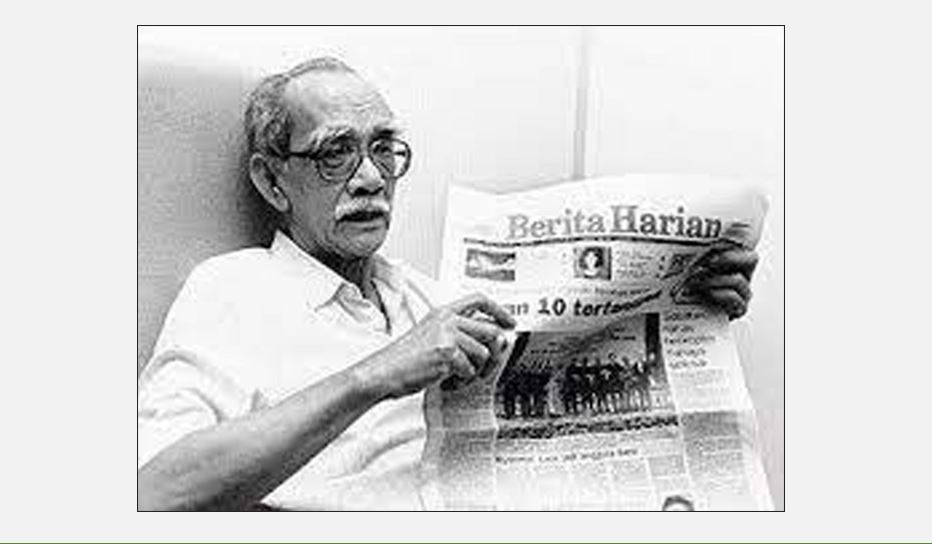
I am advocating Tan Sri A Samad Isamil (1924 – 2008) as public intellectual and statesman.
I have never worked under or with Pak Samad. My encounters with the man was much in the late 1980s and 1990s. I remember asking him two questions – one on his third detention, and the other on his ‘transfer’ to Jakarta in 1957, a move to ‘exile’ him from Utusan Melayu. He remained evasive.
Pak Samad was bestowed the Tokoh Wartawan Negara (National Journalism Laureate) in 1994. Apart from being known as a journalist and creative writer, he has also been described as language advocate, and political activist. He was awarded the Pejuang Sastera (Literary Pioneer award) in 1976 by the Malaysian government just weeks before he was detained. That was the first and only recipient.
Samad was also involved (as arms supplier) in the struggle for Indonesia’s independence in the 1940s. He was arrested, according to some accounts, twice under the Internal Security Act, once by the British, before 1957 and later by the Malaysian government. He was a founding member of the Gerakan Angkatan Muda (Geram), the PAP (People’s Action Party), and the National Association of Writers (PENA).
I quote another national Journalism Laureate, Tan Sri Johan Jaafar, who recently (2022) wrote that he told Pak Samad that he (Samad) “was one of the most productive sasterawan (literary person) the country has ever known.” Samad wrote 11 novels, more than 50 short stories and numerous essays on literature, culture and arts.
The Laureate went on to say to his mind, Samad was “the least decorated creative writer in the country.” Pak Samad never won the Hadiah Karya Sastera (the national literary award) started in 1971, and neither the recipient of the coveted Sasterawan Negara Award (National Literary Laureate).
I remember Samad’s confession on television. I was then studying journalism at a journalism school in the Klang Valley. He also taught journalism in the early years of Institut Teknologi Mara’s Kajian Sebaran Am in the early 1970s. Some 15 years later, Samad, myself and another colleague were providing training to the editorial staff of a party organ when the paper was just beginning to see the day – on journalism, opinion, witing and reporting.
There were times when I would drive him back from Jalan Pahang to Petaling Jaya. That was when he would tell me stories, and answered my questions, except two.
Quite correctly as put by Johan, Samad has always been reluctant to tell all. To use Johan’s phrase “there was always an air of mystery about him. The inscrutable Pak Samad. There were still many facets of his incredible life that are left untold.” In his preface in Memoir A Samad Ismail di Singapura (1993), Samad wrote:
Bagaimana pula saya harus menulis mengenai diri saya? Sekiranya saya gak membesarkan peranan saya, sebagai wartawan atau sebagai pejuang politik, atau sebagai budayawan, maka barangkali ada pula yang menuduh saya takbur, angkuh dan sombong. Kalau saya kurang menceritakan hal diri saya, maka saya tidak berlaku adil paa diri saya sendiri. Selain itu, ada pula hal-hal yang terlalu pahit mengenai perjuangan saya dan beberapa teman yang barangkali tidak dapat saya ceritakan (A. Samad Ismail, 1993)
(Trans: How am I to write about myself? If I amplify my role as a journalist or a political fighter or a man of culture, perhaps there will be those who accuse me of being boastful, conceited, and arrogant. If I speak less about myself I would not be fair to myself. Other than that, there are things that are too painful about my struggle and that of my friends which I am unable to tell).
Samad was anti-colonial in his belief, being earlier associated with Ibrahim Yaacob and Ishak Haji Muhammad (Pak Sako) and the Kesatuan Melayu Muda, and with many Indonesians he met during the occupation years. He identified closely with the revolution in Indonesia between 1946 and 1949 (Ibrahim Yaacob was at that time a member of the revolutionary government).
Writer and commentator Din Merican remarks that Samad promoted the cause of Indonesian independence to political parties in Malaya and Singapura, including UMNO and its founder Dato’ Onn Jaafar. Samad was also a part time correspondent for Indonesia’s Antara News Agency, with its “office” at Utusan Melayu.
Through such activities, Samad came to know several Indonesia leaders including Adam Malik, Sutan Sjahrir, Haji Agus Salim. Samad’s contribution to the cause was significant enough for Indonesia’s president Sukarno to mention him publicly during a speech in Singapura in the 1950s.
Samad survived through the Indonesian independence, the assertions of left-wing projects, and the conservative approach to decolonization by Malay elites and their allies. But he was left vulnerable. The Cold War, it was argued, has tarred him.
But he remained the leading light of the new era in Malay and Malaysian journalism, political and intellectual life. He fostered talents and careers, while filling newspaper pages and its leaders. While preparing for this series and the coming Symposium in Commemorating A Samad Ismail, planned for early 2024, I identified several names as speakers.
I was asked by one, referring to a name I suggested, on the “qualification” of a particular person to speak on Samad. I retorted and replied with a another question: Who then is qualified to talk about A Samad Ismail?
Samad knows the role of journalism. He saw the newspaper as a voice for independence. He weaponized journalism. Samad’s Tanah Air voice remained a radical one.
When he was ‘transferred’ to Jakarta by Yusof Ishak, editor-in-chief of Utusan Melayu, he took the opportunity to travel extensively in Indonesia. But disturbed he was. “The poverty! I was very disillusioned…This is what I fought for…” He had worked outside official channels on problems between Indonesia and Malaysia.
What must be mentioned is Samad’s role in the “Malaysianization” of the Straits Times and Berita Harian in 1972 – a “hostile takeover” if you will, to weaken the Singapore company’s position.
His dreams of a Melayu/Indonesia Raya seem implausible at best. “Now,” he said “you find a new nusantara.” The libertarian believes that the press should be as free as possible. Samad bears the imprint of idealism.
It was noted that with his passing on 4th September 2008, the various tributes accorded in Malaysia’s mainstream media and on Internet blogs referred to him as a “veteran journalist.” Other descriptions would be “prolific writer,” and “political activist”. Largely missing from the descriptive terms was that of “intellectual.” Balan Moses’s Obituary piece – “Tan Sri A Samad Ismail (1924-2008): the Thinking Man’s Editor,” however made an oblique reference to this.
In the 1950s, Samad in an interview with American author James A. Michener was described as a young “Malay intellectual”. Michener recorded his impressions of Samad in his 1952 piece titled “The New Intellectual.” Colleague Usman Awang has described the spirit as “intelektual yang berjiwa rakyat.”
We have to go beyond cliches and episodes on the Man. I have been hearing from those who claim to know Samad on his character and values for more almost 45 years now. His story must take a new route. It is time to accord the progressive A Samad Ismail as public intellectual and statesman, and I have to cite Johan, “we owe Pak Samad an apology.”


Leave a Reply