
By Tricia Yeoh
The conclusion of six state elections last month provided a much-needed pause in Malaysian politics.
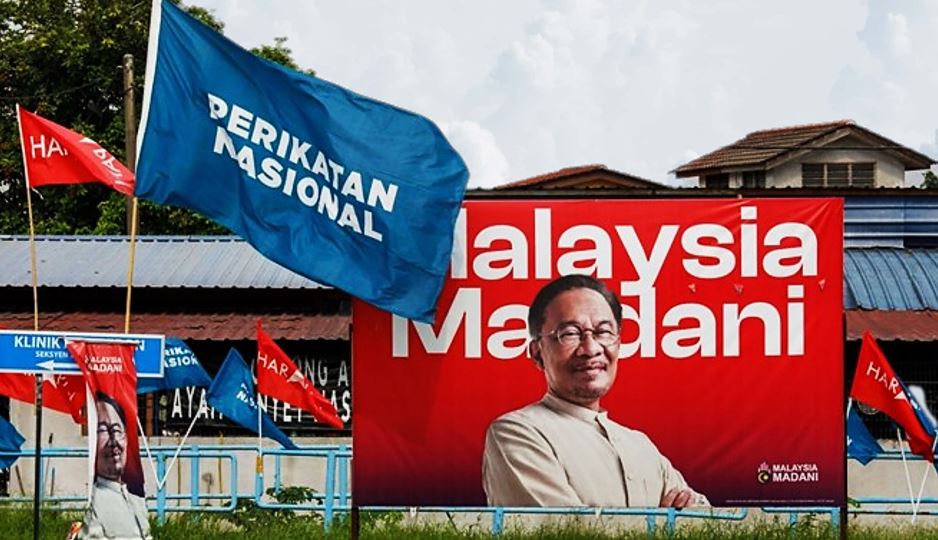
Held nine months after the 15th general election, these polls were a midterm gauge of the popularity of Prime Minister Anwar Ibrahim’s unity government, which comprises former rivals Pakatan Harapan (PH) and Barisan Nasional (BN).
The PH coalition maintained its hold on three states – Selangor, Penang and Negeri Sembilan. Opposition Perikatan Nasional (PN) and its component Parti Islam Se-Malaysia (PAS) achieved supermajorities in its three states – Kedah, Kelantan and Terengganu.

While retaining control of the west coast states gave Anwar a political reprieve, PN made significant inroads into all three. The PH coalition was denied a two-thirds majority in Selangor, where PN increased its number of seats from one to 22.
Similar seat increases took place in Penang and Negeri Sembilan. The PH coalition also retained two seats in the Johor by-elections.
PAS’ strongholds remain the predominantly Malay states in the north and east of Peninsular Malaysia, but support for PN grew even in semi-urban parts of Selangor, located around the periphery of Klang Valley’s urbanised centre.
Several reasons account for this “green wave”, including the rise of Malay nationalism, which PN leaders leaned into during both the general election and state elections.
But the decline of BN linchpin the United Malays National Organisation, plagued by fragmentation and corruption allegations, may have also played a role in PN’s success.
With an ethnically and religiously majoritarian opposition gaining Malay support, the PH coalition has chosen a more conservative route to appeal to voters.
In the lead-up to the state elections, the federal government ordered a ban on Swatch LGBTQ pride-themed watches and cancelled a music festival after a British band’s lead singer gave a pro-LGBTQ speech and kissed his male guitarist on stage.
The federal government has also increased the budget and roles of Jakim, the federal agency that oversees Islamic affairs.
Anwar’s government is meanwhile moving to restrict the use of the word “Allah” by non-Muslims in Peninsular Malaysia, and aims to table controversial legislative amendments to elevate the role of Islamic sharia law in the criminal justice system.
Anwar’s moves to strengthen his position among the Muslim majority sets up a potentially slippery slope as PN continues to set the political agenda and tone, which PH-BN is then forced to respond to.
A more significant threat to the reform agenda might emerge if, to win over Malay support, the government delays much-needed economic and institutional reforms.
While the government has approved the long-awaited Freedom of Information Act and Government Procurement Act, concrete steps must be taken for them to be enacted in parliament to avoid potential resistance.
The midterm review of the 12th Malaysia Plan proposes introducing targeted subsidies for electricity, diesel, petrol and social assistance. Fiscal consolidation is urgent given the country’s financial squeeze and high public spending in recent years.
If it can see this through, this would be a major success, since subsidy rationalisation might impair Anwar’s popularity among low-income households struggling to cope with increased costs of living.
Implementing the Government Procurement Act is crucial for enhancing transparency and competitiveness in public procurement. But the timeline and drafts of the law have not yet been viewed by external stakeholders and might be seen as an affront to existing procurement practices, which have been a source of race-based patronage in the past.
It is unclear if Anwar’s government will have the confidence to reform the large swathe of government-linked companies (GLCs) in Malaysia.
Many of these were set up to empower “ bumiputra” (sons of the soil) communities but have become victims of patronage. GLCs that are uncompetitive and underperforming put a financial strain on the public sector.
A comprehensive financial and performance review of all GLCs, especially those that are not publicly listed and hence not strictly scrutinised by regulators such as Bursa Malaysia and the Securities Commission, is necessary to determine which ones should continue to exist.
The culture of political appointments to the boards of GLCs, which Anwar’s administration has continued, will need to end.

His government has launched ambitious economic plans, including the Madani economy framework, National Energy Transition Roadmap, New Industrial Master Plan and the midterm review of the 12th Malaysia Plan. But political reform will also be needed to minimise corruption.
To see these strategies through, structural reform efforts are necessary. But if these reforms are seen as eating into Malays’ economic share, Anwar’s administration will face resistance.
The better approach would be to demonstrate that these reforms will expand economic opportunities for all and provide a time-bound financial cushion to those hardest hit financially.
The 2024 budget speech, in which some of the government’s economic agenda will be announced, is an opportune time to do so.
PH’s reform position is becoming difficult to maintain, particularly after appointing Umno’s scandal-ridden President Ahmad Zahid Hamidi as deputy prime minister.
The recent decision by the public prosecutor to discharge him from all corruption charges is surprising.
In Malaysia, the offices of the public prosecutor and attorney general are held by the same person. If the government does not heed the decades-long call from civil society to separate the two offices to avoid political interference in legal matters, PH will struggle to reclaim its moral high ground.
The minister of law and institutional reform has recently announced plans in this regard, but it needs to be urgently expedited given the circumstances.
In playing to the gallery, the current government risks portraying itself as lacking the impetus to reform, which could narrow Anwar’s options. Malaysia must reignite its reform agenda quickly, while communicating the economic benefits to the Malays.
But this will prove challenging, especially with an increasingly strong opposition that has used racially divisive language to elevate Malay insecurity.
Dr Tricia Yeoh is CEO of the Institute for Democracy and Economic Affairs, Malaysia, and Campus Visitor at Australian National University. This article was first published by the East Asia Forum.
Views in articles posted in apakhabartv are the opinion of the writer(s) and do not reflect the stand/views of the portal.




Leave a Reply