
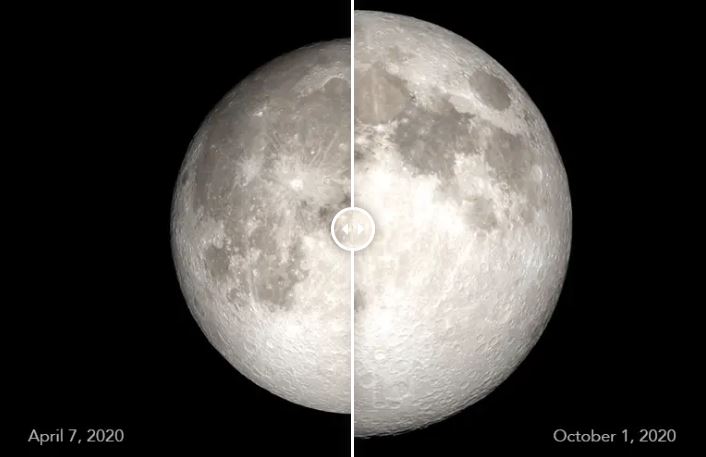
Skygazers around the world experienced the rare celestial event known as a “blue supermoon” Wednesday night, as both a blue moon and supermoon combined, lighting up the sky with a bigger and brighter moon in an event that won’t be seen again for 14 years.

The event combined a “blue moon” with a “supermoon,” marking the first time those events had been seen together since 2018.
A blue moon refers to the second full moon seen in a month, which NASA notes typically happens only every two to three years.
The last blue moon was in August 2021, and the next will be in 2026, BBC News notes.
A supermoon is when a full moon takes place at the same time that the moon is at its closest point to Earth on its elliptical orbit (known as perigee).
That happens more frequently, with NASA noting approximately 25% of full moons are supermoons and this being the third supermoon of the year.
A supermoon makes the moon look approximately 14% bigger than when it’s at its farthest point from Earth, according to NASA, which describes the difference as being about the same as the size difference between a quarter and nickel.
What to watch for
A blue supermoon won’t happen again until January and March 2037, according to NASA. Blue supermoons take place an average of 10 years apart, though the last one was seen more recently, and the time between events can be as long as 20 years.
Surprising fact
The blue supermoon may have affected the storm surge from Hurricane Idalia as it made landfall in the southeastern U.S. on Wednesday, as the event creates a gravitational pull that would increase tides more than their normal range.
What is a supermoon?
The Moon travels around our planet in an elliptical orbit, or an elongated circle, with Earth closer to one side of the ellipse. Each month, the Moon passes through the point closest to Earth (perigee) and the point farthest from Earth (apogee).
When the Moon is at or near its closest point to Earth at the same time as it is full, it is called a “supermoon.” During this event, because the full moon is a little bit closer to us than usual, it appears especially large and bright in the sky.
OK, so what is a blue moon?
A blue moon is the term for when we see the full moon twice in a single month. The Moon’s cycle is 29.5 days, so just a bit shorter than the average length of a calendar month.
Eventually that gap results in a full moon happening at the beginning of a month with enough days still remaining for another full cycle ― so a second full moon in the same month.
In other words, a full moon that happens on the 1st or 2nd of a month will probably be followed by a second full moon on the 30th or 31st. This happens every two to three years.
People sometimes refer to two types of blue moons: monthly and seasonal. This upcoming moon is a monthly blue moon. Seasonal blue moons occur when there are four full moons in a single season (spring, summer, fall and winter) instead of the usual three.
Will the Moon be blue?
No, that’s just the term for two full moons in a month.
Is the Moon ever blue?
On rare occasions, tiny particles in the air ― typically of smoke or dust ― can scatter away red wavelengths of light, causing the Moon to appear blue.
Will this Moon be bigger and more “super?”
You probably won’t notice a big difference in size. When the Moon is closest to Earth (a “supermoon”), it looks about 14 percent bigger than when it’s farthest from Earth. This is similar to the size difference between a quarter and a nickel. Because the Moon will be close to us in its orbit, it will appear a bit brighter than usual.
Do blue moons and supermoons always occur together?
No. The term “supermoon” is used to describe a full Moon that occurs within a day or so of perigee, so they happen three to four times a year. About 25 percent of all full moons are supermoons, but only 3 percent of full moons are blue moons.
The time between super blue moons is quite irregular ― it can be as much as 20 years ― but in general, 10 years is the average. The next super blue moons will occur in a pair, in January and March 2037.
So if it’s not blue and not super-sized, is this worth checking out?
Hey, it’s always a good time to look at the Moon! Try our Daily Moon Guide to see if you can locate some of our recommended daily Moon sights. – Forbes/NASA



Leave a Reply