
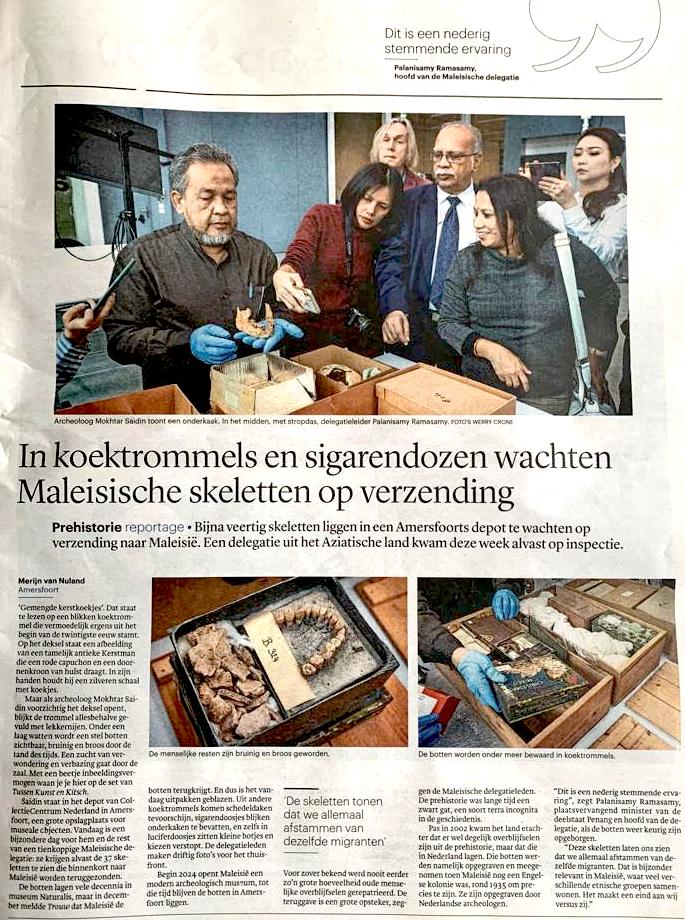
A slice of ancient history resides on the palm of Prof Mokhtar Saidin, an archeologist. Prof Mokhtar and a Penang delegation headed by Deputy Chief Minister II Dr P Ramasamy. They are in Netherlands, drawn by skeletal remains of 41 individuals dug out in the Guar Kepah area, near Kelapa Batas, by British archeologists from, roughly 1851 to 1934.
These pieces of pre-historic era have been kept at the Natuurhistorisch Museum in Leiden, the Netherlands. Penang and the Netherlands have been in communication in the run-up to this visit.
The ultimate aim is to bring them home as a precious component of our collective history.
The skeletal remains will reportedly return to Guar Kepah as showpieces at the Guar Kepah Archeological Gallery, now being built.

Prof Mokhtar reading a note written by an Australian archeologist. (From left) Head of Dutch Ark (Archeology), Prof Jos Bazelmans; Drs Hana Pennock; Dr Nor Hisham Mohd Yusof from the Malaysian Embassy and Hans Walewijin of Dutch Ark
The Dutch media, in this instance, Trouw, has been tracking the story.
Prof Mokhtar shared this newspaper cutting with ApaKhabar on Saturday, March 25.
How did the skeletal remains end up in a museum in the Netherlands? Prof Mokhtar, in between discussions, responded to the journalistic questions posed by ApaKhabar. “We are compiling the relevant data.”
This archeologist who retired from USM in 2021, has also been the prominent narrator of the Sungai Batu history in Kedah.
This episode took off in 2007 when Prof Mokhtar’s team made this defining discovery of evidence of an iron smelting industry in Sungai Batu. The team is steadfast in concluding that the Sungai Batu civilisation dated back to 788BC. Therefore, Sungai Batu, was the oldest civilisation of South East Asia!
Fast forward, in 2010, Prof Mokhtar and team began excavating the Guar Kepah site. The work was carried out over two phases. Stage Two took off in 2017. Sungai Batu and Guar Kepah, by the way, are 40km apart. And, they belong to two distinct eras. The Guar Kepah site is pre-historic (Neolithic).
Being an ApaKhabar columnist, Prof Mokhtar intends to find time to tell our readers the fuller story.
For one, deeper analysis is required. As it is, Prof Mokhtar believes the skeletal remains date back to 3, 000 to 5, 000 years.
“We have been checking every box of the skeletal remains.”
Dr Ramasamy and members of his delegation including Prof Mokhtar, are due to fly home Tuesday, March 27.

The Penang delegation led by with their Netherlands counterparts
MAIN PIX: The article featuring the Malaysian delegation that appears in Trouw Vandaag, a local newspaper. Pix shows Prof Mokhtar inspecting a mandible or lower jawbone as the journey to inspect the Neolithic skeleton of Guar Kepah gets underway



Leave a Reply