
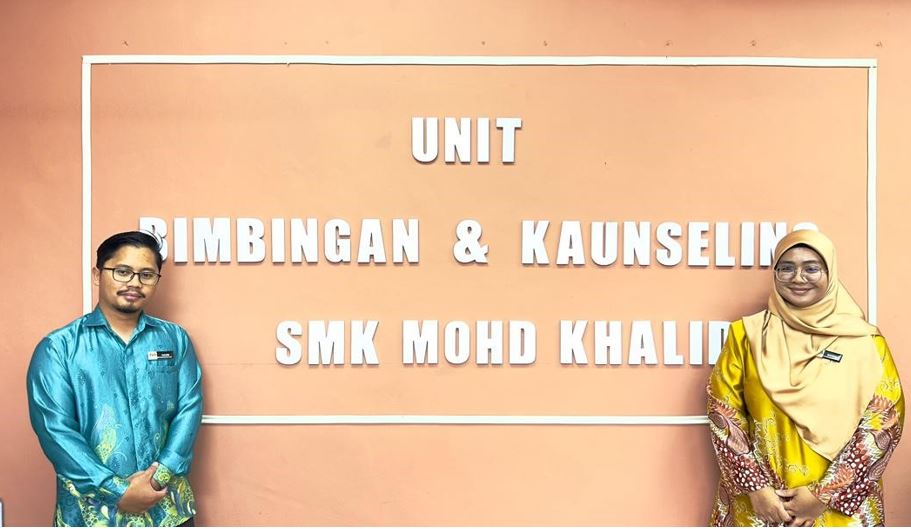
By Vincent D’Silva
JOHOR BAHRU: In a quiet counselling room at SMK Mohd Khalid, the door is rarely closed for long. Students come in hesitantly — some carrying the weight of academic pressure, others burdened by worries that cannot easily be spoken at home or in the classroom.
Inside, school counsellor Hakim Tusirin listens with patience, offering something many young people struggle to find: a safe space to be heard.
With nearly five years of experience guiding adolescents through the uncertainties of school life, Hakim believes counselling is far more than problem-solving. For him, it is about helping young people rediscover their sense of worth and direction.

“My inspiration came from a desire to help students face life’s challenges, not only in their academic direction but also in their emotional well-being and character development,” he said.
“I believe every student has potential. The role of a counsellor is to guide them so they do not feel alone when facing their problems.”
Across Malaysia’s schools, counsellors increasingly find themselves on the front lines of youth mental health. In Hakim’s counselling room, conversations range from academic stress and friendship conflicts to deeper struggles involving family relationships and self-esteem.
Among the moments that remain closest to his heart are the quiet breakthroughs that happen behind closed doors.
“One moment that deeply touched me was when a student who had always been very quiet finally found the courage to open up about something that had been weighing on them for a long time. Through the counselling process, that student slowly began to change. Seeing that growth — from silence to confidence — gives great meaning to my work,” he recalled.
Such transformations rarely happen overnight. More often, they unfold through patient conversations and small steps toward trust.
Today’s students, Hakim observes, face pressures that extend far beyond textbooks and examinations. Social media, in particular, has reshaped how many young people view themselves and their place in the world.
“I personally believe social media has changed the emotional landscape of students. Many now measure their self-worth through likes, followers and online attention. When their expectations are not met, they may feel rejected or unappreciated,” he said.
The constant comparison with others, he added, can create emotional turbulence.
“Maintaining a certain image online can make their emotions unstable and increase anxiety, low self-esteem and a lack of confidence.”
Often, the struggles remain hidden beneath the surface. Hakim has learned to notice the subtle signals that something may be wrong.

“Sometimes the signs appear as changes in behaviour — becoming unusually quiet, losing focus in class, isolating themselves, or a sudden drop in academic performance. These are often indicators that a student may be silently struggling,” he explained.
Building trust with those students requires patience and empathy.
“I try to be approachable and non-judgmental,” he said. “Confidentiality is very important. When students know they are in a safe environment and their feelings are respected, they slowly begin to open up.”
Among the many cases he has handled, one stands out as a powerful reminder of the difference a counsellor can make.
The student, he said, was struggling with family conflict tied to uncertainty about whether he might have Attention Deficit Hyperactivity Disorder (ADHD) or autism. Misunderstandings had created a painful gap between the teenager and his family.
“He felt misunderstood, while his family did not know how to understand his behaviour,” Hakim said. “There was a communication barrier, especially as he entered adolescence.”
Through consistent counselling sessions and discussions with the student’s guardian, Hakim worked to bridge that divide. Using counselling techniques and guided conversations, both sides gradually began to understand one another.
“Over time, we achieved the goals that were set,” he said. “Their relationship became more harmonious, and the student grew more confident and emotionally stable.”
Witnessing that transformation reaffirmed his purpose.
“Seeing him become more positive reassures me that the role of a counsellor can truly bring meaningful change to a student’s life,” he said.
Yet the work is not without its challenges. Counsellors today must navigate an evolving emotional landscape among younger generations.

“One challenge the public may not always realise is how quickly students’ needs are changing. We are seeing more mental health concerns appearing at younger ages,” Hakim explained.
Balancing immediate emotional support while nurturing resilience, he said, requires constant adaptation.
“We must help students cope with complex emotions while also guiding them to build strong character and resilience for the future.”
Supporting young people, however, is not a task counsellors carry alone. Parents and teachers, Hakim emphasised, form the foundation of a child’s emotional support system.
“They play a very important role. By paying attention, recognising behavioural changes and creating a positive environment, they can help children feel safe and supported,” he said.
To maintain the emotional strength required for the job, Hakim also prioritises his own well-being.
“I try to maintain balance between work and rest. Spending time with family, enjoying personal hobbies and interacting with the community helps me recharge,” he said.”
Despite the long hours and emotional demands, his motivation remains simple: the students who walk through his door. For Hakim, success is not measured in awards or recognition.
“Success, for me, is when a student comes into the counselling room with a heavy heart and leaves with hope. When a student feels heard, understood and supported — that alone is already a success story,” he said.
And to every young person struggling in silence, he offers a message that reflects the heart of his work.
“You are not alone. Your feelings matter greatly. Do not be afraid to seek help or speak to someone you trust. Every problem has a solution, and your life holds great value,” Hakim said gently.




Leave a Reply