
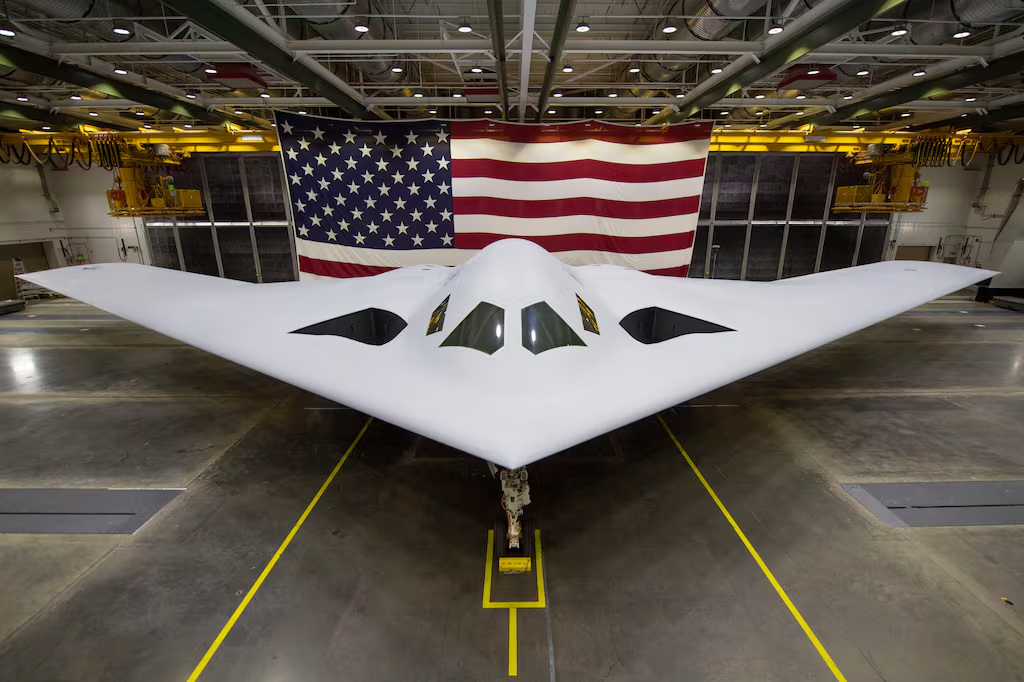
By M.A.Kadir
The United States has developed and operated some of the most advanced fighter aircraft in the world. Below is a list of top U.S. fighter aircraft, both historical and currently in service:
Currently in Service:

- F-22 Raptor
- Role: Air superiority fighter
- Manufacturer: Lockheed Martin
- Introduced: 2005
- Features: Stealth technology, supercruise, advanced avionics, and thrust vectoring.
- F-35 Lightning II
- Role: Multirole fighter (three variants: F-35A, F-35B, F-35C)
- Manufacturer: Lockheed Martin
- Introduced: 2015
- Features: Stealth, advanced sensors, network-centric warfare capabilities, and short takeoff/vertical landing (STOVL) for the F-35B.
- F-15 Eagle and F-15E Strike Eagle
- Role: Air superiority (F-15) and multirole strike fighter (F-15E)
- Manufacturer: McDonnell Douglas (now Boeing)
- Introduced: 1976 (F-15), 1989 (F-15E)
- Features: High speed, long range, and heavy payload capacity.
- F-16 Fighting Falcon
- Role: Multirole fighter
- Manufacturer: General Dynamics (now Lockheed Martin)
- Introduced: 1978
- Features: Maneuverability, versatility, and cost-effectiveness.
- F/A-18 Super Hornet
- Role: Multirole fighter/attack aircraft
- Manufacturer: Boeing
- Introduced: 1999
- Features: Carrier-based operations, advanced avionics, and improved range over the legacy Hornet.
- F-15EX Eagle II
- Role: Advanced multirole fighter
- Manufacturer: Boeing
- Introduced: 2021
- Features: Modernized version of the F-15 with advanced avionics, weapons capacity, and reduced lifecycle costs.
Historical and Retired Fighter Aircraft:
- P-51 Mustang
- Role: Long-range fighter (World War II)
- Manufacturer: North American Aviation
- Introduced: 1942
- Features: Exceptional range and performance, pivotal in WWII.
- F-4 Phantom II
- Role: Multirole fighter
- Manufacturer: McDonnell Douglas
- Introduced: 1960
- Features: Speed, versatility, and widespread use in Vietnam and beyond.
- F-14 Tomcat
- Role: Air superiority and fleet defense
- Manufacturer: Grumman
- Introduced: 1974
- Features: Variable-sweep wings, long-range AIM-54 Phoenix missiles, and carrier operations.
- F-117 Nighthawk
- Role: Stealth attack aircraft
- Manufacturer: Lockheed Martin
- Introduced: 1983
- Features: First operational stealth aircraft, used in conflicts like the Gulf War.
- F-104 Starfighter
- Role: Interceptor and fighter-bomber
- Manufacturer: Lockheed
- Introduced: 1958
- Features: High speed and altitude capabilities.
- F-86 Sabre
- Role: Jet fighter (Korean War)
- Manufacturer: North American Aviation
- Introduced: 1949
- Features: First swept-wing fighter, dominant in dogfights during the Korean War.

Experimental and Future Fighters:
- Next Generation Air Dominance (NGAD)
- Role: Sixth-generation air superiority fighter
- Status: In development
- Features: Expected to include advanced stealth, AI integration, and unmanned teaming capabilities.
- X-44 MANTA
- Role: Experimental fighter (concept)
- Manufacturer: Lockheed Martin
- Features: Tailless design with thrust vectoring.
- Boeing X-32
- Role: Prototype for Joint Strike Fighter (JSF) program
- Manufacturer: Boeing
- Features: Competed against the F-35 but lost the JSF competition.

This list highlights the evolution of U.S. fighter aircraft, showcasing their technological advancements and roles in maintaining air superiority.




Leave a Reply