
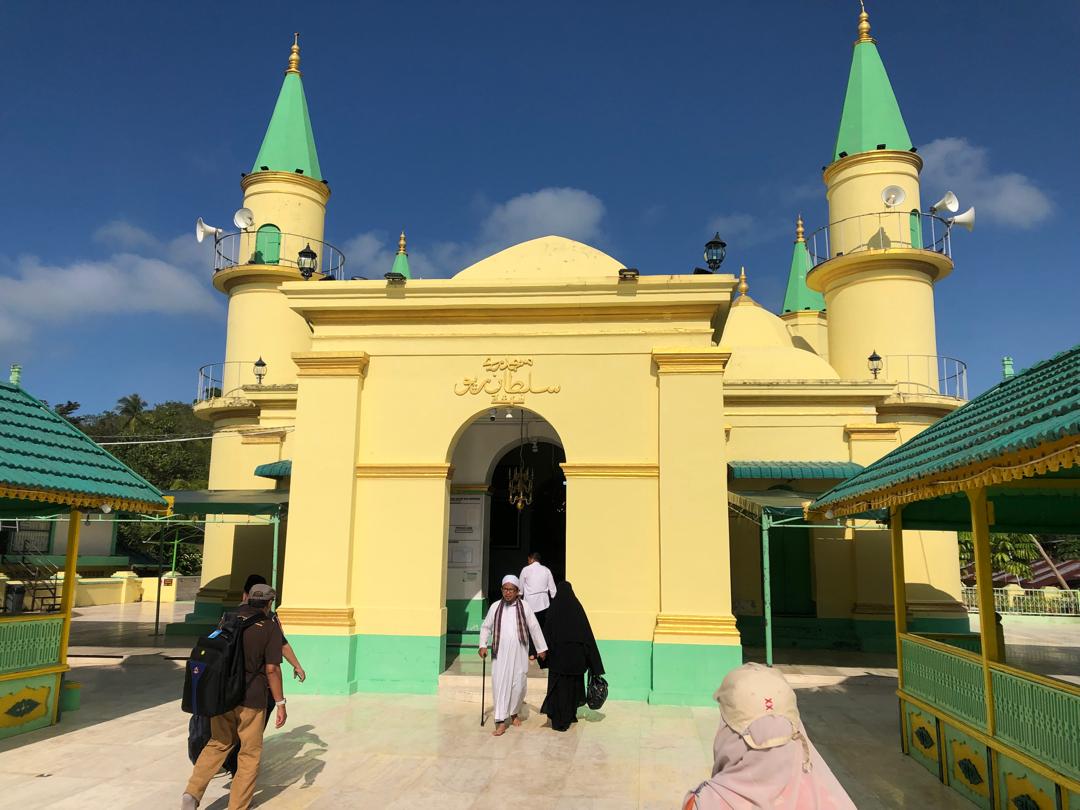

On February 14, 2025, we landed at Pulau Penyengat. The day before, arriving at the jetty in Tanjungpinang, the island of Bintan from Johor Baru after a four-hour ferry ride, I gazed at the island, some six kilometres away. Pulau Penyengat is a tiny island – some two kilometres long and abour 3/4 kilometres across at its widest point.
Anyone interested in modern Malay society and Malay print culture must visit Pulau Penyengat. It is the site in consuming a phase in Malay Enlightenment. We reached there by perahu pompong within 15 minutes – the outboard motor boats ferrying passengers to and from Tanjungpinang. From the jetty at Pulau Bintan, we can see a bright yellow- green structure – the Masjid Raya Sultan Riau (Grand Mosque of the Sultan of Riau) built in 1844. It is quite a landmark. At the jetty, we were greeted by local historian, Raja Malik bin Raja Hamzah, a sixth generation descendant of Raja Haji Fisabilillah.

Raja Ali Haji’s gurindam at the makam of Raja Hamidah
According to Raja Malik, Pulau Penyengat has a population of some 3,000 people, most of whom are teachers and government servants. In the early 1980s, the island accommodated almost 2,000 souls. The island is a living museum – kampungs, graves,and historical remains such as residences and palaces are abundant. Three places of much interest to students and scholars of modern Malay history and society are the archive at the mosque, the site of the Rushdiyah Club, and the YayasanKebudayaan Indera Sakti, a foundation for the promotion and preservation of buildings and documents which bear witness to Penyengat’s past history.
This essay is a revisit to Pulau Penyengat in relation to Syed Shaykh al-Hady. This is an extension of my earlier essay (29 April 2022) on al-Hady in relation to Riau and Malay journalism, titled ”Riau, the Cradle of Malay Journalism: The Spirit of Syed Shaikh al-Hady.” In “The Life of My Father” (in Alijah Gordon, editor, 1999) Syed Alwi recounts on his father growing up on the island.
Syed Shaykh bin Syed Ahmad bin Hasan bin Saqaf al-Hady al-Ba’Alawi was born on 22 November 1867 in Kampung Hulu, Melaka. He was brought by his father and uncle, Syed Muhammad from Melaka to Pulau Penyengat, Riau-Lingga in about 1874. Syed Shaykh was seven years old then. According to Syed Alwi, his father, Syed Shaykh attrracted the attention of Raja Ali Kelana, the son of the Yang Dipertuan Besar Raja Muhammad Yusuf al-Ahmadi. He adopted Syed SHaykh and treated him like one of his children. It was in Pulau Penyengat that Syed Shaykh received his education in the Malay language, culture and religion.

The writer at Pulau Penyengat jetty
Raja Ali Kelana was the half brother of Sultan Abdul Rahman, the ruler of Riau-Lingga. It was only natural that he learnt from instruction as well as by living as one of the members of the royal family.
Among the earlier members of the royal court at Pulau Penyengat were many notable writers and poets, the most well-known being Raja Ali Haji ibn Ahmad (1808-73) – ulama, historian, intellectual and social critic in Malay modern history. Raja Ali Haji is famous for the classic Silsilah Melayu dan Bugis dan sekelian raja-rajanya (Genealogy of Malay and Bugis Princes), and Tuhfat al-Nafis (The Precious Gift).
His other works include Syair Siti Shianah, Syair Sulu Pegawai, Syair Hukum Nikah and Syair Sultan Abdul Muluk. Others are Bustanul-Katibin and Kitab Pengetahuan Bahasa. Perhaps has come to be in Riau popular consciousness is his Gurindam Dua Belas, a form of syair (Malay verse). In the Gurindam, Raja Ali Haji instructs on values, and ethics in religious life.

Makam Raja Ali Haji

Local historian Raja Mallk bin Raja Hamzah, 6th generation of Raja Haji Fisabilillah showing the site of the Rushdiyah Club.
Pulau Penyengat and the Riau islands appear to be surrounded by Gurindam Dua Belas – inscribed, and published in booklets for public consumption. Stanzas from the Gurindam are etched in the inner walls surround the makam of Raja Hamidah, daughter of Raja Haji Fisabiillah (Engku Puteri), in the compound where Raja Ali Haji was buried. The Kompleks Makam Engku Puteri Raja Hamdah, the permaisuri (consort) of Sultan Mahmud Syah III houses notable figures residing at Pulau Penyengat at that time. This includes Royal Advisor Raja Ahmad and Raja AbdullahMursyid, the 9th Yang di Pertuan Muda of Riau.
In 2004, Indonesia declared Raja Ali Haji as the Pahlawan Nasional (National Hero) for contributions to Bahasa Melayu. Malaysia has forgotten the man who gave the nation the Bahasa Kebangsaan (National Language). Malay oral traditions andmodern Malay language owe its sustenance to Raja Ali Haji.
Syed Syaikh lived in a congenial environment. Virginia Matheson in her essay titled “Pulau Penyengat: Nineteenth Century Islamic Centre of Riau” (Archipel, vo. 37,1989) reminds us that earlier in the 19th century, Penyengat’s epithet was;Serambi Mecca; or ;Gateway to Mecca; and people living in the Riau area would visitPenyengat before embarking on the pilgrimage to Mecca.
It is important to note that although Penyengat was not settled until the early 19th century, its position off-shore from Tanjungpinang, and not far from the entrance tothe Riau river made it strategically important. It is mentioned in Tuhfat-Al-Nafis as a look out post during the wars with Raja Kecik.
The story of 19th century Penyengat begins with Raja Haji who died fighting the Dutch at Melaka in 1784. Raja Haji was the fourth Bugis Yang Dipertuan Muda (YTM) of Riau. Raja Haji is celebrated in written and oral tradition as a fearless worrier (he fought Inderagiri, Kedah and Pontianak as well as twice against the Dutch). His piety and devotion to Islam is documented in Tufat al-Nafis, where he was described facing the final Dutch attack on his stockade at Melaka with his dagger in one hand and a book of prayers in the other. Considered a syahid (martyr) he was buried in Melaka. During his lifetime, Raja Haji was widely regarded as a keramat hidup (living saint).
Raja Haji’s children then came under the care of the Sultan of Riau, Sultan Mahmud.
Particularly prominent were his eldest son, Raja Jaafar, Raja Ahmad (father of Raja Ali Haji, author of Tuhfat al-Nafis), and one of his daughters, Raja Hamidah whose title was Engku Puteri.
The island is strategically not far from the entrance of the Riau river (which leads to the 17th and 18th century Johor-Riau capitals), and is mentioned in Tuhfat-Al-Nafis as a look-out post during he Malay-Bugis wars with Raja Kechik. Penyengat as a site of permanent settlement begins only in 1804. The circumstances of its settlements are recorded by Raja Ali Haji and remembered in the oral traditions of Pulau Penyengat till today.
The island of Penyengat saw itself, and was viewed by others, as a royal centre. In the latter part of the 19th century it was sometimes referred to as Pulau Inderasakti; (the name now taken by the Yayasan of Raja Hamzah Yunus). Indera means royal; and sakti means supernatural power, both of which represent the main elements of the island’s past still evident from its historical remains.
From a map of Pulau Penyengat, Matheson concludes that only half the island on the eastern part, has been used for settlement. The western half, besides several kampungs on the northern periphery, consists of defence works and fortifications.
On the eastern side the modern paths, which probably follow the original paths laid down last century, intersect the area and divide it into the following parts, listed chronologically in order of development.
1. Kota Rentang, associated with Raja Hamidah (Engku Puteri), YTM Jaafar and Raja Ahmad.
2. Raja Haji’s grave.
3. The present mosque: associated with the three sons of YTM Jaafar who became YTMs.
4.Engku Puteri’s grave complex, near which Raja Ahmad and Raja Ali Haji are buried.
5. YTM Raja Ali’s palace and its associated perigi suluk (for tarikat ablutions).
6. The Rusydiyyah Club and Bukit Bah Yah, home of its most prominent member, Raja Ali Kelana.
7. The taman pantai area, near Kampung Kelang, developed by Raja Ali Haji’s son, Raja Hasan, and around which Raja Ali Haji’s descendants settled. They lived on the southern, Kota Rentang side of Penyengat; as their ancestor Raja Ahmad Had).
8. The palace complex of Sultan Abdul Rahman, which under the 1804 division of the Riau-Lingga kingdom, should not have been built on Penyengat. The palace is sited away from the mosque, and away from the residences of the earlier YTMS. Perhaps the enduring focus of Penyengat was undoubtedly its mosque. Raja Ali Haji conceives Penyengat’s status as a centre of Islamic scholarship, and that the YTMS were devout and pious. Learned men was celebrated by the Court. They were paid an allowance to transmit their knowledge.
It was narrated that The Yang Dipertuan Muda revered the wise, remaining humble before Muslim scholars and was most polite and courteous towards his uncles, such as Raja Ismail and Raja Jafar. In the same spirit he was not comfortable sitting on a
chair if his seniors were on the ground. It was characteristic of him to enjoy having meals with his relatives, who would come to him on a certain day, and likewise he too would visit them in their houses. During his reign he upheld the Islamic faith, attending the mosque on Fridays and ordering women to be veiled.
The YTM, apart from paying the expenses of scholars, ordered all state officials to study religion, recite books, and improve their recitation of the Quran. The YTMs benefited from the company of learned men, liked to hear their moral instruction and advice and took pleasure in listening to moralising works.
Oral tradition and contemporary practice on Penyengat reveal the continued significance of two keramat graves as foci in the lives of the local people. Matheson connects Pulau Penyengat’s written and oral traditions to three centres: the mosque, and the graves of Engku Puteri and Raja Haji. She suggests that it is not coincidentalthat the three centres lie on the same line, or axis. The grave of Engku Puteri was moved from its supposedly original site of Kota Rentang to a different site; as Raja Haji’s had been from Melaka to Penyengat). The new location, she argues, was in line
with, and equidistant from her father Raja Haji’s grave, and the mosque. The mosque provided a central focus not only for the performance of prayers, but also for scholarship, law and administration. Matheson also highlights another spatial significance of the mosque – that it stands “defiantly opposite the Dutch administrative centre of Tanjung Pinang…”
Talking to Raja Malik, I notice that there is a network of kinship in the Penyengat population. Many of the rajas are able to trace their ancestry back to Raja Haji. Raja Malik, citing from Raja Hamzah and oral traditions, refers to Penyengat as Raja Hamidah’s (Engku Puteri) mas kawin (dowry), bestowed to her by the Sultan.
She was its owner. Syed Shaykh would have been imbued with narratives of keramats and sakti, sitting together with the measured prose emanating from the Rushdiyah club – presumably from rashada – meaning guidance or the right path; or al-rushd -reason, the right way. And distilled in the periodical Al-Imam (1906-08) and the various newspapers and magazines throughout the early 1900s ending with Saudara (1928-1941), and the Jelutong Press in Tanjong, Pulau Pinang.
Note: Prof. Dato’ Dr. Ahmad Murad Merican is professsor of social and intellectual history, International Institute of Islamic Thought and Civilization, International Islamic University Malaysia.

Leave a Reply