
By Ninot Aziz
I thank Zhang Faris and a few others who brought Snow in Midsummer to my attention, telling me I would love the interpretation. Here is my feedback especially on some points that touch on Malay heritage and culture.
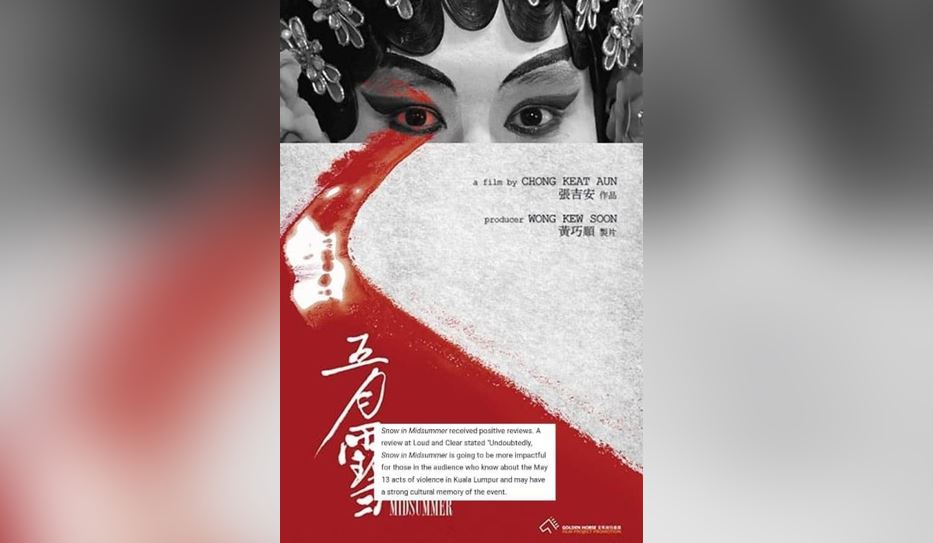
Snow in Midsummer, a Malaysian film, supported by Singapore Film Commission and Taipei Film Commission, presents an award winning narrative echoing the historical events 13th May, albeit through a somewhat unbalanced lens.
Afterall, Peristiwa 13 Mei saw victims from all sides. It is no doubt a story that needs to be told and despite the one-sided representation, this could be accepted as the storytelling is the director’s perogative.
The movie is presented in a terse, evocative storytelling, and a play of emotions which achieves its immediate objectives.
I would like to encourage all Malays especially to watch this movie.
We respect the need to tell this story. However, the portrayal of Malay symbolism and revered figures may leave some viewers conflicted, as the film teeters between storytelling license and misrepresentation.
Make no mistake, the reference of Sejarah Melayu, Makyong and Tun Sri Lanang, was beguiling.
Tun Sri Lanang as the voice, wisdom and spirit of the Malays was an excellent pull factor.
It is therefore sad that he was portrayed as a power hungry overlord (on elephant back no less) presiding over destruction and bloody bath, the precursor to ill-fate and destruction.
Did he represent the cause? The perpetrators? The executor? I would never portray Hakim Bao or Admiral Chang Ho in such light.
Firstly, the elephant must have been a metaphor as elephants were only for royal family in those ancient times. So there was a lack in research here in the portrayal.
To take it further, Tun Sri Lanang’s stature was implied to have been reduced at the end of the movie, from an autocratic figure to a rambling and unsure plebeian in today’s world – what was the narrative intended?
Another factor that was not on point was our Sejarah Melayu, a national treasure, recognised by UNESCO. In the movie, the director went through great pains to politely teach the audience that the Sejarah Melayu is merely a romanticised beautiful literature, and not a historical record.
The UNESCO website clearly refutes this interpretation and considers the Sejarah Melayu as “the only available account of the history of the Malay Sultanate in the fifteenth and early sixteenth century.” It states on the UNESCO website:
“The Sejarah Melayu or the Malay Annals are unique in that they constitute the only available account of the history of the Malay Sultanate in the fifteenth and early sixteenth century. They are in the nature of what may be termed as historical literature conveying a historical narration on the origins, evolution and demise of a great Malay maritime empire, with its unique system of government, administration and politics.”
“The Annals have universal appeal as they relate to a major transformation in the lives of the people of the Malay Archipelago from a Hindu-Malay matrix to an Islamic – Malay culture. Being an entrepot port, Melaka made rapid progress on account of its cosmopolitan population comprising merchants from India, China, Arabia, Portugal and various other nations of the world. They contributed to the social, economic and political evolution of the Malay Kingdom.”
“The Annals are therefore a vital source of information for scholars in various fields including sociology, anthropology, economics, politics, international relations, linguistics and literature.”
Source: https://en.unesco.org/…/doc…/sejarah-melayu-malay-annals
And what with the excerpt from Raja Bersiong? The reseach must have overlooked that Raja Bersiong was shown in 1967/1968 and not in 1969.
Why the particular portion that portrays a cruel ruler, a non-muslim ruler at that, must be shown? In the scene shown from Tunku Abdul Rahman’s Raja Bersiong, the Raja Bersiong was Raja Ong Maha Perita Deria or Raja Phra Ong Mahawangsa in HMM, was the bloodsucker king, a cruel and merciless king that the nobles planned to dispose of with the aid of Patani.
What relevance was that to the 13 May incident, or today? What did the director intend to imply? Again the question that begs an answer – what was the narrative intended?
On one hand the director says that Sejarah Melayu is a fiction literature which ‘keindahan’ we must accept. Then the movie brings in Hikayat Merong Mahawangsa’s Raja Bersiong which had NO RELEVANCE to 13 May, in time, place or setting.
No matter how ‘indah’ the camouflage, the movie Snow in Midsummer had a lot of visual insinuations. The movie attempted to beguile with our Sejarah Melayu and Makyong, but not very cleverly attempting a sleight of hand mockery.
The same night I watched Snow in Midsummer, I watched Jackie Chan’s A Legend, as THE MYTH is one of my all time favourites. I continue to admire China movies that continue to showcase their culture so lavishly and beautifully.
The misrepresentation or mistakes in the movie on Malay heritage warrant critical examination. Despite attempts to blend traditional elements like Sejarah Melayu and Makyong with contemporary storytelling, the film’s execution of that portion falls short of a nuanced portrayal.
Ultimately, “Snow in Midsummer” fails to properly represent history, distorting significant facts and reducing a UNESCO-recognized historical literary work to a mere fictional story. This oversimplification minimizes the rich cultural and historical nuances that underpin the narrative, frustrating viewers who seek a more thoughtful and insightful exploration of the themes at play.
By sacrificing depth for aesthetic appeal, the film risks alienating its audience and undermining the very significance of the history it purports to engage with.
I would encourage all film makers especially Malaysian ones to genuinely discover the richness of Malay culture and history, where you’ll find a beautiful blend of traditions, languages, and customs. Many within our community, myself included, have embraced and cultivated a deep appreciation for Chinese, Indian, Turkiye, European and many other cultures globally.
This cross-cultural exchange enriches our experiences and fosters a greater understanding of the diverse world we live in.
Join us in exploring this vibrant tapestry of Malay influences in our citizenry and celebrate this foundation of our shared values as Malaysian in all that we do, including in our film productions.
Tak kenal maka tak cinta.




Leave a Reply